





Ripple has submitted a follow-up response to the SEC Crypto Task Force seeking clearer treatment for payment stablecoins, crypto asset non-securities and tokenized securities under broker-dealer rules. The letter, dated May 22, 2026 and shared by BankXRP on X, points to a broader push for regulatory clarity around collateral treatment, custody requirements and whether on-chain records can serve as the authoritative legal registry for tokenized assets.
The document is addressed to the SEC Crypto Task Force at the US Securities and Exchange Commission and is marked as a follow-up to a prior Ripple meeting with the task force. According to the letter, Ripple met with the group on March 20, 2026 to discuss “the treatment of payment stablecoins and tokenized securities under the net capital and customer protection rules, and potential next steps for broader guidance.”
“We are submitting this response as a follow-up to several questions raised in our meeting,” Ripple wrote in the visible portion of the letter. “The enclosed sections outline our rationale and suggestions for the Task Force to provide clarity to the issues at hand. The response addresses the following:”
JUST IN: Ripple officially submitted a follow-up letter to the SEC Crypto Task Force on May 22, 2026 👀
Here’s what they’re demanding:
📌 Stablecoins treated as proper collateral
📌 RLUSD haircut reduced to 0%
📌 XRP & other non-securities get same treatment as BTC & ETH
📌… https://t.co/9DTmsGUz4f pic.twitter.com/MgERkvxr0O— 𝗕𝗮𝗻𝗸XRP (@BankXRP) May 27, 2026
What Ripple Is Requesting From The SEC
The first issue raised is the treatment of stablecoins as collateral. Ripple’s letter calls for Rule 15c3-1 to be amended to clarify how stablecoins can be applied on broker-dealer balance sheets. That rule sits at the center of net capital requirements, making the treatment of stablecoin collateral a practical issue for regulated intermediaries that want to handle tokenized instruments without facing capital treatment that makes the activity uneconomic.
Ripple also asks the SEC to clarify requirements for custodying clients’ stablecoins. The company proposes amending Rule 15c3-3, the customer protection rule, to define a new category called “Qualified Payment Stablecoins.” The framing suggests Ripple is seeking a clearer regulatory box for stablecoins used in payments and settlement, rather than forcing them into legacy categories that may not reflect how these assets function in crypto market structure.
Another major point concerns crypto asset non-securities beyond Bitcoin and Ethereum. The letter asks the SEC to clarify that “crypto asset non-securities aside from BTC and ETH can receive equivalent treatment,” citing the agency’s recently released guidance on the application of securities laws to crypto assets. Ripple specifically proposes revising Question 4 in the SEC’s FAQ relating to crypto asset activities to account for any non-securities that meet the “readily marketable” definition.
That language matters because it pushes against a narrow regulatory framework in which only BTC and ETH are treated as clearly eligible for certain forms of favorable or workable treatment. While the visible page does not name XRP directly in that section, the implication is significant for assets that issuers, exchanges or broker-dealers may argue are non-securities and sufficiently liquid to be treated similarly under capital and customer protection analysis.
The letter also challenges the SEC’s treatment of stablecoin haircuts. Ripple says it is providing analysis showing that a 2% haircut for stablecoins “remains punitive,” and argues that “Stablecoins should have a 0% haircut” when there is a mint-burn relationship between the broker-dealer and issuer. For firms operating in tokenized settlement, that distinction could affect whether stablecoins are usable at scale as collateral or treated as carrying a capital cost that limits adoption.
The final issue listed in the letter goes to tokenized asset ownership. Ripple asks the SEC to clarify whether an off-chain or on-chain registry takes precedence in determining ownership and legally enforceable rights. Its proposed answer is direct: “Designate the on-chain registry as the single authoritative legal register,” which Ripple says would eliminate “dual-registry ambiguity” in digital twin structures.
BankXRP framed the submission more aggressively, saying Ripple was demanding stablecoins be treated as proper collateral, RLUSD receive a 0% haircut, XRP and other non-securities get the same treatment as BTC and ETH, and on-chain registries be recognized as the only legal record. “Ripple isn’t asking anymore. They’re telling,” the XRP community account wrote.
At press time, XRP traded at $1.3299.
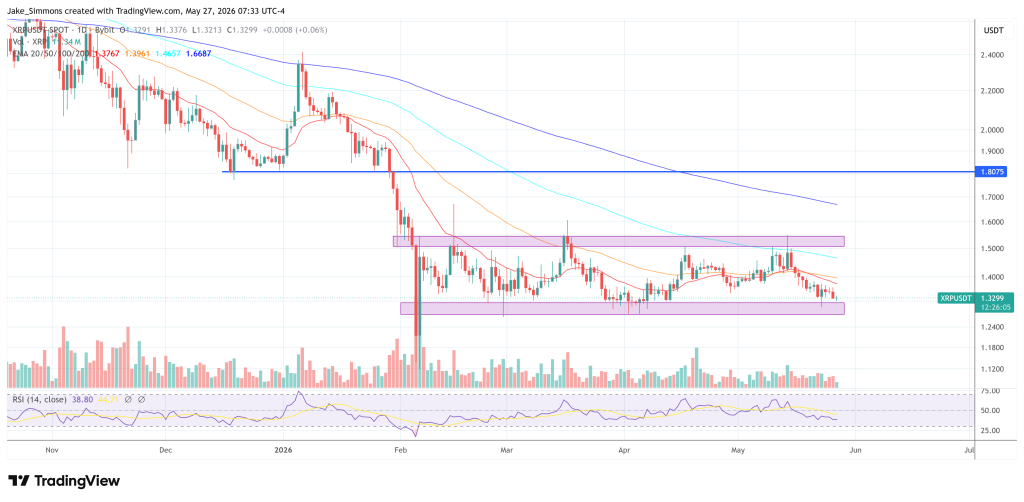
Featured image created with DALL.E, chart from TradingView.com
Editorial Process for bitcoinist is centered on delivering thoroughly researched, accurate, and unbiased content. We uphold strict sourcing standards, and each page undergoes diligent review by our team of top technology experts and seasoned editors. This process ensures the integrity, relevance, and value of our content for our readers.