





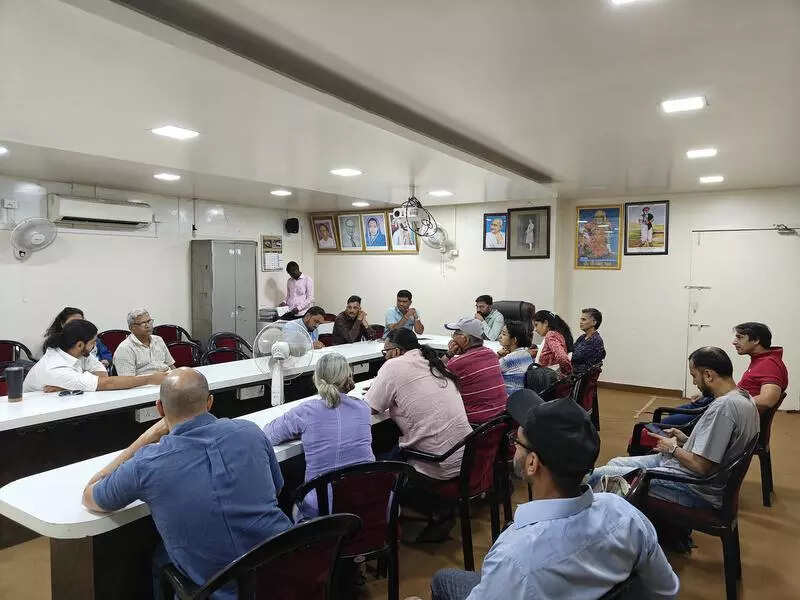
An economist, a software engineer, a law student and a retired IRS officer walk into a… No, this isn’t the lead-up to that joke. They walk into ward offices all over the city, sit through hours of discussions and debates, and fight tooth and nail to protect every single tree they can from being felled.For the past two years, under the ChaloPMC initiative, citizens who are part of the Pune Samvad group have attended several tree-felling hearings to give each tree a fighting chance. There are about five to six of these hearings every month, spread across the city. But there are only a handful of participants, most of whom also have day jobs.While many people attend the hearings for bigger projects like the Riverfront Development (RFD), smaller dockets and ward-wise meetings get ignored. The group is trying to rectify this.Economist Ameet Singh, who founded Pune Samvad, estimated that the city has lost 30,000 trees – and counting – to development projects since 2021.“Data collected by us shows that over 95% of tree cover has been removed since the 2000s only for roads. Many of these trees are over 50 years old. According to the 2021 amendment to the Maharashtra (Urban Areas) Protection and Preservation of Trees Act of 1975, any tree estimated to be over 50 years must be declared a heritage tree,” Singh told TOI.“However, the slaughter of trees to build buildings, bridges and roads has continued unabated. There is a difference between growth and development, which is that of quantity versus quality. The faster we understand the difference, the more trees we can protect,” he added.In 2023, Singh filed a petition in the Bombay high court against Pune Municipal Corporation (PMC) for blatant felling of trees. The HC then passed an order that not only directed PMC to follow the Tree Act but also ordered it to draw up guidelines pertaining to the release of a docket. A docket is a list of trees set to be felled, along with their age, species and location (see graphic).“We created a docket format in collaboration with PMC. After a docket is released, a meeting is held with the tree authority officer, who is the ward officer for the area. Before this, we send our objections to the proposal and at the meeting try to find the best way to save as many trees as possible,” Singh said.Citizens’ Involvement Is Key“It boils my blood to see trees cut unnecessarily. We are losing very crucial city foliage for absolutely no reason or sheer negligence to follow the rules. Every single tree and every citizen who fights for these trees matters. It’s important that citizens think of their immediate surroundings,” said software engineer and Chalo PMC member Sanaa Shaikh. “Power is in numbers. We need more citizens to join the fight.“A neighbourhood approach is crucial to solving the problem as the current participants, few in number, cannot be present everywhere, especially after tackling their full-time jobs. Besides, most of these hearings are held during PMC’s office hours.Learning and development professional Vijaya Suratkal, another member of the group, said she has seen the decline in the city’s green cover over the years. “The city used to be lined with large banyan and peepal trees, but now we have lost most of them to roads.”“Only a handful of citizens show up at tree hearings now. When there are just a few of us, it is difficult to convince those petitioning to cut trees to explore alternative paths. People from all walks of life must step forward to join us as protecting trees is the easiest and cheapest way to save the city from worsening air pollution. As citizens, we must take ownership of the trees in our wards,” she added. Law student and IT professional Moin Pathan spends his free time attending tree hearings and helping the team run surveys on the ground.“There is a great deal of confusion about tree-felling and tree-trimming permissions. Most apply for tree-felling even if there is a small bend in the tree. But there is a lot that can be done before a tree needs to be completely hacked off,” he said. “The goal at these hearings is to find alternative designs and plans that can ensure maximum trees are saved. However, that can only happen once citizens become aware of the rules and participate in the process.“Every Tree MattersAccording to Singh, the rampant construction boom in 2014, the Metro project (sanctioned in 2016) and the RFD (which started operations in 2017) put thousands of trees at risk.“In such a situation, not only must citizens fight to protect the trees in these spaces, also they must fight for every other tree at risk, either from road widening, a bridge or a redevelopment project. Trees are crucial not just to maintain the city’s temperature but also to prevent flooding and regulate air pollution, all problems Pune is dealing with today,” Singh said.Better SOPs Are A Must“How will I breathe, or sustain increased temperatures, if all trees get cut down eventually,” asked Rekha Joshi, a retired IRS officer who was employed with the central GST office.Joshi attends every meeting she can, irrespective of the area. “When the designs are planned, there is no consideration for saving trees or to take a sustainable approach to felling requests, which is disappointing. Officials who attend these meetings have no response to our queries and they don’t even take the help of experts to address our issues. Each time, we must take the route of RTIs to get more information. This is nothing but an administrative gap,” Joshi added.Attending these meetings is also a way to keep authorities accountable, as often, data falls through the gaps and citizens are none the wiser. Better vigilance from the public is an urgent need, said another member of the group.“During meetings, officials agree to transplant trees, but we don’t know yet if it is done. We are currently collecting data to understand this, but the number of people working on it is not enough. We have to co-ordinate within the group and with officials, and then consistently follow up. We need more citizens to join the movement,” Singh said. “We were able to save 236 trees in Yerawada earlier this year. It was only possible because we followed up constantly. But, to do this, we need people.”If you’ve ever wondered why the big tree around the corner from your house or the one that you sheltered under on a hot summer day has suddenly disappeared, and wished you could do something about it, then you’re the person the group is looking for. Saving trees is no joke.What happens at the tree hearings?– The ward office releases a docket or list of trees to be felled or transplanted, with their age and species listed– In case of transplantation, the proposal must also include where the trees will be transplanted, the number and the species as well– At the hearing, the tree officer listens to objections and then decides if amendments to the proposed docket need to be made or grants permission– In case permission to chop trees is granted, the stakeholder petitioning to fell them must provide land space and funds for compensatory plantation– A hearing is held with all stakeholders present_________________________Duties of the Tree Authority/OfficerTree Officer: Area Ward Officer | Tree Authority Municipal Commissioner1. Preservation of all trees in all lands within their jurisdiction2. Development and maintenance of nurseries and supply of seeds, saplings and trees for new or compensatory plantations3. Transplanting trees necessitated by construction of new roads or widening of existing roads4. Planting and maintaining such number of trees as it considers necessary according to the prescribed standards on roads, in public parks and gardens and on banks of rivers or lakes5. Where permission to fell a tree is granted, the tree officer may do so on the condition that the applicant shall plant another tree of the same or other suitable species, on the same site or other suitable place within 30 days from the date of felling_____________________________Other Rules– No completion or occupation certificate should be issued for new constructions until compensatory plantation or transplantation conditions have been followed– Punishment for felling a tree without following due process: Rs1,000 per offence– Punishment for felling a tree in public premises without following due process: 3 months imprisonment or a fine