




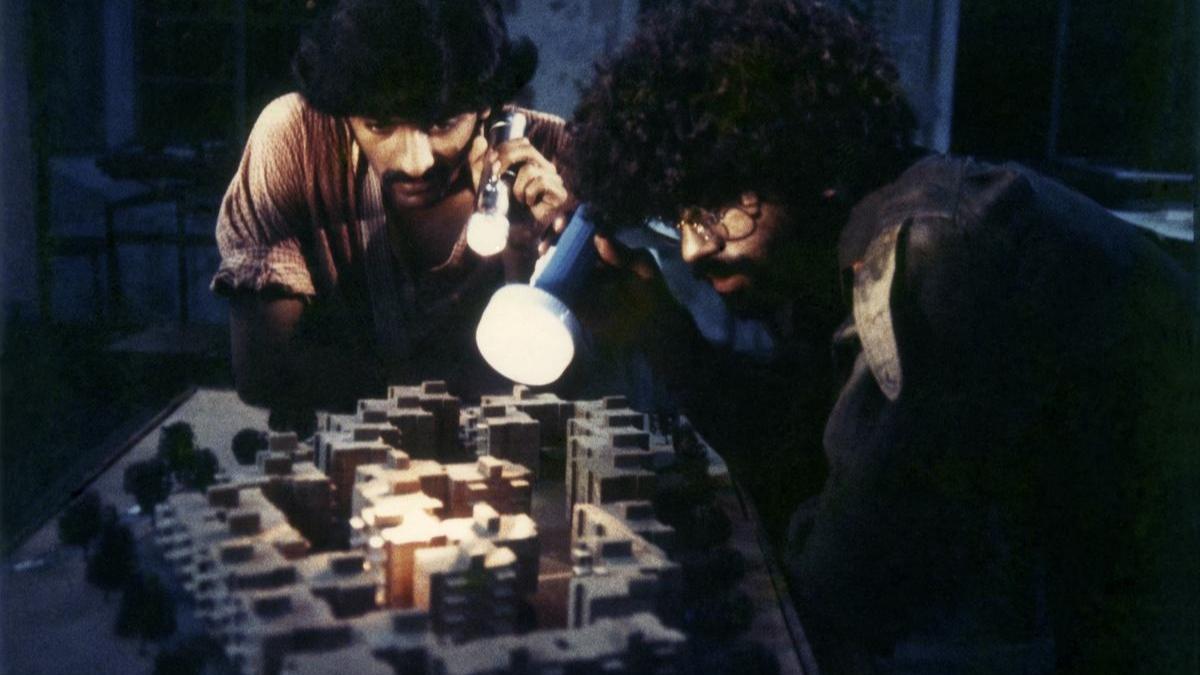
A still from ‘In Which Annie Gives It Those Ones’
| Photo Credit: Film Heritage Foundation
It is perhaps telling that the film which bustled with the joys and sorrows of being young and free in a country’s bureaucratic epicentre was left largely inaccessible after its initial run on Doordarshan. Lost within the political upheavals of the late eighties, made at a transitional juncture to liberalisation, Pradip Krishen’s In Which Annie Gives It Those Ones is a disarming quest of the in-betweens. Much like the mundane appeal of its title, the film captures everyday moments with mediated grace and self-aware wit. Its memory of time doesn’t carry burdens of the past or bearings of the future, but revels in the rapturous making of the present.

The focus here is on a bunch of final year students at Delhi’s National Institute of Architecture, where dreams are stripped off their gleam. It is almost an un-coming-of-age story of nights spent completing laborious last-minute assignments in cramped shared rooms of the hostel. The setup itself is the joke. Like, Kasozi, the international student from Uganda, who we first see moving his jaws in sleep, dreaming supposedly of Ugandan military officer and the third president, Idi Amin. Or Arvind Kumar Khungar, the table tennis enthusiast, who loses forever to his opponents. Or the famed Anand Grover, known to his friends as Annie, living alone in a room with a hen named Sangeeta and a cock named Sadhana. Annie has been in college for nine years, stuck in the halo, with his delusional ideas for the final year thesis. He shares his aimlessness and existential emptiness with Daljeet (Aamir Khan) from Rang De Basanti (2006), who too is scared to make a move to the outside world.
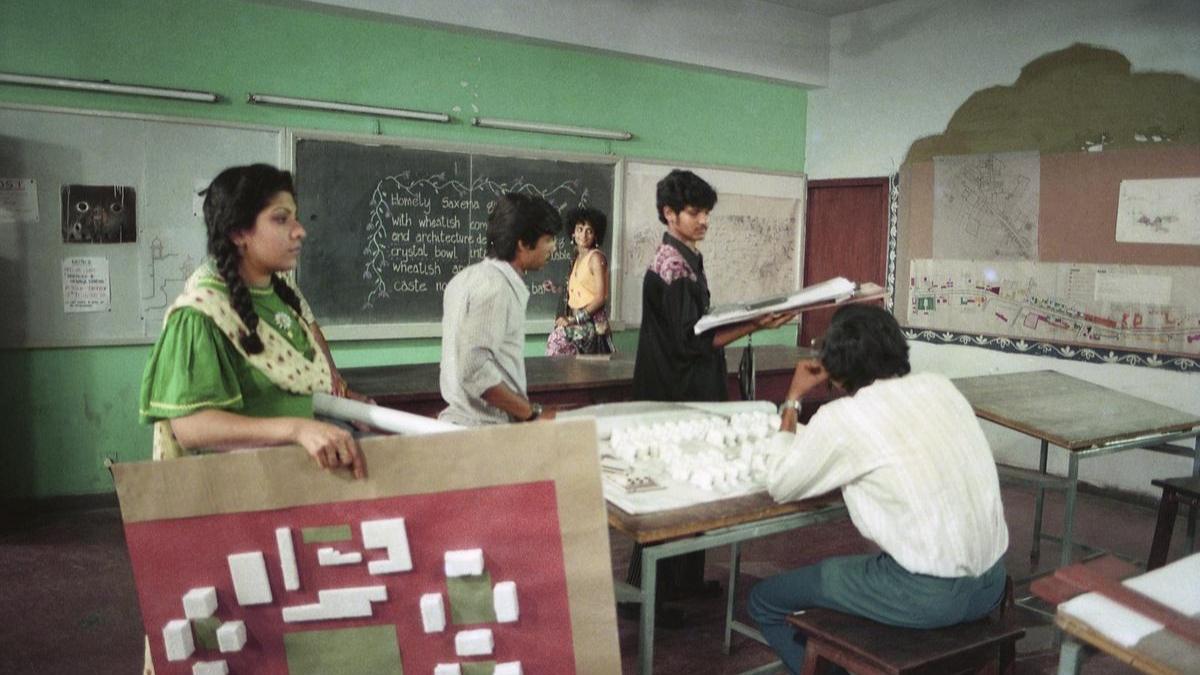
A still from the film
| Photo Credit:
Film Heritage Foundation
The course of ‘In Which Annie…’, however, differs from that of the Rakyesh Omprakash Mehra film. While the latter believed in adding a sense of purpose to youth, the former lies in a state of unbecoming. Youngsters here are not boiling with a need to do something, rather revel in the laid-back (dis)comforts of confusion and disillusionment. There is a clear absence of the process of knowing as a life-skill — their quest for finding meaning never takes off.
All except for Radha, whose anarchic tendencies reflect the thoughts and aspirations of the actor who essays her, Arundhati Roy. Also credited as the writer of the film, Roy immaculately fuses progressive ideas in the dialogue, which she later expanded upon eloquently in her non-fiction work. Krishan treats her material without a sign of heavy-handedness. He remains an observer of the state of being young. Much like its free-wheeling characters, with smiles on their faces and pranks in their pockets, the point of the film is in its refusal to make one.
Perhaps that’s what lends it a refreshing quality as it unfolds sombrely throughout its runtime, never in a hurry to reach somewhere or with a worry of getting lost along the way. With its restrained camera-work and mix of psychedelic tracks in the music, the film’s style reflects the spirit of an American indie, reminiscent of Richard Linklater’s early, plot-less work in Slacker (1990) and Dazed and Confused (1993), as it also pushes an ethos that is steadfastly Indian in discourse, seen in the localised sense of humour and the multi-lingual appeal of the dialogues.

Watching the film in 2026 feels almost utopian as it carries the beat of a college campus where students are allowed to falter; the pressures of becoming are not as much as the pleasures of being. The film documents a simpler time, with uncorrupted attention spans and lack of instant gratification, when making friends didn’t depend on phones and disagreements didn’t necessarily turn hostile; when an English speaking Shah Rukh Khan made a fleeting appearance as one of the students, only to later resound the film’s coolth in his popular college film, Main Hoon Na (2005) as another generation said, “Avoid, ya”, with panache.
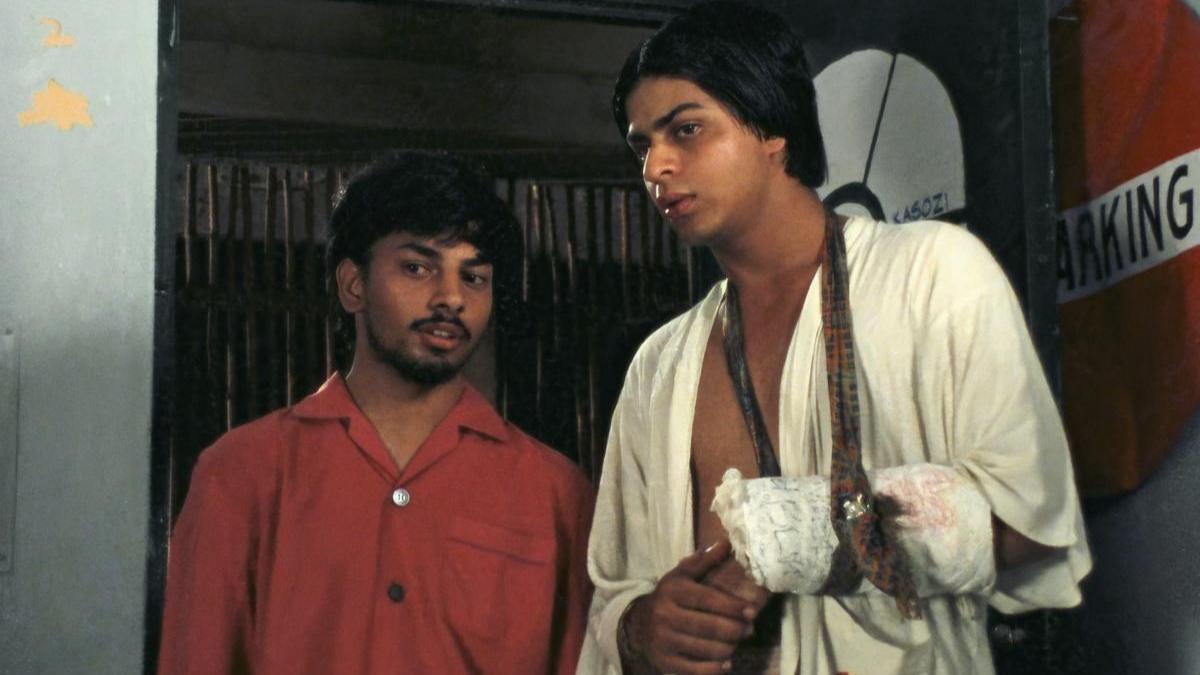
Shah Rukh Khan’s still from the film
| Photo Credit:
Film Heritage Foundation
Even the film’s critique of systemic gambles which shake the youth off their idealism is timely and almost prophetic. As a character remarks while looking at a model designed by his batch mate comprising of high-rises, “How will anyone live here? They will do it today for marks and tomorrow for money.” The tomorrow of then has become the today of now and the film’s restoration feels monumental as revving in its grainy layers are the defocused dreams of an India on the brink of change.
Much like the aspirations of an even older generation that were captured in the Films Division documentary, I am 20 (1967), where the seeds of Nehruvian optimism reigned high, arriving over twenty years after that, Krishen’s youths were hibernating with rock-and-roll dreams, brimming with an intoxicating carelessness. Unbound by the dramatic aesthetics of the mainstream, the film voiced the idiosyncrasies of a cosmopolitan generation with an absurdist, ironical resolve. Its unassuming rigour became the style. As the film ended with small paragraphs about the afterlife of its characters, I couldn’t help but wonder, where is the Annie of today and when will he give it those ones?
A restored version of the film is currently running in theatres and it is also being screened at a special retrospective of Pradip Krishen’s films at the Red Lorry Film Festival 2026
Published – March 15, 2026 10:52 am IST