





“Vellore!”
“Kanchipuram!”
“Pondicherry, Pondicherry, Pondicherry!”
The spirited meter that conductors use to beckon impatient passengers to their buses at the Chennai Mofussil Bus Terminus (CMBT) in Koyambedu is of a certain timeless disposition.
“Arani ah? Go to platform 2,” announces Superintendent V Dhanasekaran, ensuring that buses do not leave the stand empty. The call was the same before CMBT was established here in 2002. It will remain the same if ever the location shifts, he says. Quantum tunnels often possess this quality.

R Dillibabu, a driver who has been listening to his conductor’s call for two decades now, says that there is one other wormhole similar to that of the boarding announcement for his bus travelling from Chennai to Kanchipuram.
“For 25 years now, the first song that is played on the bus’ speaker is a saami paatu (invocation). What follows is a medley of songs by Ilaiyaraaja. I love his music and have a playlist of his songs on our music system. There are at least 100 that play on loop,” he says.
Dillibabu is one of several hundred drivers in Tamil Nadu that find comfort in the familiarity of Raaja. Anyone who has travelled in mofussil buses transporting people through routes that zoom past beaches, fields, hills and plains, will tell you that the majority of the songs that play on speakers are unmistakably by the Tamil composer.
Life may have drastically changed. Yet, the town bus playlist full of melodies from the Tamil countryside, speaking of innocent first love, heartbreak, friendship, maternal love, and the vast Tamil landscape, holds a steady permanence. It helps that Ilaiyaraaja’s expansive repertoire of over 8,000 songs composed over 50 years since the release of his first album Annakili, covers nearly every range of emotion and has a string of mellifluous voices attached to them.
Over the last seven years, transport authorities have disallowed drivers from playing songs in their buses, citing distraction. Only private operators are permitted to play songs on their now up-to-date speaker sets. Yet, some drivers and conductors are given permission to play songs at a cost of ₹3 a song, based on requests. Many drivers, particularly the ones operating outside of Chennai persist, and play the songs for both themselves and the passengers.
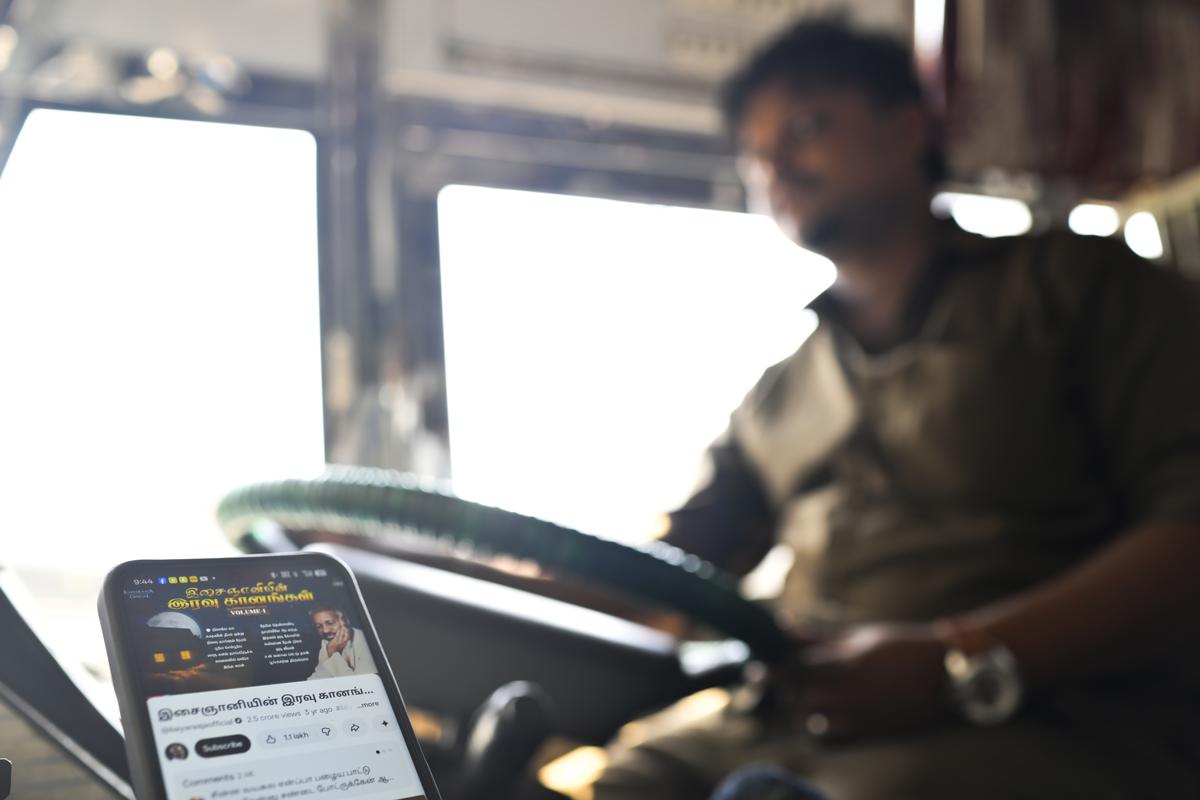
A driver plays a curated YouTube playlist of Raaja songs.
| Photo Credit:
Johan Satyadas
With Raaja, several generations have been transported not just to their destinations, but to the halcyon days, when life seemed visibly different.
Dillibabu makes eight trips a day between Kanchipuram and the city; he can sometimes feel age catching up. “But when I listen to a song by Raaja, everything becomes calm. I compulsorily play ‘Senthazham Poovil’ at least once each night. Everything changes when that song comes on,” he says.
Some drivers like Dillibabu seem to have accumulated a set of fans for their playlists. M Vinoth, who rides his bus between Chennai, Vandavasi, Thiruvanamalai, and Cheyyur, has a playlist of 500 songs that he begins playing early in the morning. His bus, which usually departs from Koyambedu at 8am, not only invites regulars but also new travellers who enter the bus thanks to his playlist. “For the working man, Raaja is solace. He is there for our happy days. More importantly though, he is there for all our sad times,” he says.
B Kumaresan, a conductor whose bus plies between Cheyyur in Chengalpattu and Chennai, says that at night, passengers sometimes fight for seats. However, when Ilaiyaraaja songs come on, the scuffle quickly stills. “There is something about him,” he says. Kumaresan has a certain penchant for love songs and songs about mothers. “I had a love marriage and my wife and I often listen to his songs together. Maybe that is why I am so attached to his music,” he says.
On some occasions, it has been observed that bus drivers play AI remixes of old songs. M Paneerselvan, a bus driver who has been driving for 19 years, says that he loves Raaja’s latest ‘Kaatumalli’ but adds that since his bus plies between Puducherry and Chennai, a mixed crowd comes onboard. To appease the older passengers and the younglings, these AI mixes which are likely flouting copyright laws, are played nevertheless.
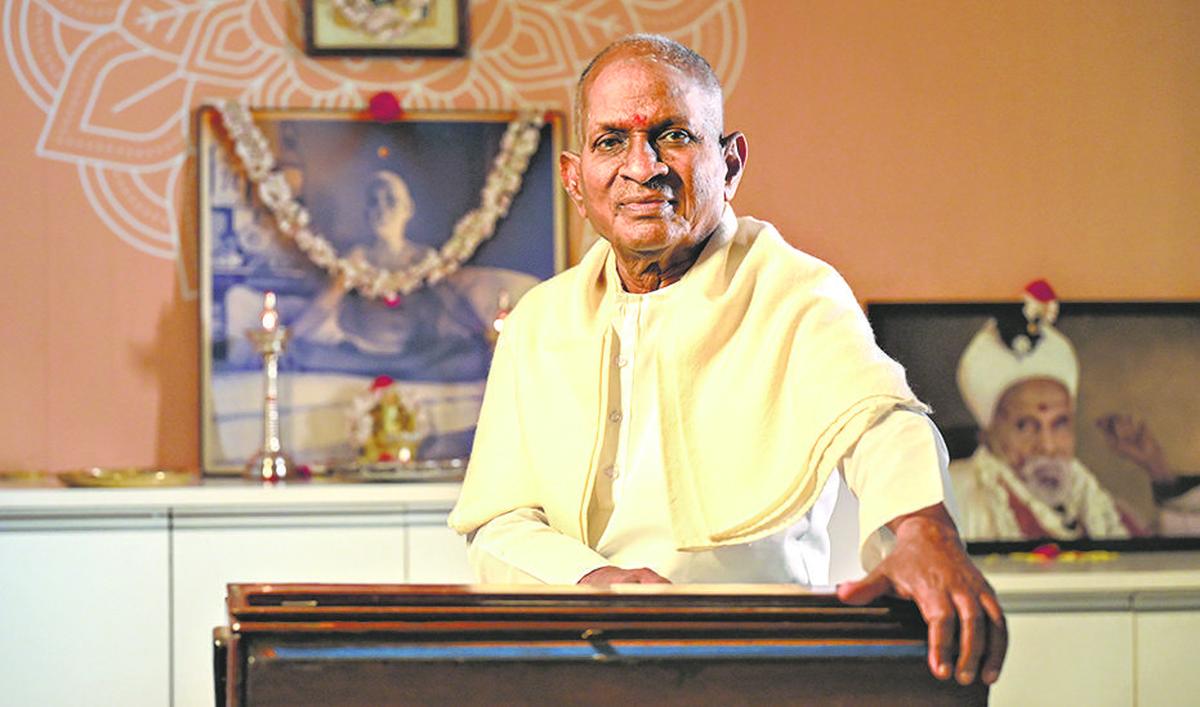
Maestro Isaignani Ilayaraja in conversation with The Hindu about his symphony on 29, January 2025.
| Photo Credit:
Thamodharan B
A dash of nostalgia
Many interviewees repeat that Raaja’s songs are great company for lonely long rides at night when the world around them sleeps. His melodies do not interfere with the driving and help them remain even-keeled despite their physically strenuous journeys. “It helps us stay wide awake, and allows restless passengers to relax and doze off,” says M Rajappan, a conductor from Puducherry who loves listening to all the songs from the 1985 film Idaya Koil including ‘Idayam Oru Koil’.

Writer-translator G Kuppuswamy who has authored Kaalathai Isaitha Kalaignan: Illaiyaraja 80, a book of three essays on Ilaiyaraaja (published by Kalachuvadu), jokingly recounts a trip from Tiruvannamalai (his workplace) to Arani (where his home is located), where a bus driver engaged in a heated exchange with another, yelling at the top of his lungs. “The man was exploding with expletives when the song ‘Ennai Thottu Alli Konda’ came on. His demeanour completely changed. Suddenly, he was asking a woman carrying a heavy bag to keep it aside and sit down comfortably. He seemed like a different man,” he recounts.
The writer who has met the composer, says that drivers may say that Raaja helps them stay up, but that only scratches the surface. “Talking to a driver who travels long distances is obviously distracting. However, music can be transformative. A pacy song may want them to go fast. Raaja’s music, particularly his melodies, retain a certain consistent sound. That goes a long way on a hard night,” he says.
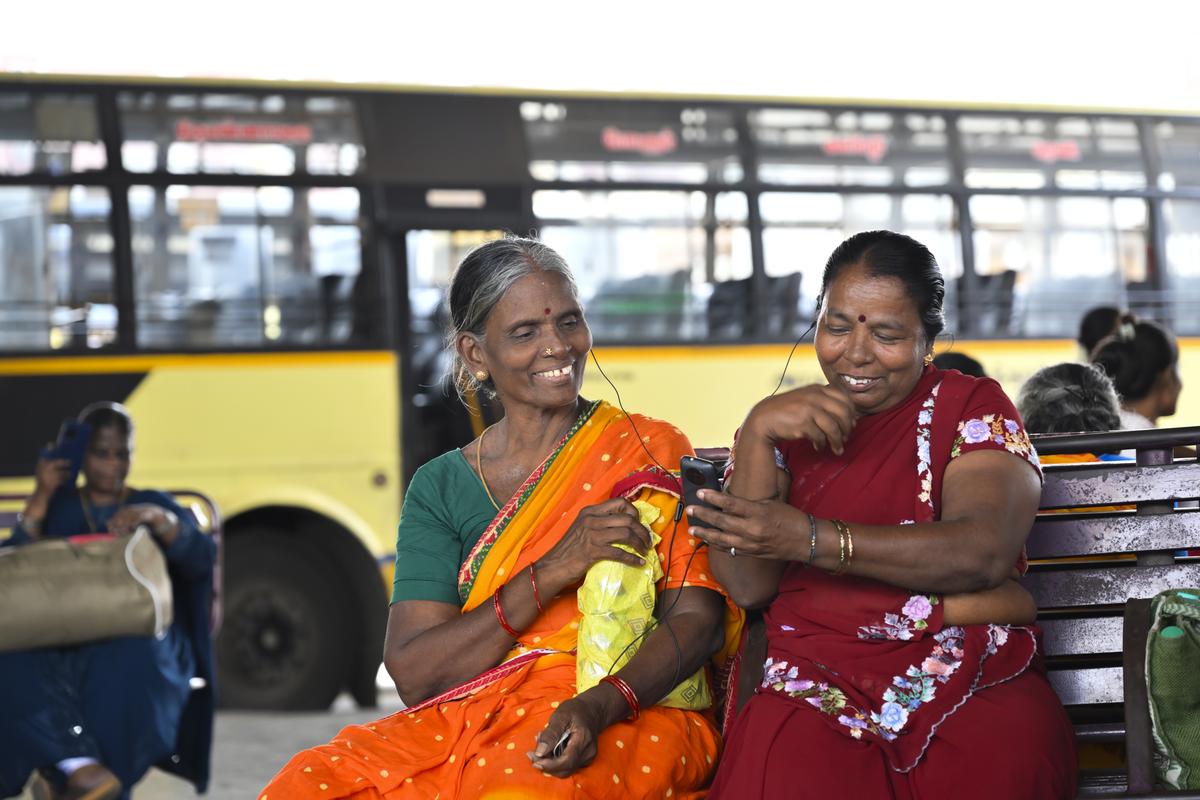
M Dhanalakshmi and M Meenakshi sharing their earphones to listen to a song.
| Photo Credit:
Johan Satyadas
T Dharmaraj, Professor and Head, Department of Folklore and Cultural Studies, Madurai Kamaraj University, who has written the book Ilaiyaraajavai Varaithal, wishes to draw a metaphorical parallel between a bus being a vessel that transported one to a destination, and Raaja being a vessel that transports one to different planes. “Think about the themes in most of his songs. They all have a deeply nostalgic trait about them. The scenery around a traveller is constantly changing. One feels like they are still in movement despite having stopped sometimes. Ilaiyaraaja’s songs are similar. They have allowed an entire generation to go back to a time they cannot access anymore,” he says.
Back at the bus terminus in Koyambedu, M Dhanalakshmi, and a group of five other women, are travelling to Vandavasi. These fans say that Raaja’s 1989 hit album from the film Karakattakkaran is their favourite. They even burst into a short-giggly rendition of the song ‘Maanguyile Poonkuyile’ from the film. “I am not sure of the lyrics but I think this is it,” says Meenakshi, singing coyly to the camera.
Conductor B Rajan Prabhu who walks past them turns to his much younger colleague who has just joined the job. “You 2K kids,” he sighs. “Will you ever know how precious this is.”
