


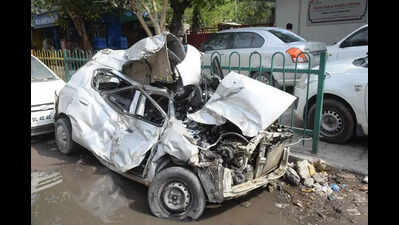
New Delhi: Ring Road and Outer Ring Road may be the city’s lifelines, but ironically, they are death bringers too. At the end of July, the two corridors had accounted for total 381 accidents involving cars, two-wheelers and pedestrians — more than one in every 10 accidents in Delhi this year. Stretching nearly 90km and forming loops through the capital, Ring Road and Outer Ring Road carry millions daily and are, therefore, susceptible to a high accident burden. The first half of 2025, however, saw the overall crashes dipping after the traffic police pushed a mix of road engineering fixes, stricter checks and speed barriers. However, a high share in road crashes shows the two arteries still need attention. The figures are more startling when seen across categories. Pedestrians and two-wheelers bore a significant brunt of misfortune. In the first seven months this year, pedestrians were involved in 1,246 accidents, 337 of them fatal, while two-wheelers figured in 1,335 crashes, 300 of them fatal. Together, they accounted for over four-fifths of all the accidents. Of these, 289 accidents happened on the two arteries: 141 on the Ring Road and 145 on the Outer Ring Road, meaning nearly 12% of all crashes. In comparison, the third riskiest corridor, GTK Road, suffered just 88 accidents. Of the 921 car crashes till July, 113 had fatalities. Once again, the two corridors dominated the count, with 51 accidents on Outer Ring Road and 41 on Ring Road. Najafgarh Road was third with 24 cases. The pattern is unmistakable. In 2024, Ring Road and Outer Ring Road together recorded 634 crashes (343 and 291, respectively) involving pedestrians, two-wheelers and cars. The numbers were even starker in 2023, with 399 crashes on Ring Road and 320 on Outer Ring Road. S Velmurugan of Central Road Research Institute considered why these two roads took such a toll of lives and vehicles. “The core reasons lie in poor geometrics at the flyover locations as well as poor driving behaviour,” he said. “Generally, most of the sections of Ring Road and Outer Ring Road have carriageways that are either 6-lane or 8-lane. This invariably encourages speeding with little deterrence in place for controlling the speeding, especially during the lean hours of traffic flow. A few speed enforcement cameras placed at sporadic locations are exceptions.”He noted, “Invariably, the slip roads located adjacent to the flyovers and interchanges on the two roads lack basic road safety measures in the form of engineering gaps compound the problem: inadequate gore/common area treatment at the merging locations in the form of absence of crash cushions, diagonal markings, object hazard markers, absence of overhead informatory gantry signs at several locations, safety design on slip roads remains flawed, and speed-calming measures are either inadequate or absent on slip roads.“Vulnerable road users such as pedestrians are denied safe crossings and hence are pushed into life-threatening road crashes in most of the road stretches of Inner Ring Road and Outer Ring Road, said Velmurugan. “Such crashes invariably occur at major attraction points like metro stations and major bus stops due to one or a multitude of factors mentioned above. Further, the other vulnerable vehicles like two-wheelers, often try to slip past verges or cut across lanes and end up at high risk of collision with cars and trucks. Together, behaviour and design form a lethal mix that keeps Delhi’s two busiest corridors firmly among its most dangerous.” Traffic officials said road safety awareness programmes have become more frequent, targeting drivers across categories — from two-wheeler riders to DTC bus staff — and are now being held on a near-daily basis to discourage reckless driving habits. In fact, officials said a letter has even been sent to the education department, recommending the introduction of a road safety curriculum in schools so that driving ethics can be instilled from an early age.