




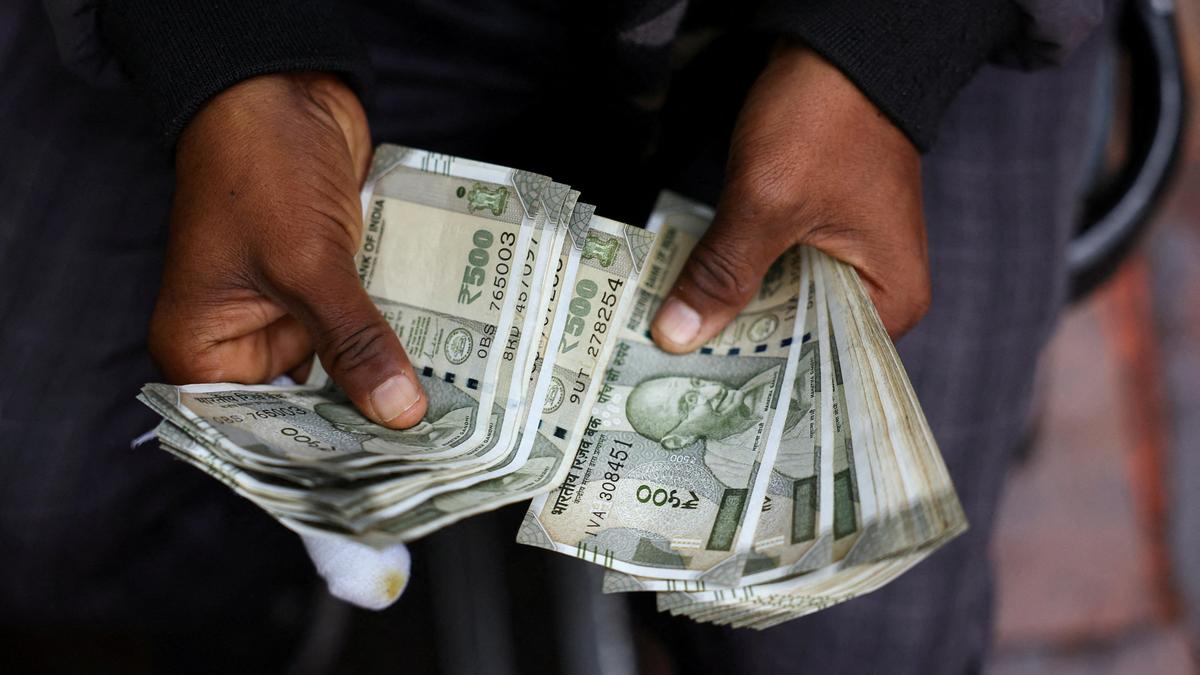
The rupee opened on a weak note and slumped to an all-time low of 96.25 in early trade on Monday (May 18, 2026), as elevated crude oil prices, global uncertainty, and a stronger dollar continue to remain key risks for the domestic unit.
Forex traders said higher crude oil prices, a stronger U.S. dollar, and ongoing geopolitical tensions have together created a difficult environment for emerging market currencies, and the rupee is now clearly reflecting that stress.
At the interbank foreign exchange market, the rupee opened at 96.19, then fell further to 96.25 against the U.S. dollar, registering a fall of 44 paise from its previous close.
On Friday (May 15, 2026), the Indian rupee crashed below the 96/$ mark on Friday (May 15, 2026) before closing at an all-time low of 95.81 against the U.S. dollar.
“For now, elevated crude oil prices, global uncertainty, and a stronger dollar continue to remain key risks for the rupee. However, the encouraging sign for markets is that both the government and the RBI have already started taking proactive measures to manage the situation before it becomes more uncomfortable,” CR Forex Advisors MD Amit Pabari said.
“Technically, 94.80–95.10 is expected to act as an important support zone for USD-INR, while 96.00–96.50 remains a strong resistance area in the near term,” Mr. Pabari added.
The dollar index, which gauges the greenback’s strength against a basket of six currencies, was trading at 99.32, higher by 0.04% due to simmering Iran tensions.
Brent crude, the global oil benchmark, was trading up 1.83% at $111.26 per barrel in futures trade.
“With the rise in oil prices to beyond $111.50 per barrel, rupee will be affected the most as rising oil prices increases the outflows of U.S. dollar along with the outflows already happening due to FPIs,” said Anil Kumar Bhansali Head of Treasury and Executive Director Finrex Treasury Advisors LLP.
Meanwhile, within days of levying high customs duties on precious metals, the government on Saturday (May 16, 2026) imposed import curbs on silver by putting the metal under a licensed regime for inbound shipments.
The government, on May 13, hiked import duty on precious metals – gold, and silver – from 6% to 15%. The effective duty (including 3% IGST) is over 18%.
It was hiked to control the outflow of forex by curbing non-essential imports. “Only stoppage of war and reopening of the Strait of Hormuz can bring about a lower demand on the $/rupee pair, else 100 seems to be on the card if RBI does not announce any schemes to increase dollar inflow into the country,” Mr. Bhansali added.
On the domestic equity market front, Sensex tanked 833.20 points to 74,404.79 in early trade, while the Nifty was down 234 points to 23,401.70.
Foreign Institutional Investors remained net buyers for the second straight session, purchasing equities worth ₹1,329.17 crore on Friday (May 15, 2026), according to exchange data.
Meanwhile, India’s forex reserves jumped by $6.295 billion to $696.988 billion during the week ended May 8, the Reserve Bank said on Friday (May 15, 2026). The overall reserves had dropped by $7.794 billion to $690.693 billion in the previous reporting week.
Published – May 18, 2026 10:31 am IST
