






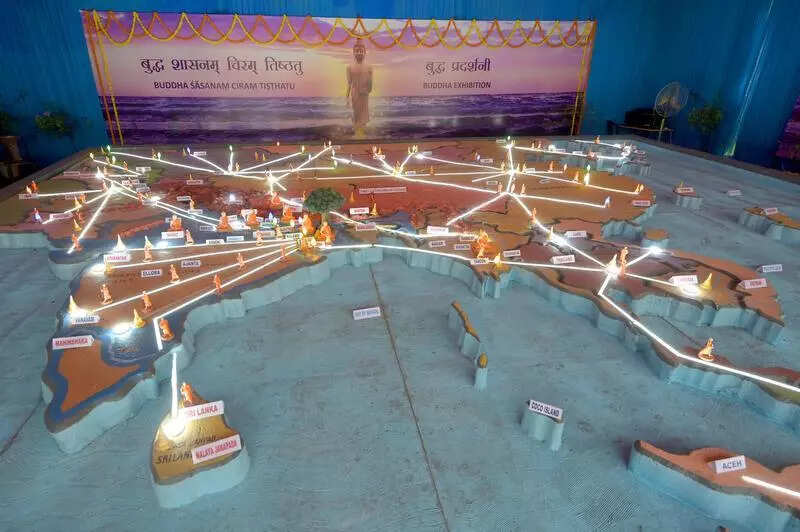
New Delhi: From the quiet groves of Lumbini to the grand temples of Kyoto, the journey of the Buddha still echoes across Asia. More than 2,600 years after Gautama Siddhartha first preached compassion and non-violence, a new exhibition at the Indira Gandhi National Centre for the Arts brings his story alive, tracing how his teachings travelled from India to distant lands, shaping cultures, building bonds and leaving behind a legacy of peace.Open until Aug 23, the exhibition takes visitors through the defining milestones of the Buddha’s life: his birth at Lumbini, enlightenment at Bodh Gaya, first sermon at Sarnath and mahaparinirvana at Kushinagar. It also retraces the routes of his journeys to Rajagriha, Vaishali, Shravasti, Sankasyanagar and Mathura, where the foundations of the Buddhist order were laid.Prepared by the Brihattar Bharat Division of IGNCA, the exhibition is themed ‘Buddha Sasanam Ciram Tisthatu (May the Buddha’s teachings live forever)’. It is part of the larger Brihattar Bharat Project, an IGNCA initiative to safeguard and study India’s civilisational links beyond borders. The project covers 28 countries — 11 in East Asia, 11 in Southeast Asia, and six in Central and Inner Asia — exploring cultural footprints from Angkor Wat in Cambodia to Gandhara in Afghanistan.“Through the Brihattar Bharat Project, we seek to rediscover and reaffirm India’s role in shaping Asia’s spiritual and cultural landscape,” said Vivek Aggarwal, secretary, culture ministry.DC Chobey of Brihattar Bharat Study added, “This exhibition is not just a visual journey of Lord Buddha’s life but a reminder that the Dhamma is India’s most profound gift to humanity.” Expanding on the idea, Dr Sachchidanand Joshi, member secretary, IGNCA, said, “Each stupa, monastery and sculpture tells us that India was never an isolated land. It was a radiant centre from which knowledge and spirituality flowed outward across Asia, creating bonds that still resonate.“The exhibition presents this cultural saga through maps, sculptures and visual depictions of stupas and monasteries. Emperor Ashoka convened a grand council of scholars at Pataliputra to compile the Buddha’s teachings and spread them far and wide. His emissaries, the Dhammamahamatyas, carried the Four Noble Truths to distant regions. Centuries later, the Kushan ruler Kanishka ensured Buddhism flourished across the continent.Powerful Buddhist centres rose within India at Sanchi, Bharhut, Amaravati, Mathura, Sahasram, Dhauli and Kashmir’s Kundalvana. Abroad, monasteries and shrines became hubs of faith and learning, from Luoyang, Chang’an and Dunhuang in China to Nara and Kyoto in Japan, Seoul in Korea, Ulaanbaatar in Mongolia, Kandy in Sri Lanka and Gandhara in Afghanistan. Each site testifies to Buddhist influence on local art, philosophy and cultural identity.The curators of the exhibition say that the IGNCA project positions India as vishwamitra (friend of the world), highlighting how Buddha’s universal message of peace, non-violence and harmony remains relevant in a fractured global order. “This exhibition is a reminder that Buddha’s teachings are not relics of the past,” a curator explained. “They are bridges that still connect India with the wider Asian family.”