



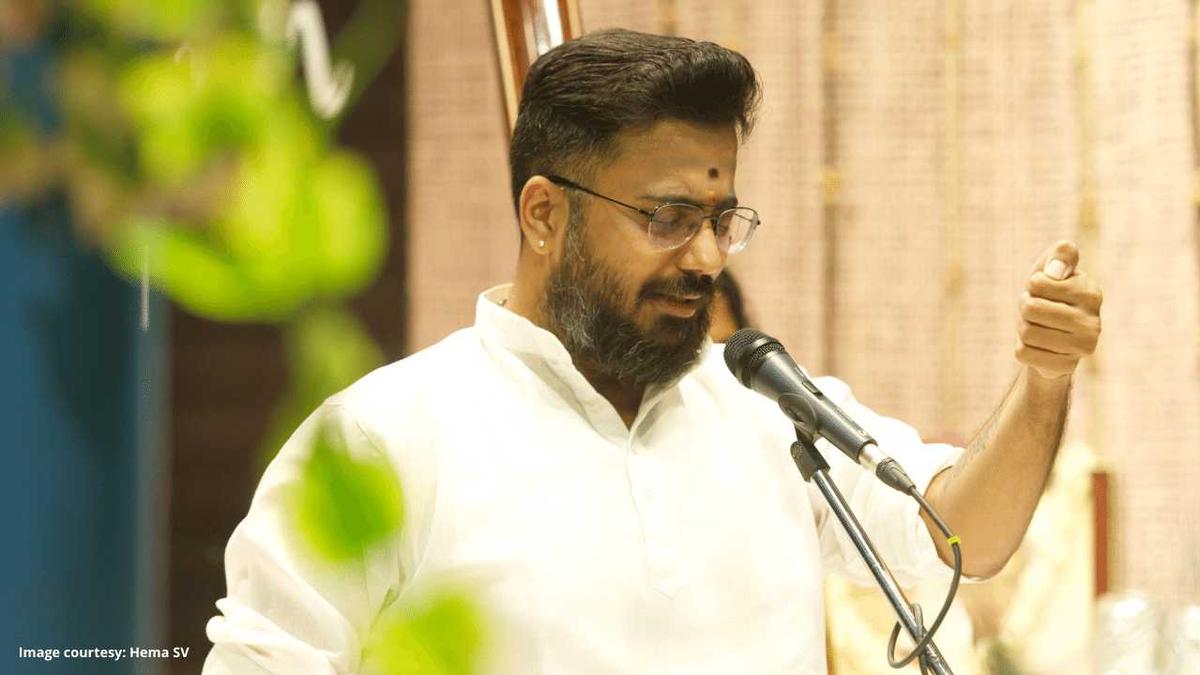
Bharat Sundar
| Photo Credit: Hema SV
At a recent lecture-demonstration at the University of Chicago titled ‘In Tune with Time’, Carnatic vocalist Bharat Sundar explored the living interplay between rhythm and melody in Carnatic music, and did so with a rare blend of depth, humour, and ease.
Bharat began by discussing the pitfalls of comparing the Carnatic raga system to scales. While this reductionist framework may serve as a cognitive shortcut, it fails to capture the essence of melody in Carnatic music. A raga’s identity, he said, does not come from a fixed sets of notes, but from phraseology that is vast, fluid and ever-evolving patterns of movement. In fact, he suggested the learning method should be reversed — instead of starting with fixed notes and attempting to arrive at the raga, one should first absorb the phrases that define it. The notes then become reference points, mere approximations of something far more alive. Without this awareness, we risk clinging to the simplification and lose the purpose for which it was created.
Ludwig Wittgenstein once wrote about a ladder that must be climbed and then kicked away. Every formal system, scale, grammar and map is such a ladder. Its purpose is not to be clung to, but to be used as a means to move beyond it.
Time, he suggested, is not something you just measure in music; it is something you inhabit. He spoke about how laya and tala function as frameworks through which Carnatic music organises time. Within these structures lies a world of immense creative freedom. One can work within a fixed meter while choosing how to engage with the gaps — add, subtract, extend or compress. He referenced composers such as Arunagirinathar, highlighting the playful complexity of meter, language and meaning in works such as ‘Muthai tharu’. Bharat demonstrated how misalignment among melody, rhythm and meaning can lead to unintentional comedic effects, rendering a stanza from ‘Muthai tharu’, which evokes vivid imagery of a war sequence, in a sweet lullaby-like tone.
He also spoke about how language should sound when sung, illustrating how Tamil intonation and its inherent sinuosity can subtly shape the rendering of another language, like Hindi, in music, and why such nuances demand careful attention.
The evening ended with a delightful Q&A session, which gave rise to more interesting ideas.
One assumption Bharat gently dismantled was that ragas carry inherent emotional associations. Emotions, he said, are subjective and shaped by one’s conditioning. To illustrate this, he sang Subhapantuvarali in multiple registers — mourning, vibrant and yearning.
The question of composing within a tradition surfaced too: how does one create within something so architecturally elaborate? His response was focused on sincerity, what we make is shaped by what we have absorbed, and if something feels true to the artiste, it can belong within the tradition even if it stretches beyond what has been familiar thus far.
The audience got to hear glimpses of Sahana, Charukesi, Thodi, Shubhapantuvarali, Kosalam, Karaharapriya, Abheri, Atana, and even a playful Shanmukhapriya rap. At one point, he even compared the beats of the Snarky Puppy band to a Dwijavanti composition. Perhaps the most profound takeaway was his reflection on how the human need to organise information often makes us forget that art is not merely a system to be decoded, but an experience to be inhabited. By the end of the session, Carnatic music felt more accessible and intimate.
Published – May 08, 2026 06:32 pm IST
