





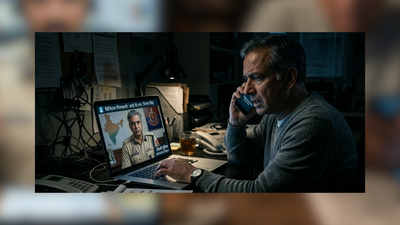
NEW DELHI: The phone vibrates at an odd hour, and before you can even say hello, a voice laden with the practised gravitas of a high-ranking law enforcement official cuts through the silence. In the world of the ‘digital arrest’ scam, the first weapon of the cybercriminal is not a virus or a phishing link, but a name. These are not random names plucked from a phonebook; they are the names of men who have built decades-long reputation as the iron fist of the state.By invoking figures like Daya Nayak — the high profile “encounter specialist” known for his pursuit of the underworld in Mumbai — or former Delhi police commissioner Neeraj Kumar, scammers are leveraging a specific kind of cultural fear.
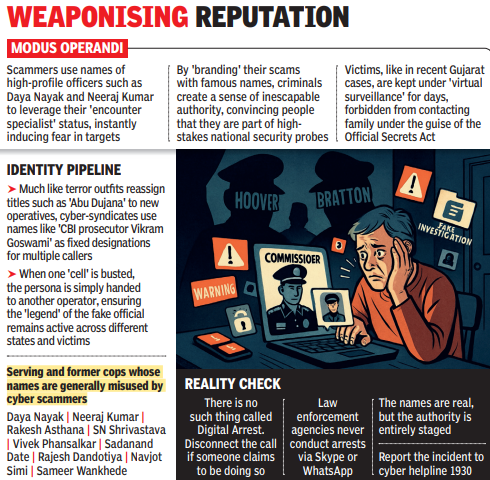
Recent cases from Gujarat have highlighted this evolution in social engineering. In one harrowing incident in Ahmedabad, a retired professional was kept under ‘surveillance’ for over 48 hours, during which the fraudsters presented themselves as subordinates to “DCP Daya Nayak”. The scammers didn’t just use the name; they adopted the persona. They spoke of “secret investigations”, “national security implications” and “immediate custodial interrogation” if the victim dared to end the video call.“By using a name synonymous with high-stakes policing, the criminals create a psychological cage. The target isn’t just afraid of the police; they are afraid of the specific, uncompromising legend that the name Daya Nayak represents,” says a cyber cell cop.Similarly, in other rackets, the name of former Delhi police commissioners Neeraj Kumar, SN Shrivastava or Rakesh Asthana has been brandished like a badge of absolute authority. Even if the real Neeraj Kumar or Shrivastava have long moved on from active duty, scammers exploit their names and reputation with surgical precision.This deliberate “branding” of authority is among the most chilling aspects of modern cyber-extortion. It operates much like the internal structure of global terror outfits. In organisations like Lashkar-e-Taiba, the name “Abu Dujana” or “Abu Hamza” is rarely just a person; it is a designation. When one operative carrying the title is neutralised, the mantle is passed to the next, ensuring that the fear it inspires remains immortal. Cyber-syndicates have adopted this exact model. Take the name “CBI prosecutor Vikram Goswami”, who has appeared in dozens of FIRs across different states. There is no singular “Vikram Goswami” making these calls; rather, he is a ghost in the machine. To the scammers, “Vikram Goswami” is a script, a specific set of aggressive legal jargon and a curated background on a Skype call. The background of the video call looks like a functional police station, complete with files, national emblems and the distant sound of wireless sets. The man on the screen wears the uniform, but it is the name on the nameplate — often a name the victim has seen in news headlines — that seals the trap.The use of names like Daya Nayak serves a dual purpose here: it validates the secrecy of the “operation” and ensures the victim feels th-at any attempt to verify the call would result in a violent, late-night raid.Cybercriminals also execute the scams by sending forged PDFs over WhatsApp that feature official Delhi Police logos, fake govt stamps and the fraudulent signatures and photographs of IPS officers to intimidate victims.To heighten the realism, they conduct video calls while wearing police uniforms, often with incorrect insignia. During these interactions, they frequently escalate the psychological pressure by claiming to transfer the case to higher authorities like the CBI, ED or RBI.“Fraudsters often use the designation of the DCP (IFSO) (Intelligence Fusion and Strategic Operations) without a specific name, or by attaching a random name to the real office address (Dwarka, Sector 19),” said a cyber cell cop.However, for the citizen, the only defence to such impersonation is the realisation that the law does not operate through Skype or WhatsApp. “No matter how famous the name on the other end of the line might be, the real police don’t “arrest” you through a smartphone screen. Once you stop believing in the ghost, the handcuffs vanish,” says retired senior cop whose name was misused in several cases.