




NEW DELHI: In 1980, Amar K Shridharani was in Sao Paulo procuring sea food for the multinational he worked for. For any lover of Brazilian football, which he was, the city was the place to be. In his free time, he would watch local league games, especially those of Santos, the club that Pele, the original GOAT once played for.Shridharani didn’t stay long enough to watch coach Tele Santana’s famed midfield of Zico, Socrates, Falcao and others on the pitch, the finest ensemble not to win the World Cup. Men who created football’s version of transient art, and in the process, became a fable. As Socrates later wrote in Alex Bellos’ book, ‘Futebol: The Brazilian Way of Life’, “Football…I believe, is part of our most primal genome, like dance.”
Exploring Kinship Between Game’s Body Movement And Performance Of Art Form
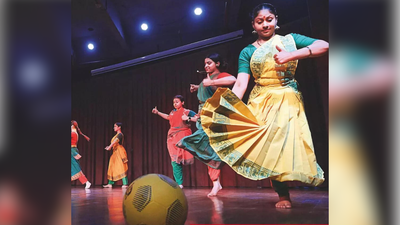
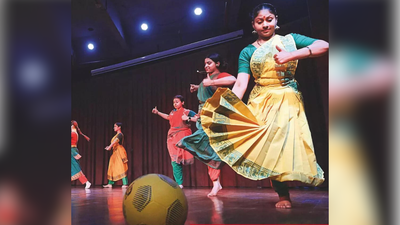
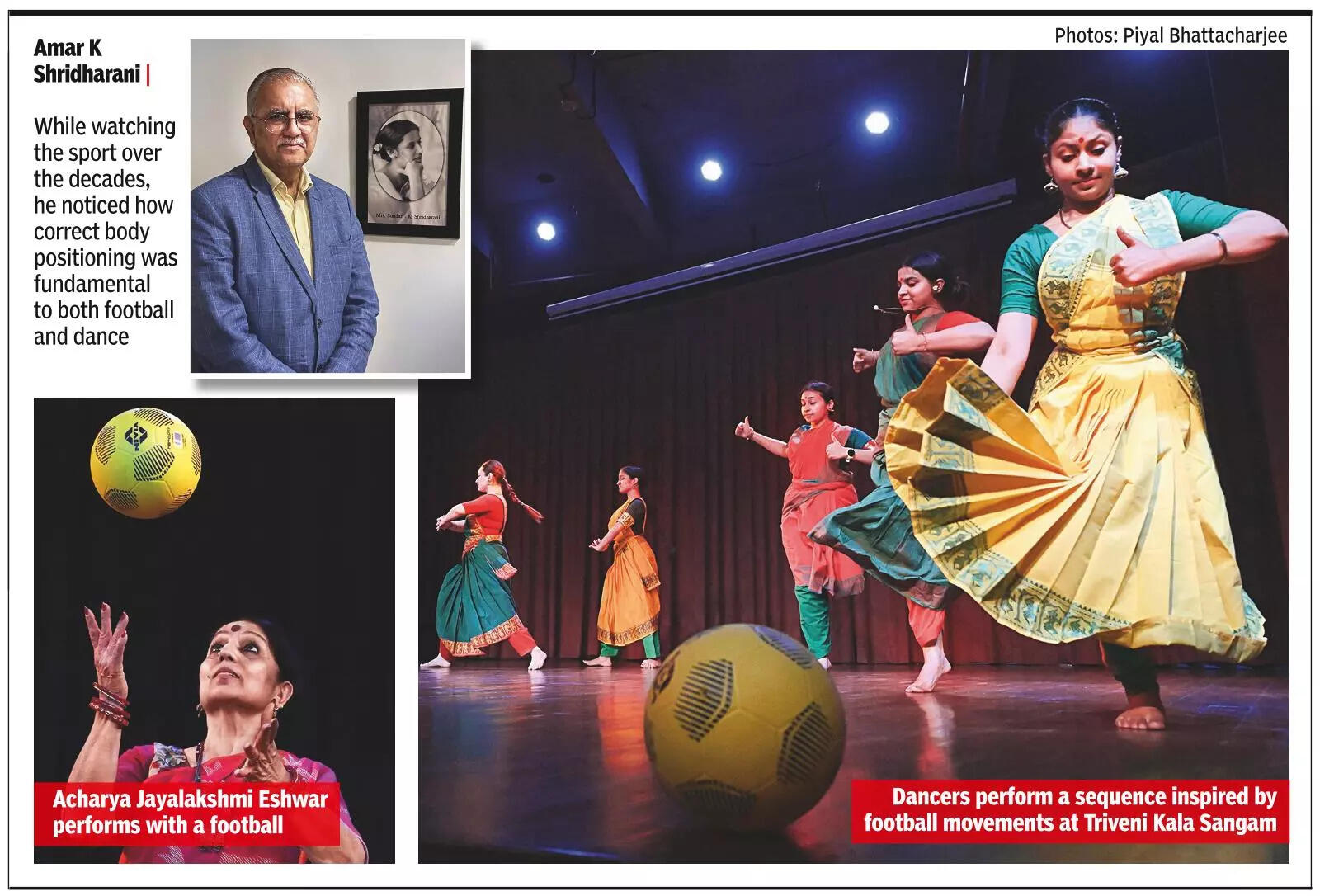
Dance — that’s the word. ‘Jogo bonito’, or the beautiful game, as the Brazilians describe football in Portuguese, has often been equated to the joyous samba and the more relaxed bossa nova, two dance forms which were born in the land of Garrincha, Ronaldo (again, the original), and now, Vinicius Junior. Players who made opponents dance to their tune. Brazil has won the World Cup five times, more than any other country.While watching the sport over the decades, Shridharani also noticed how correct body positioning was fundamental to both football and dance. “A great footballer will always be elegant,” he says. That was when the germ of an idea first took shape: blending Brazilian football with Indian dance.Yet the concept felt too offbeat. Which is why Shridharani—the honorary general secretary of Triveni Kala Sangam—was both hesitant and apprehensive when he broached it, albeit indirectly, with Acharya Jayalakshmi Eshwar some years ago. Would she consider a project where two very different performance traditions could come together in seamless synergy?For Eshwar, a Sangeet Natak Akademi awardee who teaches Bharatanatyam at Triveni, the concept presented an unusual challenge. “The grammar of classical dance is vast. You can do anything without losing the classicism,” she says. But there was a problem. Cricket and tennis interested her, football didn’t. But once Eshwar agreed to take up the project, the classical dance teacher plunged headlong into research. She watched Brazilian football videos for a month to study leg and torso movement and technique.Slowly, Eshwar started spotting the similarities. “I realised a lot of movements were similar to the Natyashastra’s charis, roughly translated as feet movement,” she says. There are two types of charis: bhumi, where both feet are on the ground, and akasha, where one foot is in the air. She also found connections in warm-up techniques and in the way penalties were taken. In the end, she decided to bring together three Indian dance forms – Bharatanatyam, Saraikela Chhau and Kathak – for a 90-minute show.But there were improvisations and adjustments to be made. In Bharatanatyam, the hands and the expressions are fundamental to the routine. But in the football-dance show, facial expressions and hand movements had to be avoided to stop the audience from getting distracted. “If we were choreographing basketball, it would have been easier because you could use your hands,” she says.There were other challenges too. Kathak, the famous dance from north India, is relatively static, which makes football-like movements harder to incorporate in the choreography. “Chhau was easier because it has a lot of jumps like football and also showcases more athletic movements,” says Eshwar, who presented her first show after the 2022 World Cup. She remembers the final was decided on penalties. A sequence with spot kicks was introduced later. For the record, Argentina won. The final score was 3-3 (4-2).Now with the next football World Cup just a few months away, another enactment is scheduled for Monday as part of Triveni’s ongoing 75th year celebrations. The performance was postponed from Sunday since the timing clashed with the T20 World Cup final. The show is titled, “The Rhythms of Indian Classical Dance meets the Art of Brazilian Football.” Guru Sapan Kumar and Guru Sanjeev Gangani are also engaged with the project. Entry is free.Subasree Arvind, a software engineer by profession, has been practicing since Diwali for the recital. Like Eshwar, she admits to being initially wary as to how dance and football could fuse. “But once we started practicing, it was both fascinating and fun. It opened a new door of creativity for all of us,” says Subashree, who has been learning Bharatanatyam for over a decade.Another senior student Nandita Nambiar remembers her teacher sharing football videos with them. “She conceptualized the entire choreography. I never thought so many football moves would be like dancing,” says Nambair, a Messi fan who supports Argentina, the traditional rival of Brazil in Latin American and world football.After introducing the concept, Shridharani once visited the practicing dancers. “You don’t have to do it, if you don’t like it,” he told them. They responded, “This is one of the best things that has happened to us!”