




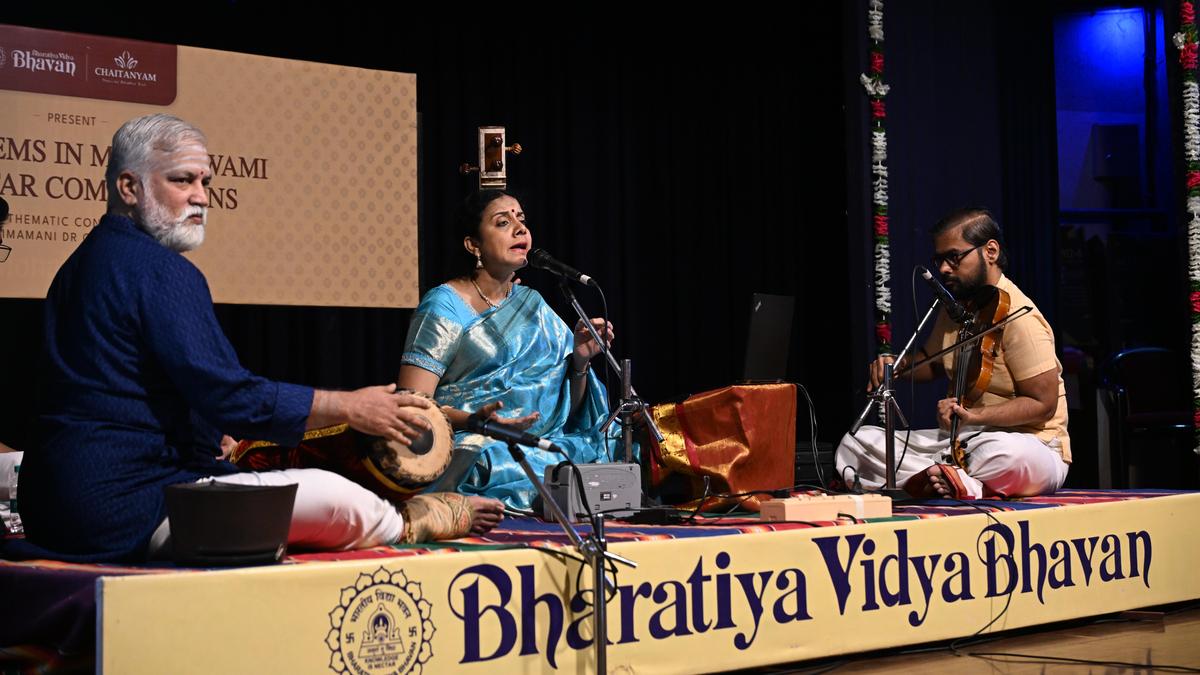
Gayathri Girish with Poongulam S. Subramanian on the mridangam and M. Vijay on the violin at Bharatiya Vidya Bhavan, Mylapore.
| Photo Credit: M. Srinath
Dikshitar 250 (250th birth anniversary) may have been a focal point of the past year, but the composer’s influence on Carnatic music resonates incessantly. That came through in vocalist Gayathri Girish thematic concert ‘Hidden gems in Muthuswami Dikshitar’s compositions’, held recently at Bharatiya Vidya Bhavan, Mylapore. Dikshitar, the youngest of the Carnatic music Trinity, was an inveterate pilgrim,’ said Gayathri at the outset.
The theme echoed the composer’s passion for travel and his penchant for composing kritis on the deities of various temples. His works are rich with references to anecdotes, rituals and festivals associated with each shrine. In that sense, Dikshitar was a historian, Gayathri observed during her well-researched presentation. She was accompanied by M. Vijay on the violin and Poongulam S. Subramanian on the mridangam. Vijay was at his melodious best in solo raga sketches, while the mridangist seamlessly brought out the interesting rhythmic structure of every composition.
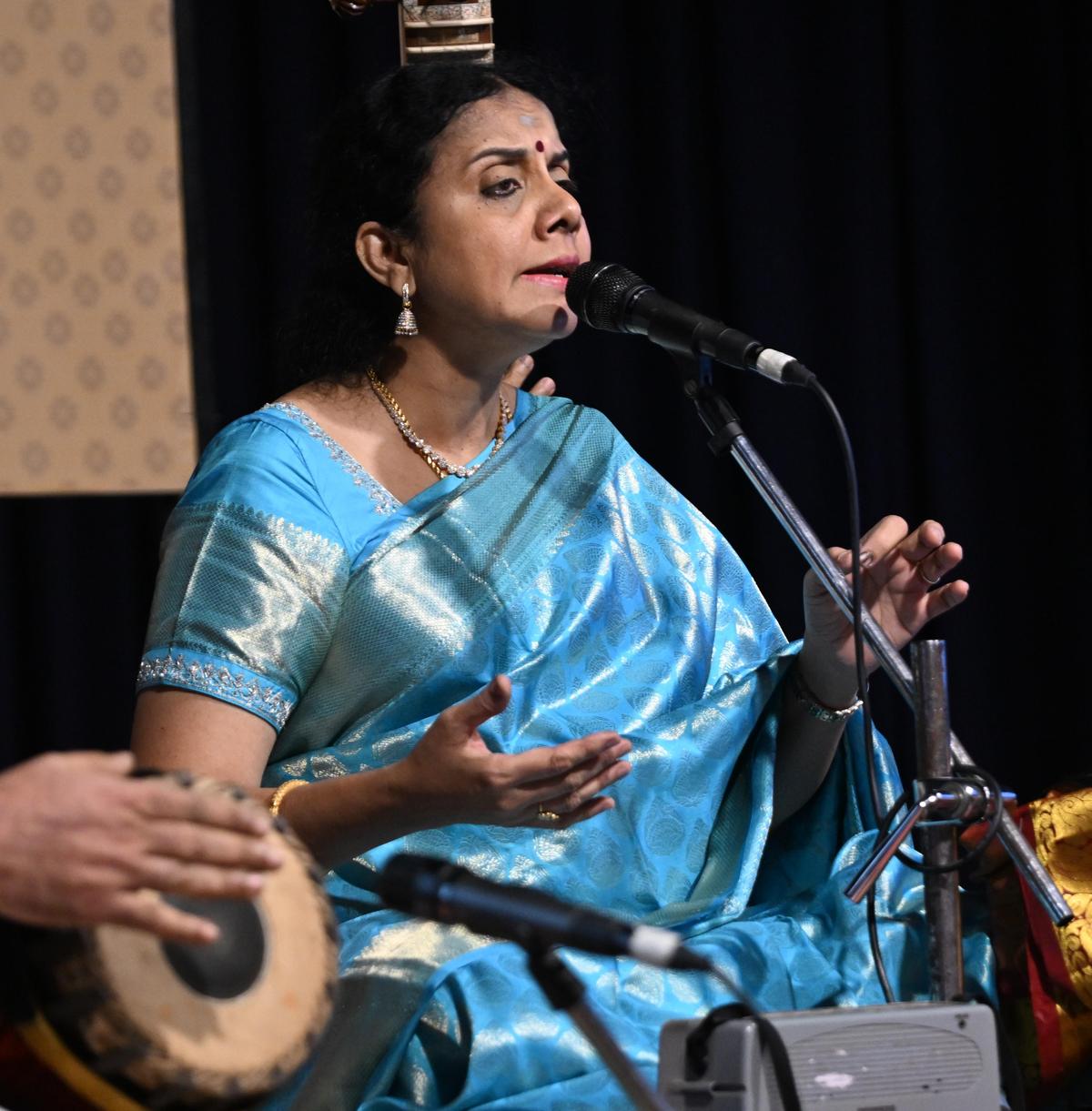
The singer Gayathri presented nine temple compositions.
| Photo Credit:
M. Srinath
As part of Dikshitar’s kshetra kritis, Gayathri sang songs on Achaleswarar temple in Tiruvarur (Sadachaleswaram in Bhupalam), Varadaraja Perumal temple in Kanchipuram ( ‘Varadarajam upasmahe’ in Saranga), Rathnagiriswarar temple in Nagapattinam district (‘Pahimam ratnachala’ in Mukhari), Bhaktavatsala Perumal temple in Thirukannamangai ( ‘Bhaktavatsalam abishekavalli’ in Vamshavati), Subramania Swamy temple in Tiruchendur ( Sri subrahmanya mam’ in Thodi) and the shrine of Kamalamba in Tiruvarur (Sri kamalamba jayati’ in Ahiri). The list also included ‘Narasimha aghacha’ in Mohanam and ‘Tyagaraja mahadvajaroha’ in Sri raga. Each kriti was preceded by a brief description of the kshetra, accompanied by a slide show of these temples. One only wished that the slides were less cluttered.
The high point was the song ‘Bhaktavatsalam abhishekavalli’, which recounts the wedding of Lakshmi and Vishnu, and how Lakshmi asked the devas to refrain from attending it. Undeterred, they are said to have swarmed the wedding in the guise of bees — a presence that, to this day, is believed to linger in Abhishekavalli Thayar’s shrine. These facets were reflected in the verse ‘Sura maya madhu makshika-aradhitam’ (the one worshipped by honeybees, who are themselves forms of the devas).
The evening gave the audience a glimpse of the many kshetras that inspired Dikshitar’s compositions, establishing him as one of the uttama vaggeyakaras.
Published – May 08, 2026 06:32 pm IST
