




Of course there are companies where you can rent a husband, a daughter, a wedding guest, a videogame partner, or just someone to clap for you at karaoke. Only in Japan could loneliness evolve into something this efficiently organised — it’s exactly the kind of thing us ‘gaijin’ describe as “so Japanese” while secretly wondering why no one else thought to formalise emotional outsourcing with this level of commitment. Werner Herzog took one look at this ecosystem in his 2019 quasi-documentary Family Romance, LLC, about actors hired to impersonate loved ones, and spiralled into metaphysical dread, convinced that if you stare at the performance long enough it might stare back and erase you. But Japanese filmmaker Hikari saw the opportunity for something warmer, even a little seductive, because she understood the one fatal flaw in any philosophical objection to this business model: Brendan Fraser. After all, who would say no to a day drifting through Tokyo with one of the world’s most kind faces?

Rental Family opens on Fraser’s Phillip Vandarploeg, an American actor who moved to Tokyo years earlier for a fleeting commercial success as a toothpaste mascot, and the residue of that minor fame lingers in the corners of his life, which places him in a professional and emotional limbo. Philip is a man who has learned how to occupy space in Tokyo without quite belonging to it, and Fraser plays him with a transparency that turns this condition into a plot engine as well as a liability, because every role he accepts within the film’s premise asks him to simulate intimacy while the film itself struggles to examine what that simulation costs him in return.
Rental Family (English, Japanese)
Director: Hikari
Cast: Brendan Fraser, Takehiro Hira, Mari Yamamoto, Shannon Mahina Gorman, and Akira Emoto
Runtime: 110 minutes
Storyline: Struggling to find purpose, an American actor lands an unusual gig with a Japanese rental agency to play stand-in roles for strangers
Hikari stages this strange Japanese industry with a functional clarity, allowing Phillip’s entry into the titular agency as the “token white man” to unravel through a series of assignments that range from absurd to the ethically loaded. His first job as a mourner at a faux funeral establishes the tone, since the revelation that the deceased is alive frames grief as a performance, while also giving Phillip a mirror he does not fully confront. From there, the film moves through weddings, companionship gigs, and other small acts of emotional labour that position the service as a pragmatic response to loneliness in a society infamous for their inability to directly confront vulnerability.

A still from ‘Rental Family’
| Photo Credit:
Searchlight Pictures
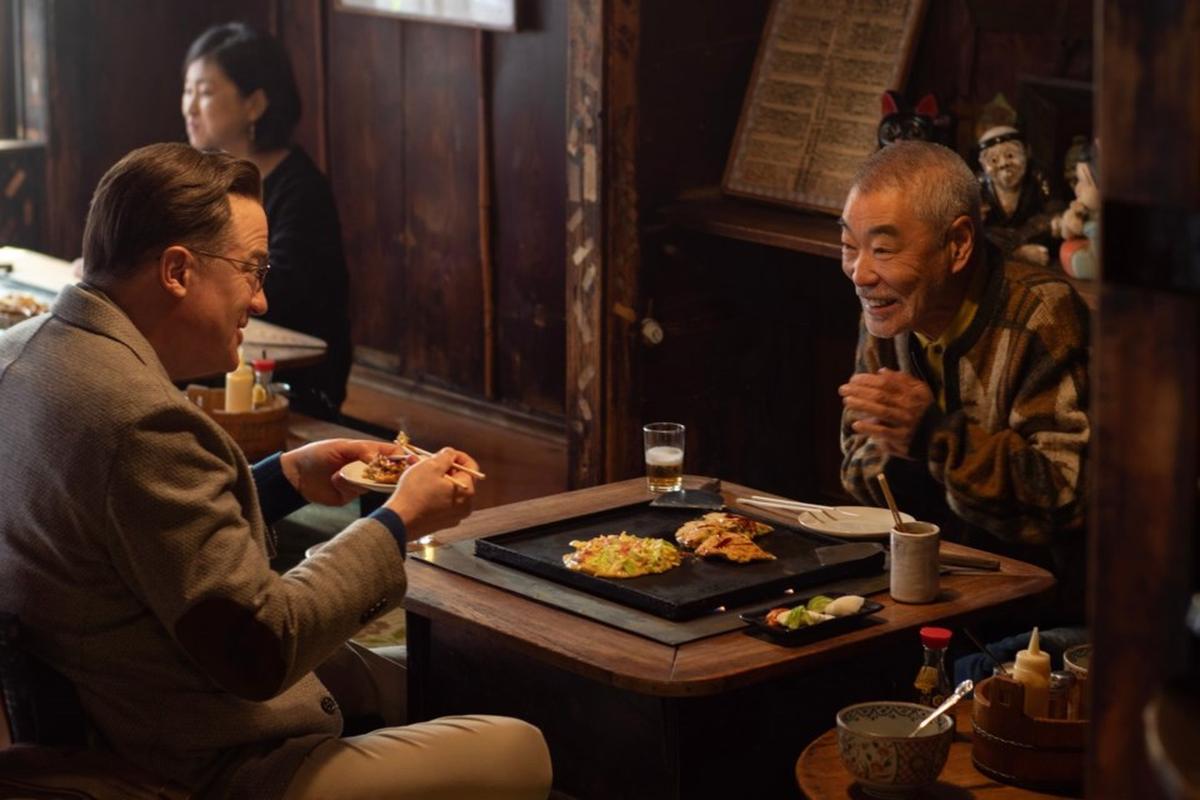
Fraser’s performance anchors these scenarios with a carefully sustained openness and empathy, as Phillip approaches each assignment with the earnestness of someone who wants to do the job well without entirely understanding its implications, and this quality allows the film to build a pattern in which performance becomes indistinguishable from care. When Phillip agrees to pose as the estranged father of an 11-year-old girl named Mia, the narrative finds its most durable throughline, since the arrangement requires him to maintain a fiction over time, to earn the trust of a child who believes in his presence, and to navigate the expectations of a mother who treats the deception as a strategic necessity for her daughter’s future. The school admission framework gives the lie a clear objective, yet the film’s attention shifts toward the incremental growth of the relationship, as Phillip adopts the gestures of fatherhood with increasing ease while Shannon Mahina Gorman’s Mia recalibrates her sense of abandonment into a tentative attachment.
This progression unfolds alongside a second long-term assignment in which Phillip poses as a journalist interviewing an aging actor suffering from memory loss, and the parallel is not subtle, since both roles require him to validate another person’s sense of self through sustained attention. There is a metatextual undercurrent here, as Fraser shares the frame with a character confronting obsolescence, inviting us to fold his own career’s long detours and returns into the exchange. Akira Emoto plays Kikuo with a lifetime of performance settling into fragility, and the dynamic between him and Phillip introduces a generational echo that the film uses to expand its emotional field, even if it does not fully integrate the implications of that expansion into its broader structure. The cumulative effect of these storylines produces a steady accrual of sentiment that aligns with Hikari’s directorial instincts.

The film’s visual approach reinforces this orientation, as Takuro Ishizaka’s cinematography renders Tokyo in bright, even light that resists the nocturnal Citypop stylisations often associated with the city, and this choice situates Phillip’s experiences within a recognisable everyday environment rather than some exoticised backdrop. The surface then feels inviting and coherent, though it also contributes to the film’s tendency to smooth over the more difficult questions embedded in its premise, particularly those concerning consent, deception, and the long-term effects of manufactured relationships.
Hikari’s script acknowledges these tensions in passing, especially through the character of Mari Yamamoto’s Aiko, a co-worker whose assignments expose the harsher edges of the industry, yet the film does not pursue her perspective with the same persistence it grants Phillip, which creates an imbalance that narrows the scope of its inquiry. Takehiro Hira’s Shinji, who manages the agency with a mix of pragmatism and detachment, introduces a counterpoint that frames the work as a necessary service, though later revelations of his own reliance on rented relationships complicates that stance in ways the film sketches without fully developing. These elements only signal towards a more layered exploration of the system’s internal contradictions, but the narrative remains oriented toward Phillip’s personal journey, which it resolves through saccharine gestures of growth that feel emotionally loaded even when they leave broader questions intact.
A still from ‘Rental Family’
| Photo Credit:
Searchlight Pictures
Pop culture has decided to protect Brendan Fraser at all costs, and it is easy to see why, since his screen persona offers an unguarded emotional availability that feels almost out of step with the present moment. Even after the industry ceremonially welcomed him back with an Oscar for The Whale, what lingers is how the man still carries that faintly rumpled, open-hearted quality that made him impossible to dislike in the first place. There is a wistfulness to his face, a sense that every smile has travelled through something to get there, and a slight hesitation in his body language, as if checking that the other person is alright before proceeding, yet none of it curdles into self-pity or performance. His endless capacity to give is a rare instinct in an industry built on extraction, and it explains why even his most uneven projects tend to inherit a baseline of goodwill simply by having him at the centre of them.

Hikari has made a modest, carefully shaped drama that understands the appeal of its premise and the strengths of its charismatic lead. While it leaves certain complexities at the edges of its frame, the film sustains a steady engagement with the human desire to be seen, which gives its most effective moments a poignant, sentimental clarity that lingers on.
Rental Family is currently streaming on JioHotstar
Published – March 23, 2026 12:04 pm IST

