



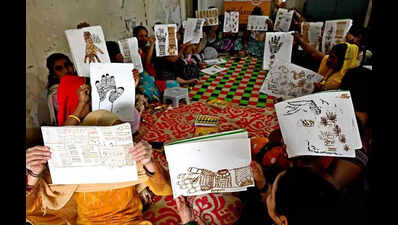
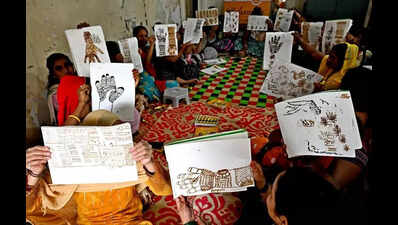
For a few hours, I forget everything — work, chores, kids.”Amid gullies lined with gutters, goats, gutka packets and gritty women fanning themselves with plastic hand fans in Turbhe’s infamous ‘Red Area’, a dimly-lit classroom offers daily escape to an oval of nightie-and-dupatta-clad mothers. Despite the clockwork lack of electricity in this afternoon mehndi class, 31 women bend over free drawing books, waving away flies to complete roses, shoeflowers and other delicate patterns with hands that trembled when they first held a pencil at this course that began last month on July 21.Together with the tailoring centre in nearby Drum Galli where 35 women face the walls of a long room lined with sewing machines–some donated, some motor-operated— the mehndi course forms part of a new skilling initiative launched in July by the Navi Mumbai Municipal Corporation (NMMC) with the NGO Kshamata. “The idea is to enable these 66 women from Turbhe’s red-light area to rise above their squalid environment and integrate into mainstream society through skills that build independence,” says Prakash Kamble of NMMC’s social development department. “I have always loved putting on mehndi,” says Shazia (name changed), a Kolkata-born mother of two who has managed to apply henna on her left palm mid-class while continuing to draw on pages bearing her name in English. “If I learn make-up too, I can work at a parlour,” she beams. The project took root in Jan 2025, when Kshamata approached NMMC with the idea of creating safe, skill-based learning opportunities for sex workers in Turbhe, which has long been home to migrant families seeking work. Over time, even as real-estate prices shot up in infamous red-light districts such as Kamathipura and Falkland Road, pockets of this settlement became red-light hubs where women and adolescent girls from UP, West Bengal and Nepal face risks of violence and stigma. Many drop out of school and get drawn into the trade. Poverty, insecure housing and poor healthcare don’t help.“When we began work here in 2022 with a pilot on micro-business development, the biggest challenges were stigma, lack of trust in outsiders and resistance from exploitative groups,” says Pratishtha Ratndip, program director at Kshamata. Trust had to be built patiently. Over time, Kshamata expanded to include livelihood training, trauma counselling, literacy, healthcare, and community-building. Women now form self-help groups to advocate for their rights. In three years, 12 women have quit sex work, secured mainstream jobs and are living independently. Many now have ration cards, Ayushman Bharat health insurance, Gumasta licenses, Udyam certificates, and bank accounts.The current programme focuses on tailoring and beauty care with mehndi — chosen for their popularity and immediate income potential. While NMMC provided stationery, sewing machines, and other supplies for free, families and brothel owners had to be convinced to let women attend. Initial days were especially hard — occasional raids, customers calling mid-session, or women being summoned home by alcoholic husbands—led some participants to drop out. “Stress is rife among the women. Many fall prey to domestic abuse and take to gutkha, alcoholism, and other addictions,” says Reshma Kalamkar of Kshamata. Some women were initially sceptical, recalling earlier short-term courses that led nowhere. But seeing neighbours stitch garments and earn from bridal mehndi assignments changed minds. “Peer encouragement played a vital role,” says Ratndip.Inside Kshamata’s office near Nav Jivan Hindi High School, where women have been stitching palazzos and purses since July 22, teachers saythose who once hesitated to speak now stay back after class to practice, voice opinions, and guide peers. Aparna (name changed), a mother of three who recently fashioned a palazzo for her middle daughter, Leela. Nearby, her eldest, Rita (name changed), a thalassemia patient, paints when not fatigued. A beautiful doe staring from a tiny canvas was made by her in spurts. Aparna’s concern, however, is her son — a restless fourth-grader who refuses to attend his Hindi-medium school. He wants English-medium education. “Do you know of a good hostel?” Aparna asks. Aruna (name changed), clad in a red batik kurta she stitched herself, is working on a top for her daughter in a Belapur hostel. She shows off green bangles from the glass factory where she works part-time. “I bought a house here for Rs 10 lakh when we were in dire straits. I had to do many unspeakable things, but now that I’ve paid off the loan, my road ahead is clear,” she says, hopeful of joining a boxer shorts factory that Kshamata is helping set up next.By 4 pm, the mehndi class winds down. Shazia returns after a quick stop at home, proudly displaying her freshly washed hand. The brown fingertips have turned orange. Even as her five-year-old Shamim cries for attention, she holds out her drawing book, eager: “Can you show me how to write my name in Hindi?”