



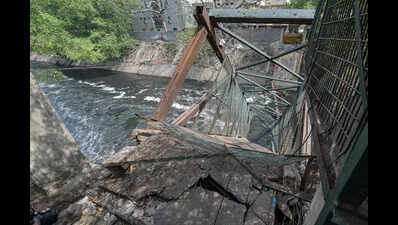
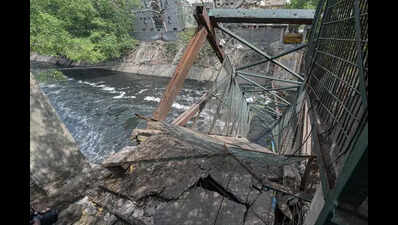
New Delhi: A 60-foot iron foot overbridge built across the Najafgarh drain collapsed in north Delhi’s Roop Nagar on Tuesday, killing a woman who fell into the drain water.Following a PCR call at 9.28am, teams from police, the fire brigade, National Disaster Response Force and other agencies conducted rescue operations at the site near Block 3. Six boat club rescuers searched 200 metres of the area and retrieved the body after one and a half hours. Police said the woman was probably a beggar in her 50s and yet to be identified. Locals also said they did not know the victim. DCP (north) Raja Banthia said a case under Section 106 (1) (causing death by negligence) of Bharatiya Nyaya Sanhita had been registered at Roop Nagar police station.The bridge connected Rajpura Gurmandi village with Roop Nagar. The section on the Roop Nagar side gave way in a slanted form. At the site, the bridge appeared dilapidated, with the fall having caused further damage. Residents said it often used to shake. The iron structure was rusted, the nets were in poor condition, and the walking path was made of slabs. The water below was flowing strongly. The area, near Delhi University, has at least five schools, including govt institutions, and numerous hostels and PG accommodations.Tina, a cook who was just a few steps from the bridge, said she noticed it shaking and initially thought monkeys were on it. Moments later, the vibrations intensified, and the structure gave way. She saw the woman trying to get up before falling into the drain. Shocked, Tina ran home screaming and crying.“For the past 12 years, I have been using this bridge. It used to shake, so initially I didn’t think that something like this would happen. I cannot forget the last moment — the woman tried to get up and then it collapsed. There was a loud blast,” she recalled.Another cook, Sanju, a resident of Rajpura, and a woman had just crossed the bridge and heard people shouting warnings to run. Seconds later, the bridge collapsed with a loud crash. Totaram, a shopkeeper, said he heard a loud sound, “just like a blast”. For residents, the only relief was that the incident did not occur in the early morning when many people, including college students, school children and office-goers, would have been on the bridge, or around 1 or 2pm, when children return home. “Several children use this bridge to cross,” said Arvind, who works at a hostel, adding that at least four-five people on both sides were about to step on it. Another resident noted that since most classes and examinations were not on, the bridge was less crowded.Residents said children and others used the bridge daily instead of taking the longer main-road route to save 10-15 minutes. The main road is also considered risky.Locals said there were two iron railings on one side and three on the other side of the bridge, and a wall to prevent crossing, but all were partially damaged. Police frequently install barricades, but they are usually ignored.Neeta Mardi, a Roop Nagar resident, witnessed the collapse from her second-floor balcony. “Police always put up barricades, but people, especially those on two-wheelers, remove them to cross. Garbage is also thrown onto the bridge.”