





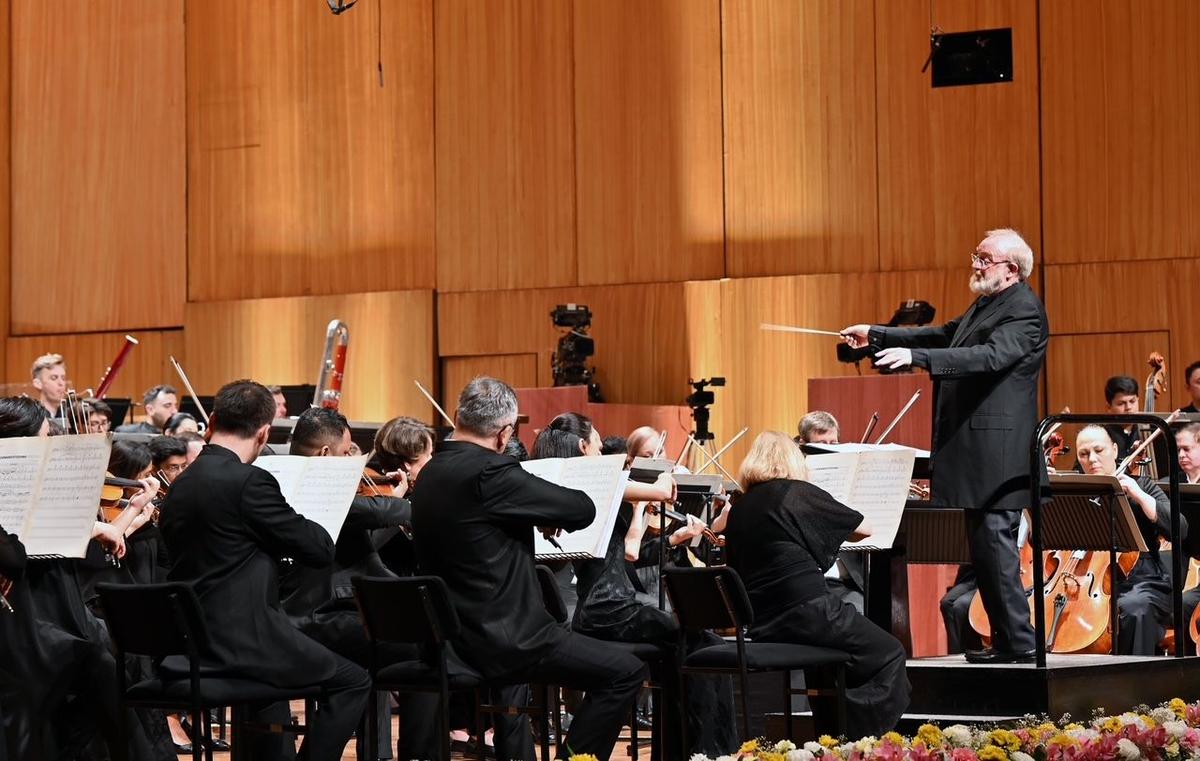
For the finale of the 2026 spring season of the Symphony Orchestra of India (SOI), Italian maestro Carlo Rizzi conducted one of the most popular pieces written in Western classical music — Ludwig van Beethoven’s ‘Symphony No. 5’. Best recognised for its opening sequence symbolising ‘fate knocking at the door’, it was played to perfection.
Held last month at Mumbai’s Jamshed Bhabha Theatre, the season was significant as it marked 20 years of the SOI, formed in 2006 by Khushroo N. Suntook, chairman of the National Centre for the Performing Arts (NCPA), and Kazakh conductor Marat Bisengaliev, who joined as music director. Another crucial development this year is the appointment of British maestro Martyn Brabbins as chief conductor. Brabbins conducted two shows last month.
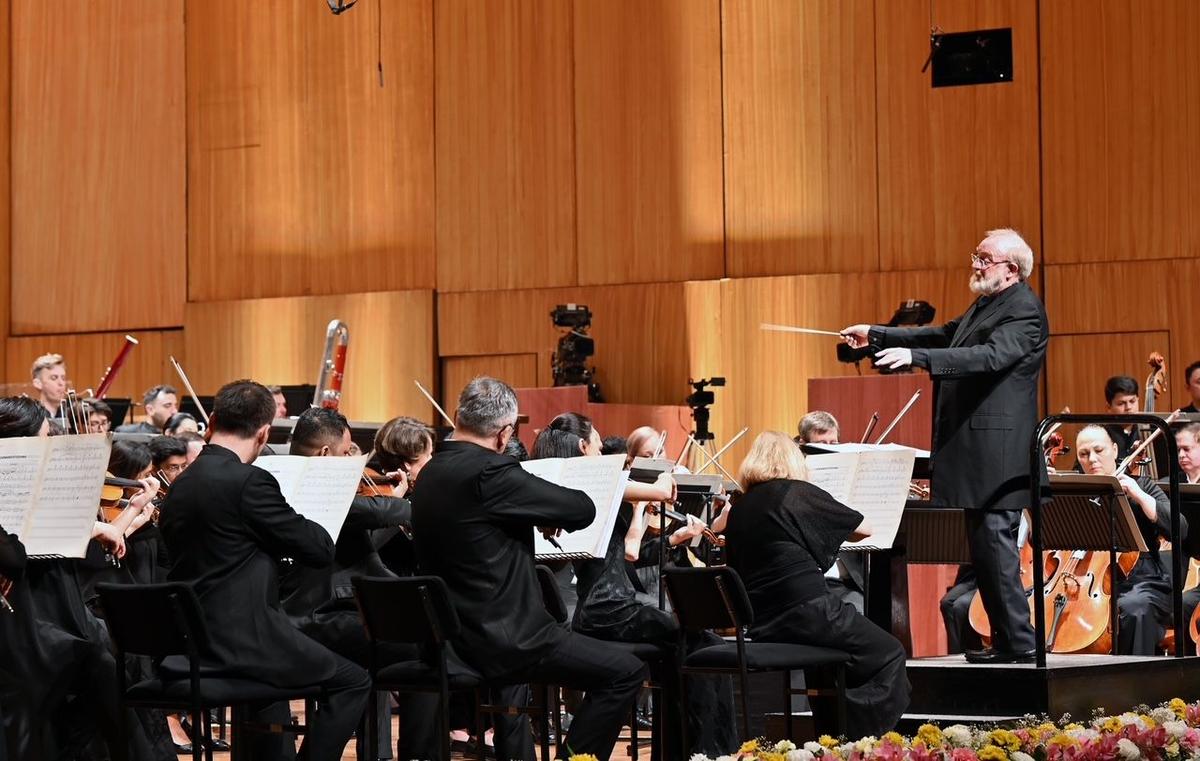
Brabbins conducting at Jamshed Bhabha Theatre.
| Photo Credit:
NCPA
As India’s only full professional symphony orchestra, the SOI has come a long way since its inception. Reflecting on its role, Suntook says, “Those who have watched and helped it grow as supporters, patrons, advisors and listeners will perhaps agree that the SOI is not just an ensemble but a culmination of the endeavours of many passionate individuals and groups before us, who contributed towards giving Western classical music its due in India. Twenty years later, the SOI, with an increasing number of Indian players in it, continues to present some of the finest concerts in the genre.”
Besides numerous guest conductors, SOI earlier had Zane Dalal as associate music director, and Evgeny Bushkov, Piotr Borkowski and Mikel Toms as resident conductors. Apart from the spring season in February and autumn season in August-September, it has many symphonic and chamber performances through the year.
The idea of forming the orchestra germinated almost 22 years ago, when Suntook was at a concert in London. After the event, he asked conductor Bisengaliev, whether he would like to set up India’s first professional Western classical orchestra. classical orchestra. The Kazakh musician was initially not convinced, but after some thought, decided to take up the challenge.
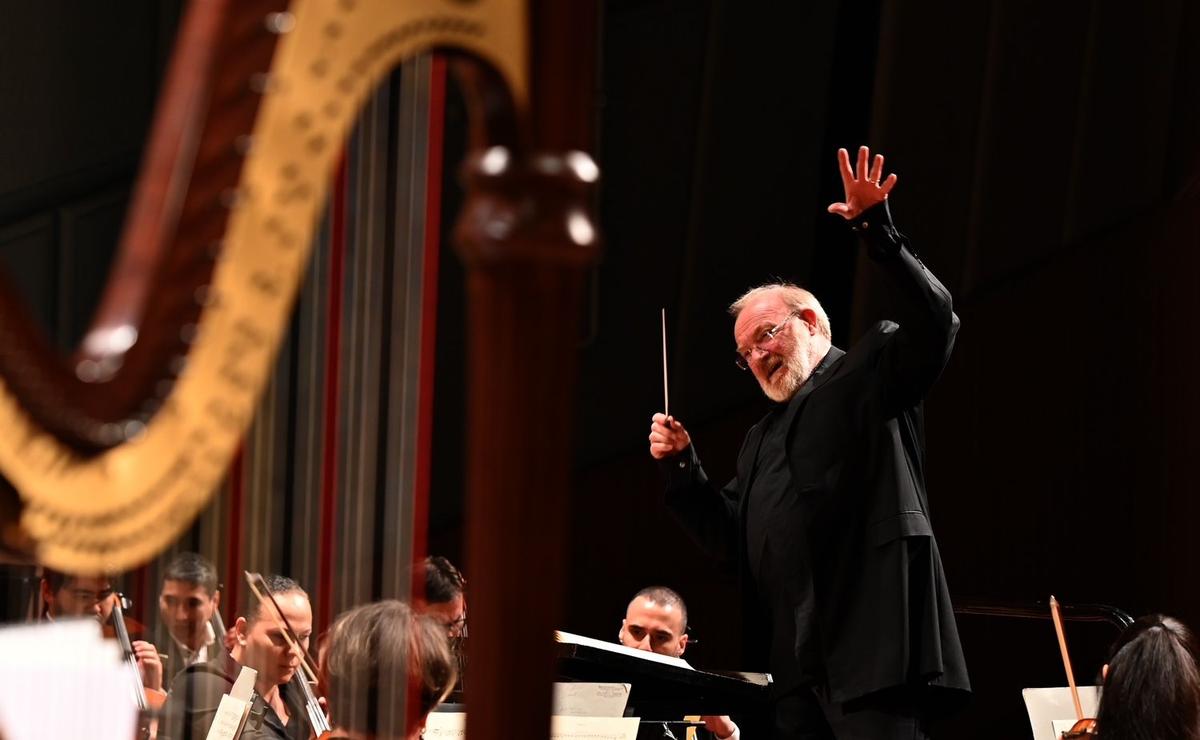
For his opening show, Brabbins conducted Holst’s ‘The Planets’.
| Photo Credit:
NCPA
It took two years to piece together 70 musicians, bringing together a mix of string, brass, woodwind and percussion players, as required by any symphony orchestra. The number of Indian musicians, minimal at the outset, increased over the years.
The SOI began its performances in September 2006 in Mumbai, with over four concerts that included Pyotr Tchaikovsky’s ‘Symphony No 6’ and Antonin Dvorak’s ‘Symphony No 9’ (‘From The New World’). The opening also included a presentation of Tchaikovsky’s ballet ‘The Nutcracker’ — led by the New Jersey Ballet Company.
Ever since, the SOI has followed the tradition of presenting two seasons a year — Spring and Autumn — while its musicians also performed at smaller chamber recitals throughout the year. Though, most shows were held in Mumbai, the SOI has also performed in Bengaluru (2007) and Chennai (2011). The latter, conducted by Zane Dalal, included Maurice Ravel’s ‘Bolero’ and Franz Listz’s ‘Piano Concerto No 1’. The orchestra has also performed overseas — Oman, Moscow, Abu Dhabi, Switzerland and the United Kingdom.
The core group of musicians are the resident artistes at NCPA and form the SOI Chamber Orchestra. Additional performers are recruited from a talented pool of professionals worldwide. Besides venues within the NCPA complex in south Mumbai, the Chamber Orchestra also performs at the Prithvi Theatre in the city’s suburb.
The SOI has worked with renowned conductors such as Brabbins, Rizzi, Charles Dutoit, Karl Jenkins, Alexander Anissimov, Christoph Poppen and Sir Mark Elder. The Mumbai-born Zubin Mehta first conducted the orchestra in 2023, visiting the next two consecutive years; even leading the Opera Gala in 2025. Speaking to The Hindu he had said, “Before I did those shows in 2023, I wasn’t sure if I would come again. But, I was impressed from the rehearsal stage itself. We played Mahler’s ‘Symphony No 1’, which requires proficiency. They did a wonderful job. So when Suntook asked me to return, I readily agreed.”
Though the SOI is relatively new compared to the other orchestras that Zubin Mehta has conducted, he felt it would establish itself over time. He said, “Each orchestra has its own personality and flexibility. Conducting them is a process that builds up over a period of time.”
Brabbins takes over as the chief conductor at a point when the orchestra is seeking to move to the next level. He is already familiar with the SOI’s functioning, having conducted it in 2016, 2017 and 2025. He says, “The chief conductor’s role is important for an orchestra such as this. For me, it’s an honour and a responsibility. Our aim, like any other orchestra in the world, is to play great music.”
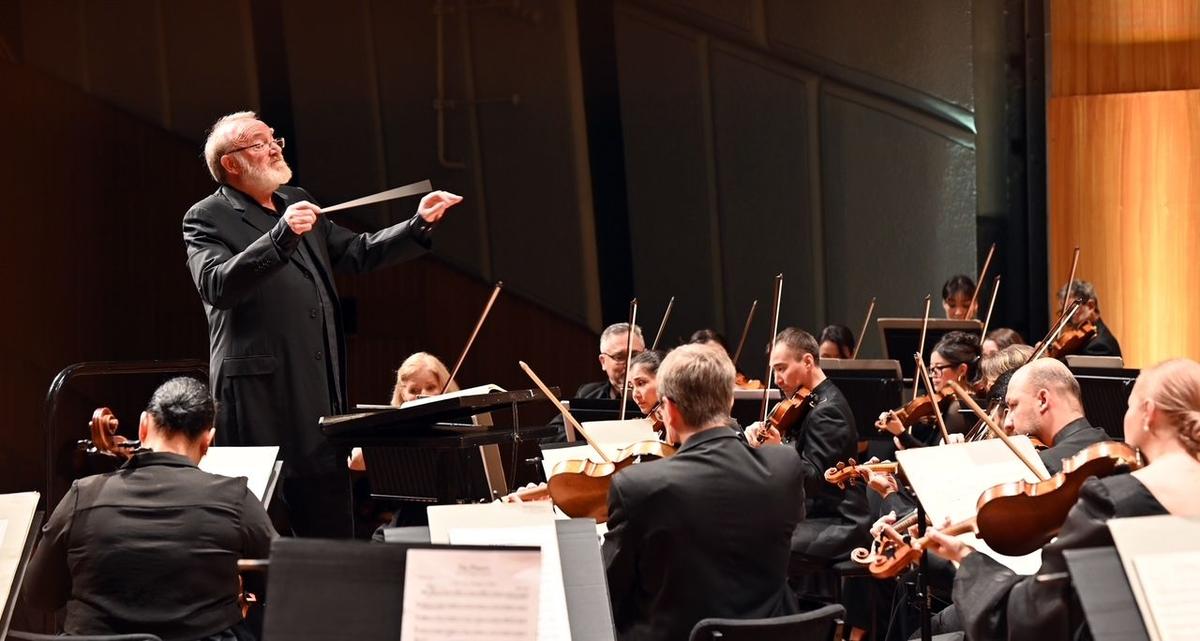
Martin Brabbins at the Spring 2026 Season.
| Photo Credit:
NCPA
One decision, jointly taken by Babbins and Suntook is to perform all the Beethoven symphonies again.
Brabbins, who is also the chief conductor of the Maimo Symphony Orchestra in Sweden, will visit Mumbai before both seasons as part of his new assignment. He will also come before major symphonic concerts if necessary.
He says that though he will try to introduce rare pieces by British composers — Edward Elgar and Ralph Vaughan Williams — he plans to focus on compositions that the SOI is more comfortable with. The next couple of seasons will determine the direction he takes.
Published – March 09, 2026 03:44 pm IST


