





I wasn’t bracing myself for this to end up as my absolute favourite film of the year, especially with its Cannes contemporaries in Jafar Panahi’s It Was Just an Accident and Joachim Trier’s Sentimental Value making perfectly reasonable claims for the crown, but the deal was effectively sealed once I realised that The Secret Agent intended to feature a great white shark both on screen and off it — as flesh-and-blood predator that populates the headlines like an idée fixe, and as Jaws (Tubarão in its Brazilian incarnation) tearing through Recife’s cinemas for the first time — because any film that keeps Spielberg’s great communal fright carried by my preferred apex predator in active circulation has already anticipated my weaknesses.

That personal bias may have tipped the film towards something generational for me even once it became clear that Kleber Mendonça Filho wasn’t indulging trivia or nostalgia. With his Oscar-nominated follow-up to his 2023 Recife-set documentary, Pictures of Ghosts, the Brazilian auteur seems to fully grasp that cinema tutors its audiences where to deposit their fears, and once something as absurd as a shark becomes the popular container for civic anxiety, the real machinery of violence gains room to operate elsewhere with minimal scrutiny.
Set in Recife in 1977, at the height of Carnaval and deep into a regime that had learned how to disappear people quietly, the film follows Marcelo (played by a bravura Wagner Moura) a widowed university researcher traveling under a false name after crossing a federal official who attempted to privatise his publicly funded work. Unsurprisingly, the act of professional resistance soon turns into a death sentence administered through hired killers and obliging police.
The Secret Agent (Portuguese)
Director: Kleber Mendonça Filho
Cast: Wagner Moura, Carlos Francisco, Tânia Maria, Robério Diógenes, Maria Fernanda Cândido, Gabriel Leone, Alice Carvalho, Hermila Guedes, Isabél Zuaa, and Udo Kier
Runtime: 161 minutes
Storyline: In 1977, Marcelo, a technology teacher, moves from São Paulo to Recife during Carnaval to escape his violent past and start over. He finds the city full of chaos, and his neighbours begin to spy on him
The Secret Agent is the most concentrated articulation yet of what Mendonça Filho has been circling throughout his career, that extends the spine of ‘60s-’70s Cinema Novo, and tells the same story of people fighting to keep their bearings while global capitalism, state power, and cultural vandalism close in from every side, with restless ingenuity. Each film finds a new formal route, yet the pressure remains constant, as persecuted individuals improvise flotation devices from memory, cinema, rumour, and stubborn attachment to place, trying to stay afloat while an unseen war grinds away at the conditions that once made their world legible.
Moura is introduced through one of Mendonça Filho’s most rigorously designed openings, as Marcelo stops his striking, yellow Beetle at a rural gas station where a corpse lies decomposing under cardboard while the police ignore the body and focus on extorting him. The opener established a moral order under Brazil’s erstwhile military dictatorship in which violence has been fully absorbed into administrative habit.
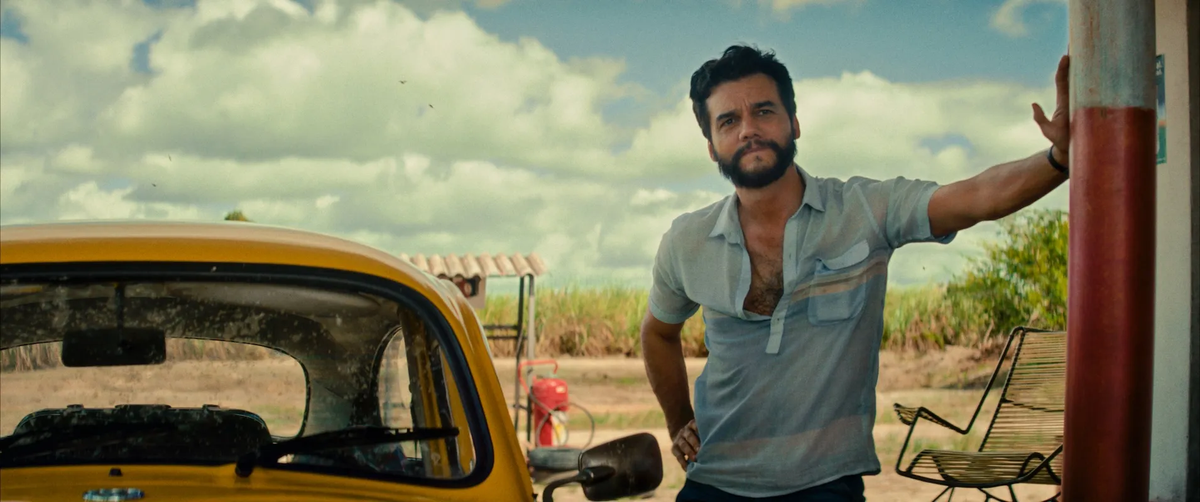
A still from ‘The Secret Agent’
| Photo Credit:
Neon
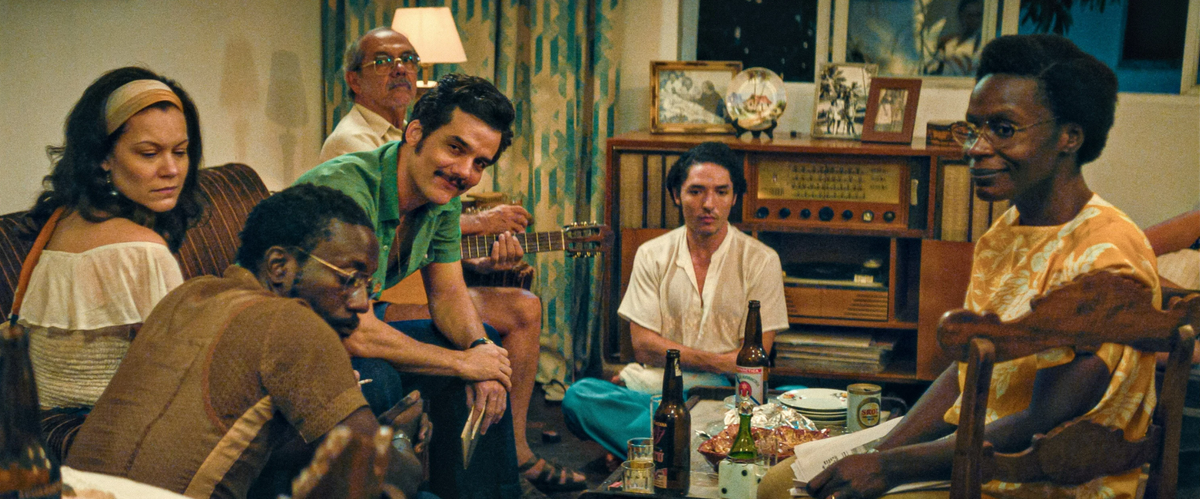
From there, the narrative settles into Recife with patience, introducing a safe-house apartment complex overseen by Dona Sebastiana, played by a terrific Tânia Maria with weathered snark and a voice that carries decades of political fatigue. The space doubles as a temporary refuge for dissidents, migrants, queer runaways, and other endangered folk. Marcelo’s personal stakes sharpen through his reunion with his young son Fernando, cared for by his late wife’s parents, including a projectionist grandfather whose daily labour inside the real-life Cinema São Luiz links the film directly to Pictures of Ghosts’s explorations of Recife’s movie palaces and grounds the thriller inside a broader meditation on cultural memory.
The plot advances through procedural steps, following Marcelo’s placement in a government identification office where he issues documents while secretly combing archives for traces of his vanished mother. The tension stems from bureaucracy as weapon and shelter at once, while parallel threads track the movement of hired killers and the maneuvers of a corrupt police chief who treats the chaos of Carnaval as logistical cover for disposal. Mendonça Filho structures these strands to accumulate pressure through proximity, allowing characters to brush past one another in offices, streets, cinemas, and stairwells, with danger emerging through sheer chance timing.

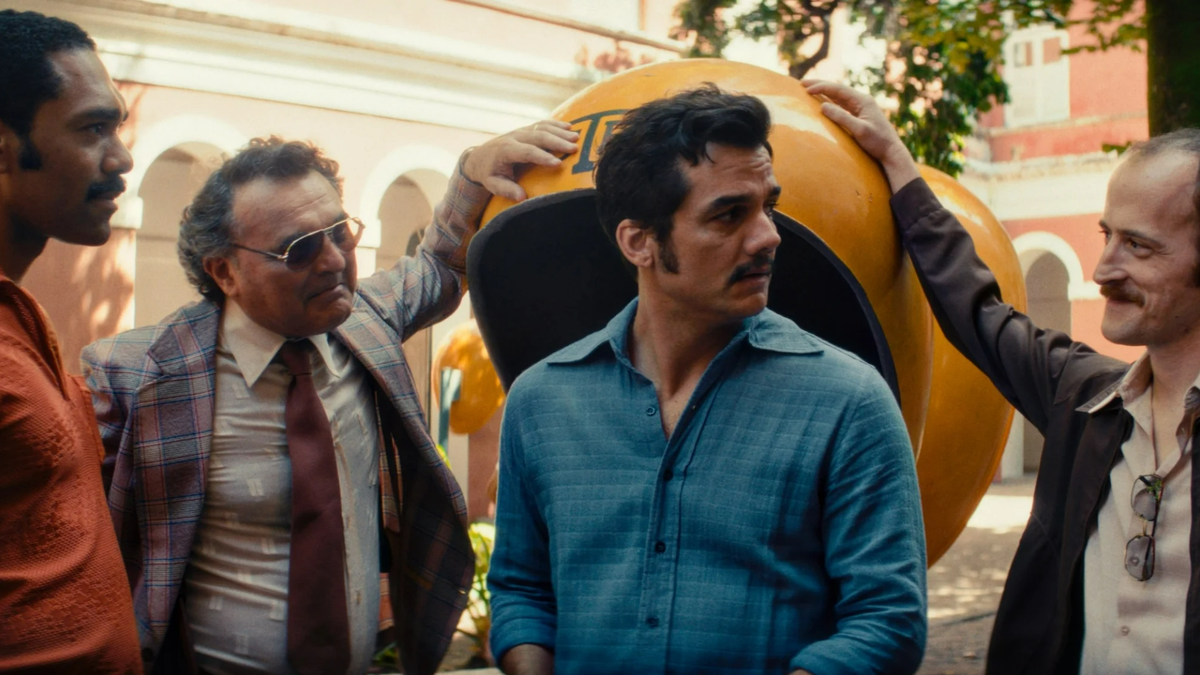
Production-wise, the film is built with meticulous period specificity that never calls attention to itself as décor, as production designer Thales Junqueira fills the frame with manual typewriters, egg-shaped phone booths, crowded shelves, and heat-heavy interiors that communicate both era and class position, while costume designer Rita Azevedo dresses characters in a confrontational palette of yellows, blues, and greens that subtly echoes national symbolism without drifting into abstraction. The realism of the setting carries a sensory weight, as the sunny, sultry Brazilian summer is captured with a tactility that feels woozy and faintly nostalgic. The decision to shoot in anamorphic Panavision with cinematographer Evgenia Alexandrova gives the image a high-contrast density that favours lateral movement and deep backgrounds, allowing Mendonça Filho to stage power relations within a single frame rather than through montage that keeps the film grounded in observation even during moments of surreal intrusion.
A still from ‘The Secret Agent’
| Photo Credit:
Neon
Those intrusions, most notably the recurring motif of a Janus cat making the odd appearance among the occupants of the safe-house, as well as a hairy, severed leg pulled from a shark’s stomach and reimagined through tabloid hysteria and exploitation-film fantasy — translate the fear of state violence against marginalised communities into folklore that circulates freely because it cannot be officially named. Mendonça Filho treats these sequences with straight-faced commitment, folding stop-motion effects and genre pastiche into the film’s texture so that absurdity reads as just another register of truth.
Moura’s performance anchors this complexity with prudence, presenting Marcelo as a man trained to minimise his footprint, whose intelligence expresses itself through listening and timing. The choice allows his character’s moral clarity to emerge through action and reaction. Around him, a densely populated ensemble registers with precision, from an aging hitman and his younger partner whose lackadaisical professional routine make for one of the best chase sequences the year had to offer; to neighbours in exile whose personal histories surface during evening soirées with found family.

The political context emerges through operational details such as wiretapped conversations, opened telegrams, falsified records, and the insouciance with which officials expect compliance, situating the dictatorship as a banal ecosystem of casual cruelties. Mendonça Filho’s decision to cut intermittently to the present, where young researchers transcribe cassette tapes connected to Marcelo’s case, reframes the narrative as an act of recovery, suggesting that history persists through material traces that require patience and care to interpret.
When the film reaches its closing movement, which aligns Marcelo’s fate with his son’s adult life inside a repurposed civic space, The Secret Agent has completed its central argument through the power of accumulated history that presents fiction as a durable vessel for truths that official records either distort or erase. Mendonça Filho’s control over pacing and chronology results in an urgency that absconds at the first sign of spectacle, and in doing so he delivers a work shaped by anger, affection, and a historian’s refusal to let silence stand in for closure.
A still from ‘The Secret Agent’
| Photo Credit:
Neon
What made The Secret Agent my favourite film of the year wasn’t some abstract admiration for period filmmaking or Mendonça Filho’s impeccable sense of texture, but the clarity in recognising how that same grammar of fear plays out in the here and now. The cadence of authoritarianism in erstwhile Recife feels disconcertingly familiar if you’ve been paying attention to how the social inoculation against dissent is handled in India today. If you’ve watched how the state’s rolling use of laws to detain the likes of Umar Khalid or Sonam Wangchuk, the bureaucratic terror in The Secret Agent feels almost local in dialect. This isn’t to conflate contexts simplistically, but there is a recognisable logic in the way power normalises surveillance and silence, whether through Brazil’s unresolved reckoning with its dictatorship or India’s contested transformation toward an exclusionary civic order; a nationalist fervour that has, in multiple arenas, restructured citizenship, culture, and collective memory into tools of control rather than sites of freedom.

There is also a certain gall in observing this logic of normalisation, because what The Secret Agent does with dream-logic and genre pastiche is exactly what the immediate realities around us do in sober daylight by rebranding fear and coercion as “national security”. The film advances a bracing thesis in which forgetting accrues material cost, and fascism sustains itself by laundering cultural amnesia into the language of stability and order. To anatomise fear as fiction is to recognise its very real mechanics in the places we actually live, and that uncomfortable truth is what elevates The Secret Agent above and beyond the year’s more self-satisfied seriousness and leaves it the most urgent Best Picture nominee in the race this year.
The Secret Agent is currently running in theatres
Published – February 27, 2026 12:51 pm IST