






Something curious appears to be happening inside Scandinavian families, at least if the region’s filmmakers serve as our sociologists. This marks the second Nordic film this year to interrogate a ruptured household with almost anthropological seriousness, and the trend seems to be speaking a little too close for comfort directly to my own backlog of unprocessed familial history. Yet comparison clarifies the difference in temperament. Joachim Trier’s Oscar-nominated Sentimental Value approached art and inheritance through a haze of clever metaphors and directorly self-regard that in retrospect, kept the emotional stakes hovering at a distance. Meanwhile, Hlynur Pálmason pursues almost identical terrain with the opposite instinct in The Love That Remains. The Icelandic entry to the Oscars this year breathes with the stubborn familiarity of lived experience, with a knowledge of Icelandic rhythms, domestic habits, and rural solitude that gives the drama a grounded texture, and the result makes Trier’s carefully arranged and stylised musings feel like a tasteful museum exhibit beside something messy and alive.

Pálmason’s fourth feature takes place across roughly a year in rural Iceland and follows a family already living in the uneasy condition that comes after separation yet before anything final has been decided. Anna, played with weary self-containment by Saga Garðarsdóttir, remains in the family home with her three children while her estranged husband Magnús, portrayed by Sverrir Guðnason, spends long stretches at sea working on a herring trawler. Their relationship lingers in a strange half-life. Magnús still visits for dinner, sometimes stays the night, occasionally indulges in casual sex in the car, and then disappears again for weeks while she shoulders the daily work of parenting and tries to advance a struggling art career that involves leaving iron shapes on canvases outdoors so rust and weather can slowly paint them. The children, played by Pálmason’s own kids, build a makeshift armored knight to use as an archery target while their Icelandic sheepdog Panda patrols the edges of every scene with a shaggy sense of ownership. The film begins after the marriage has already cracked, so the story unfolds through the subtler logistics of a family figuring out what remains of their shared future.
The Love That Remains (Icelandic)
Director: Hlynur Pálmason
Cast: Saga Garðarsdóttir, Sverrir Guðnason, Ída Mekkín Hlynsdóttir, Þorgils Hlynsson, Grímur Hlynsson
Runtime: 109 minutes
Storyline: Anna’s journey in the midst of a separation, is juxtaposed with that of Magnus, her ex-partner, and the father of her three children
Pálmason also serves as cinematographer and shoots on 35mm in the Academy ratio, and the images carry the calm confidence of someone who knows exactly how Icelandic light behaves across a day and year. The film moves from sweeping coastal vistas to cramped domestic interiors, and the compositions consistently arrange the five family members within wide frames that emphasise the small distances forming between them. A fishing vessel slides through silver water while nets haul hundreds of herring into mechanised storage and an orca circles nearby hoping for scraps. Children skate across a frozen pond under pale winter light that makes the sky feel like brushed steel. Summer brings endless white nights where the family plays with freshly-hatched chicks while Panda’s curiosity constantly gets the better of him. Pálmason lingers on close studies of hands gathering mushrooms, berries staining fingertips purple during jam-making sessions, and rust spreading across Anna’s canvases as the weather collaborates in her work. The camera treats these activities with the same attentiveness it grants the volcanic landscapes and glacial horizons surrounding them, and the cumulative effect makes this one of the most visually assured films of the year, which renders its absence from the season’s cinematography race feel scandalous.
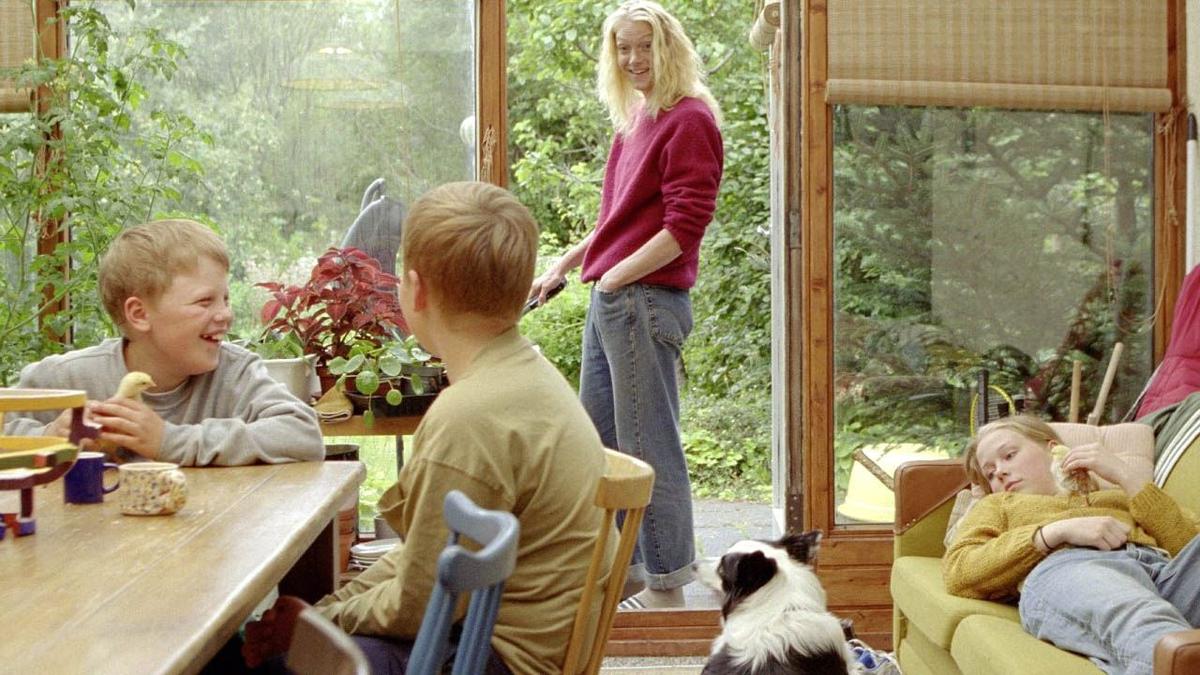
A still from ‘The Love That Remains’
| Photo Credit:
Janus Films
The narrative advances through vignettes that accumulate into a portrait of life after separation, where grief exists alongside routine and affection continues to surface in inconvenient places. Magnús discovers that his authority inside the household has evaporated as the children instinctively respond to Anna’s instructions while ignoring his attempts at discipline. Anna navigates the humiliation of hosting an obnoxious Swedish gallerist who spends an entire afternoon talking about wine while barely acknowledging her work. The children debate whether their parents still have sex while watching chickens in the coop and drawing conclusions about adult life that feel both innocent and strangely perceptive. Pálmason observes these interactions with a calm understanding of how families metabolise disappointment without dramatic confrontations, and the film gradually reveals how isolation can create emotional vacuums where frustration curdles into stray flashes of violence or fantasy. Yet tenderness persists in quieter gestures, like in shared hikes along mossy hillsides, and in evenings spent watching nature documentaries on the couch, or simply in the stubborn fact that Magnús continues to show up even when he no longer belongs.
The editing by Julius Krebs Damsbo gives the film a pulse that mirrors the unpredictable rhythms of domestic life. One particularly striking sequence assembles a montage of images set against an ominous verse that carries a particularly jarring violence, and the passage gathers fleeting stills that feel like emotional residue from the family’s year together. The editing allows the uncanny valley imagery to echo each other in ways that suggest the tension simmering beneath otherwise ordinary days.

What gives the film its strange dreamlike aura involves Pálmason’s willingness to let a few Lynchian provocations slip into the narrative without explanation. A plane that carries the insufferable gallerist away from Iceland crashes in Anna’s imagination after a particularly frustrating afternoon. The children’s armored knight sputters to life and moves in the darkness like a visitor from some medieval nightmare. But best of all, Magnús dreams of a giant rooster seeking revenge after he kills the real bird that once terrorised the chickens. These moments carry the logic of folklore and subconscious guilt, but they feel entirely natural within the film’s emotional landscape because Pálmason treats them as extensions of his characters’ inner lives rather than puzzles demanding interpretation.
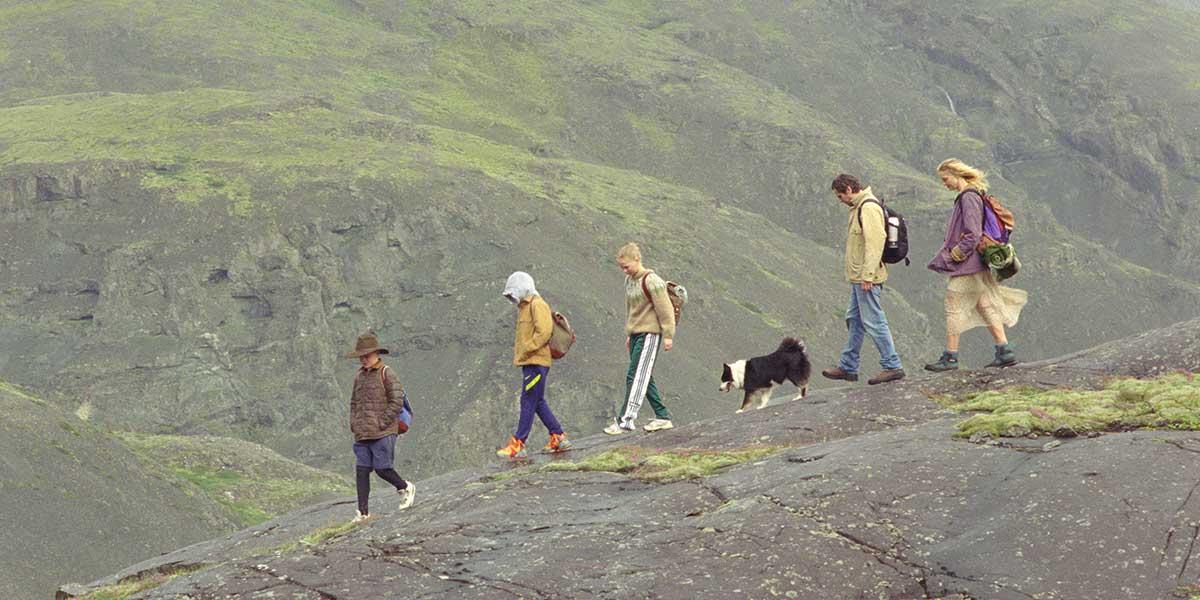
A still from ‘The Love That Remains’
| Photo Credit:
Janus Films
The film’s clearest articulation of what separation actually does to a family arrives late, during a chaotic crisis sparked by the children’s archery games. Pálmason stages the moment with a macabre comic energy that briefly tips the film toward outright farce before settling into something far more revealing. Anna and the children respond with a frantic competence that feels entirely believable for a household accustomed to improvising solutions without waiting for a missing parent to intervene. Panic, irritation, gallows humor, and logistical focus flow together in the same breath as they deal with the consequences. There is a strange buoyancy to the scene because Anna’s life with the children has already reorganised itself into a functioning ecosystem. Magnús, meanwhile, occupies an increasingly spectral orbit around that world. The ocean offers him purpose while simultaneously emphasising his isolation, and the film’s final movement leans fully into that metaphor with the crushing image of Magnús adrift on his back in the water, waiting for a boat that may or may not arrive, emotionally tethered to a family that has already learned how to function without him. Pálmason frames it without bitterness or accusation.

Icelandic cinema often places fragile human intimacy against landscapes that feel ancient and indifferent, and Pálmason pushes that contrast further by suggesting that living amid overwhelming beauty may sharpen the emotional weather of the people who call it home. The Love That Remains approaches family breakdown with patience, curiosity, and an endearing belief that affection survives even after collapse. In a more attentive awards season, this intimate epic of separation might have carried Iceland’s banner to the Oscars with complete dignity.
The Love That Remains premieres at the Red Lorry Film Festival that will be held from 13 to 15 March 2026 in Mumbai
Published – March 09, 2026 01:12 pm IST


