




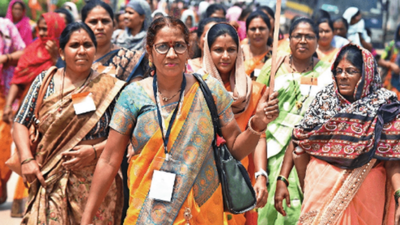
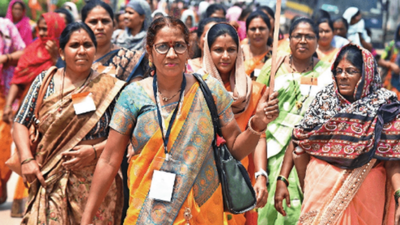
Lata Khade, an angan‑wadi worker who once helped enroll hundreds of women under the Mukhyamantri Majhi Ladki Bahin Yojana, is now finding the very scheme she championed slipping out of her grasp.Despite having all her documents in order, technical glitches and e-KYC hurdles have left her without the last three months’ payouts.“As I try for e-KYC, technical glitches and non-uploading of documents keep me at bay,” she said.Like her, thousands of women across the state are scrambling to meet the March 31 deadline to ensure that they are not dropped from the scheme.Her story is mirrored by Tai Waghmode, a divorcee, who has struggled to become a beneficiary.“I am struggling to make both ends meet. The scheme has made no impact on my life,” she said.The scheme had close to 2.47 crore beneficiaries initially. But after the Mahayuti govt returned to power, mandatory e-KYC checks led to a significant drop. Early 2025-26 figures show only 1.8 crore beneficiaries remain, with 86 lakh removed for failing to meet eligibility criteria, including state residency, age, and an annual family income below ₹2.5 lakh.“The e-KYC verification will go on till March 31, and after that the final number of beneficiaries will come to fore. Once that is done and if there is a need for increasing or even reducing the scheme funds, it can be done through the supplementary demands that are presented thrice in the year during the three sessions,” a govt source said.Despite the dip in beneficiaries, the scheme continues to receive the highest allocation among all WCD programmes, with ₹29,570 crore earmarked for 2025-26, slightly lower than the previous year’s ₹32,470 crore, as highlighted in the State Economic Survey presented in the current state legislative session.CM and finance minister Devendra Fadnavis in the state budget presented on Friday, confirmed that the scheme “will continue,” but declined to comment on raising the stipend or the duration of funding, a key question for all beneficiaries.For Ashwini Bandewar, 33, a single mother of two, the scheme has been a lifeline. She juggles work as a waste picker and in hospitality just to make ends meet.“Most of what I earn goes toward school fees and everyday expenses. I never had any savings. So when I started getting ₹1,500 per month into my account, I decided to use it for a big emergency or if I need it for my children’s educational needs,” she said.Many women have, however, been left behind. Sugar cane cutter Savitra Ankushe, 52, was cheated by an e-Seva Kendra employee and has yet to receive her stipend.Savita Gaikwad, 45, from Patil Estate slums, hasn’t received her payment since last Oct because she is illiterate and does not own a phone.“I wish it were an office where I could have submitted my documents,” she said.Officials admit that technical issues and poorly worded e-KYC questions have led to confusion. A question phrased as a double negative — “No one in your family works for the govt, right?” — led many women to fill forms incorrectly. Now, they say that they have three weeks to rectify it.The delay in funds and no fixed time frame for disbursement also confuses many, Pushpalata, another beneficiary, said.Welfare scheme with many twists➤ Introduced in July 2024, the Ladki Bahin scheme provides a monthly stipend of ₹1,500 to underprivileged women aged 21–65, with an annual family income of less than ₹2.5 lakh➤ Those with four-wheeler vehicles, govt jobs, or income-tax obligations are excluded➤ The scheme has been among the largest unconditional cash transfer programmes in the country, giving women money directly without conditions on how it is spent➤ Its promise created high expectations, particularly among economically weaker sections, who hoped the extra support would help manage household expenses➤ But as leadership and funding interpretations shifted after the elections, delays and exclusions became increasingly common, leaving out eligible women