




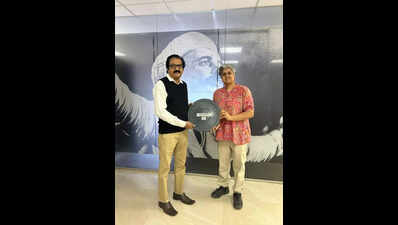
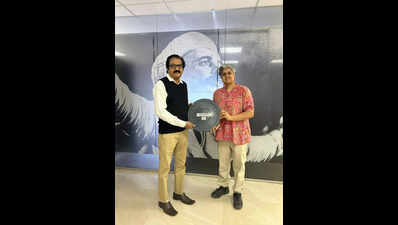
Pune: A rare copy of the 1954 Tamil film “Ratha Kanneer” was formally added to the National Film Archive of India (NfAI), reinforcing the urgency of preserving cinema history that risks disappearing into private collections and low-quality digital circulation. The copy was donated by Aparna Subramanyam, film research officer at FTII, who handed over eight jumbo reels in 35mm format from her personal collection.Calling the acquisition significant, National Film Development Corporation’s managing director Prakash Magdum said archiving is a continuous and long-term process. “We are always on the lookout for rare films to be deposited at the archive. In India, it is not mandatory for films to be deposited, so outreach becomes essential. We have to keep appealing to production houses and individual collectors,” he said.
Magdum noted that many collectors preserve films purely out of passion. “But we saw this happen many times. After they are gone, nobody knows what happens to the material. Our effort is to convince them to deposit it here, where it can be preserved and made useful for researchers and film lovers.”Magdum described “Ratha Kanneer” as a particularly important find. “It is a rare film from the 1950s. You can imagine its impact even today. Clips from the film still circulate widely online. MR Radha plays a foreign-returned man who is indifferent to Indian values before a sharp realisation sets in. It is satirical, the dialogues are catchy, and the themes are bold for its time,” he said.He added that Subramanyam’s role was crucial in locating the print. “She is an archivist. Because of her passion, she encouraged film lovers and distributors from south India to come forward with the material. Sometimes, when such a rare film surfaces, it gives us the opportunity to renew our appeal to the public,” said Magdum.The film will now undergo a detailed technical assessment. “We first check the condition and quality of the analogue material. After that, we clean it and carry out all necessary preservation steps,” Magdum said. NFAI will also explore digital restoration. “Our aim is to improve picture and sound while staying as close as possible to the original and retaining the film’s distinct identity,” said Magdum.The restoration timeline will depend on the condition of the reels. “If the quality is good, it can take two to three months. Otherwise, four to five months,” he said, and added that once restored, the film can be made accessible for screenings, research, and exploration, including subtitling for wider audiences. “This is how films remain alive.”