



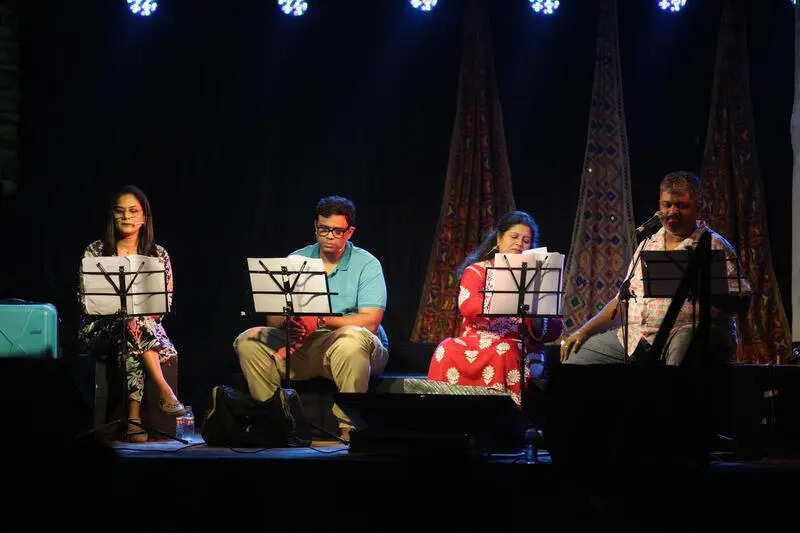
Pune: The audience will feel they are onboard the iconic train Deccan Queen and not seated before a stage as the interactive poetry and music experience, ‘Sahib, Sindh, Sultan,’ unfolds at the Kalachhaya Cultural Centre on SB Road on April 11.The Theatre India Company in collaboration with We The Artists attempts to do something deceptively simple, like urging the audience to look again at something they see all the time, but rarely pause to understand.The production is directed by Vaidehi Sancheti and leans into what she calls an “infotainment programme,” blending storytelling, performance and sensory design to recreate the experience of train travel.The performance unfolds like a journey. A narrator steps in and invites the audience into a coupe, introducing them to a set of co-passengers. What begins as casual conversation, soon becomes immersive theatre. “We treat the audience as if they are part of the journey. You are not just watching. You are travelling with us, singing along, listening to these people and becoming a part of their conversations.”At the heart of the show are four distinct personalities, each responding differently to the journey. “One plays the enthusiastic rail expert, another the curious listener, a third remains indifferent and the fourth drifts between perspectives. Fragments of railway history, trivia and personal memory emerge organically through their exchanges. We also reveal the idea behind the show title in the end,” said Sancheti.The Deccan Queen is a daily blur of red and silver cutting through the Western Ghats, carrying office-goers, weekend travellers and the occasional daydreamer between Pune and Mumbai. In the show, train number 12124 becomes both the set and character. “We chose to set the show on the very familiar Pune to Mumbai route deliberately. It allows us to tap into nostalgia. The sounds, the smells and the landscape. Most of our Pune and Mumbai audiences have experienced it all,” said Sancheti.The production also traces the origins of railway travel in India, going back to 1853, when the first passenger train ran between Bori Bunder (now Chhatrapati Shivaji Maharaj Terminus in Mumbai) and Thane. The history is woven into the narrative alongside poetry and music.Sancheti’s own relationship with trains inspires the show. “I am a major train fan. It was the most affordable way for our family to travel when I was growing up. There is something romantic about train journeys, meeting strangers and sharing food. I remember elders saying you never had to worry about meals if there was a Gujarati family in your compartment, because they would feed you delicious home-cooked food. Even the slightly scary parts, like lights being switched off while passing through routes once known for dacoity, added to the thrill. Everything felt like an adventure,” she said.The sound and light design help present the show in a dramatic reading format, as it aims to recreate a train adventure within the confines of a theatre.