





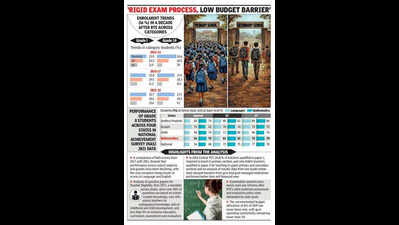
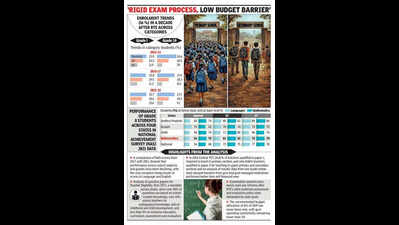
Mumbai: A decade and a half after the Right to Education (RTE) Act was implemented, the world’s largest schooling system is facing a learning crisis that threatens to undermine the massive gains in student enrolment. While the country successfully brought nearly 260 million children into classrooms, a recent paper from the Tata Institute of Social Sciences (TISS), published in Education Policy Analysis Archives, points to a significant performance gap, with over 70% of students performing at basic or below-basic levels. The paper also notes that although enrolment in primary classes has improved, the system struggles to retain students as they grow older. Enrolment drops by around 17% by the time students reach Grade 9, when the legal mandate for free education under RTE Act expires, mentions the paper.The analysis, undertaken by professors Mythili Ramchand, who worked at TISS till 2024, looks at ‘the conceptions of equity and quality that have shaped varied policies and state reform efforts in curriculum, teacher education, RTE and also the latest National Education Policy (NEP) 2020′. The researchers examined school enrolment, sample-based national assessment surveys and central teacher eligibility tests (TET) to interpret the RTE. “Unlike earlier policy discussions on quality, the RTE Act uniquely articulates quality as a legally enforceable right for all children aged 6 to 14 years… What prompted our study was the observation that while the Act offered a robust framework with equity and inclusion at its core, subsequent interpretations, state-level formulations, and amendments appeared to have ‘hollowed out’ these conceptions of quality,” Chandran told TOI.Analysing the enrolment data, researchers noted that 73.65% of the population drops out before completing senior secondary school, as per the National Sample Survey Organisation. The risk is even higher for students from marginalized sections, where as many as 80% drop out before finishing Grade 12, at a point when education is most crucial for breaking the cycle of poverty.In the classroom, the data presents a stark picture of declining learning outcomes. As per the National Assessment Survey 2021, the proportion of students failing to meet proficiency levels rises in subjects sharply as they progress from Grade 3 to Grade 10. By the time they reach Grade 10, nearly 90% of students fall into the lowest performance categories in science and language. While the 2021 data also reflects the impact of school closures during the Covid-19 pandemic, the disruption disproportionately affected students from marginalised sections in the higher grades, further widening existing learning gaps.Even as the RTE ACT envisioned teachers as ‘transformative agents’, the reality has been a decline of professional credibility through ad-hoc appointments and narrow, managerial accountability measures. Additionally, the paper highlights how the central TET assesses teachers on school content knowledge with little emphasis on pedagogical knowledge and overall child’s development (see box).TISS researchers highlighted the ‘four important barriers’ that have contributed to the massive gaps in quality and equity in education — a narrow and instrumental definition of quality in the course of RTE implementation, a rigid examination system with no reforms, a weak teacher education system primarily operated by private players and a lack of desired budgetary allocation (less than 3% of the GDP, as opposed to 6% recommended in the RTE).Based on their experiences, Chandran suggested that policy makers take several measures, including a significant increase in investment by states, allowing more autonomy to schools and teacher education institutions to adopt quality measures suited to their contexts, moving away from content testing to robust pedagogical knowledge in teacher preparation. “Also, structural inequities through affirmative action should be addressed. The 25% reservation for economically weaker sections in private schools, while well-intentioned, has been critiqued as weakening govt school provisioning. The focus, therefore, must return to strengthening public schools as neighbourhood schools of equitable quality,” said Chandran.