



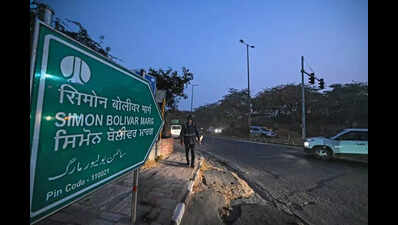

New Delhi: As the US strikes on Venezuela thrust the South American nation into the global spotlight, Delhi carries on with a quiet reminder of an older, deeper connection. Tucked into the diplomatic avenues of Chanakyapuri is Simon Bolivar Marg, a road named decades ago after Venezuela’s “iconic liberator”.Lined with dense trees, the stretch blends seamlessly into Delhi’s everyday chaos. In moments of global crisis, the green signboard on this leafy stretch turns into a reminder of shared histories, ideologies and India’s long-standing engagement with anti-colonial struggles far beyond its borders.Simon Bolivar Marg runs from Kautilya Marg to Sardar Patel Marg, passing through the heart of New Delhi’s diplomatic enclave. Surrounded by embassies and official residences, it forms part of the arterial network linking central and south Delhi. Like many roads in Chanakyapuri, its name is not incidental. According to historians, Delhi’s post-Independence planners consciously etched global history into the city’s map, honouring leaders who symbolised freedom from colonial rule.Simon Bolivar (1783–1830) remains one of the most influential political figures in South American history. Known as “El Libertador”, he led independence movements that freed Colombia, Ecuador, Peru and Venezuela from Spanish rule, and played a key role in the creation of Bolivia and Panama. Beyond military victories, Bolivar called for the abolition of slavery, land distribution to indigenous communities and even envisioned a Latin American Union, ideas that resonated with newly decolonised nations elsewhere in the world.“These roads are from the post-Independence era, when India was trying to establish friendly diplomatic relations, particularly with the Global South. As a newly independent country, India sought to build ties with nations that also ‘threw off the colonial yoke’, whether in Africa or Latin America. Anti-colonial leaders and movements were consciously acknowledged and honoured during this period, which is why figures like Bolivar found a place on Delhi’s streets,” explained historian Swapna Liddle.According to Minni Sawhney, professor at Delhi University’s Department of Germanic and Romance Studies, many such road names emerged during the era shaped by the Non-Aligned Movement and broader anti-imperialist thinking.“When India played a leading role in the movement, particularly during Indira Gandhi’s tenure, there was a conscious effort to build ties with countries of the Global South. That context explains why names such as Simon Bolívar, Benito Juarez and Jose de San Martin appear on Delhi’s map. India has historically maintained a warm relationship with Latin America. As a socialist, secular republic, India shared ideological affinities with several countries in the region,” she said.That symbolic connection was reinforced through direct diplomatic engagement. Venezuela’s late President Hugo Chavez paid a state visit to Delhi, including the JNU campus, in March 2005, holding bilateral discussions with then Prime Minister Manmohan Singh and President A P J Abdul Kalam. Years later, in Aug 2012, Nicolas Maduro, then Venezuela’s foreign minister, visited New Delhi for the India-CELAC Troika foreign ministers’ meeting, signalling continued engagement between India and Latin America.Today, Venezuela reels from a dramatic escalation, with US military strikes on Caracas and northern regions, the capture of President Maduro and his subsequent court appearance in the US. Venezuelan authorities condemned the action as imperialist, declared a state of emergency and issued decrees against collaborators.Far from the sound of jets and strikes, Delhi’s boulevard stands unchanged, showing how global histories continue to intersect on the city’s streets.