






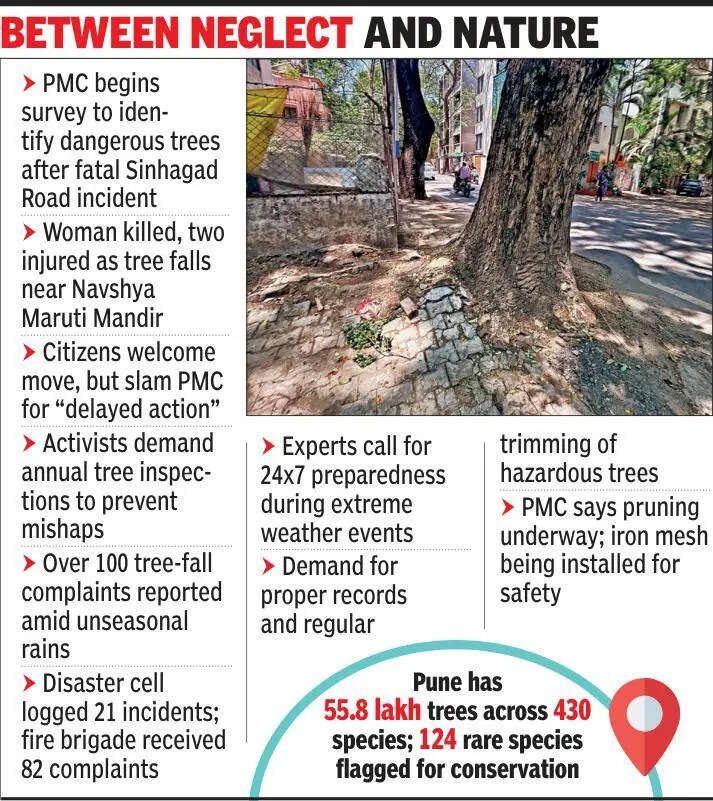
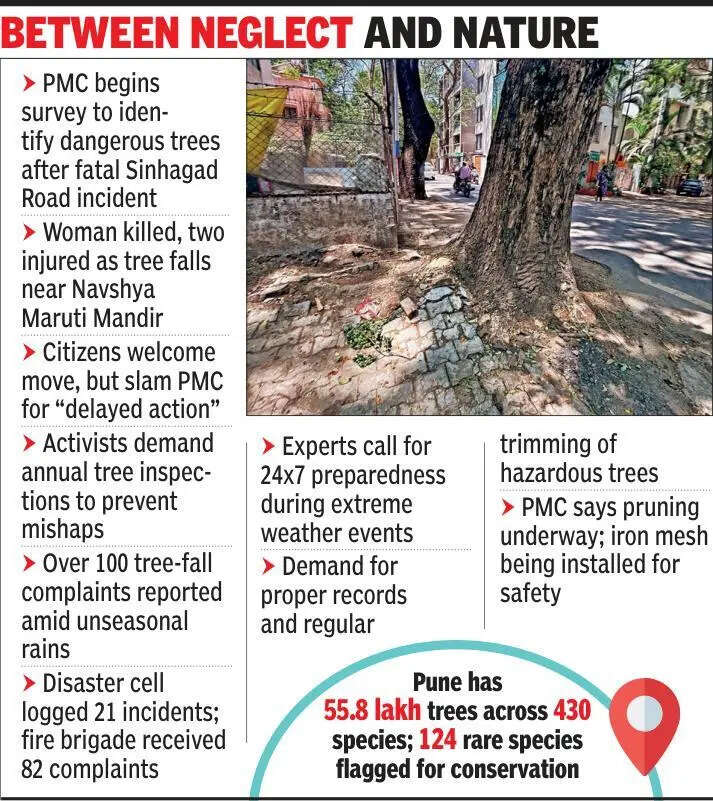
Pune: The civic body has started a survey to identify dangerous trees two days after a woman died when one fell on her on Sinhagad Road.Activists and citizens have welcomed the initiative, but criticised the Pune Municipal Corporation (PMC) for “waking up late.” They said the survey should have happened earlier and such inspections should be an annual exercise to help reduce accidents caused by trees uprooting.A resident of Ganeshmala off Sinhagad Road, Ranjana Navnath Giri, died after a tree fell on her around 3.30 pm on Friday near Navshya Maruti Mandir. Two others sustained minor injuries.The authorities received over 100 complaints of trees uprooting on Thursday. The PMC disaster management cell reported 21 incidents, while the fire brigade recorded 82 complaints from different areas.“Unseasonal rains can lead to uprooting of trees in large numbers. The administration should be prepared for it 24×7. It is tragic to see people losing their lives because of the civic administration’s ignorance,” said Mitali Mahajan, a resident of Sinhagad Road.Environment enthusiast Manasi Kulkarni said, “The civic administration organises tree censuses frequently. It should make sure that the records of dangerous trees are maintained and a regular follow-up is taken. Such trees should be trimmed when necessary.”Deputy commissioner of the civic disaster management department Madhav Jagtap said, “PMC is trimming tree branches that could be dangerous. Iron mesh is being put up around roadside trees. Steps are being taken to ensure mishaps due to trees uprooting are averted.”Last month, the civic body decided to halt the latest tree census following strong objections over rising costs. The decision was finalised during a standing committee meeting after elected members raised concerns regarding tender estimates.According to the PMC’s environment status report, the census is a critical tool to maintain the city’s biodiversity and green cover. It covers diverse terrains, including the hills of Taljai, Pachgaon-Parvati, Katraj, Vetal, Chaturshringi and Baner.The earlier census data said the city is home to 55,81,578 trees, spanning 430 different species across 75 botanical families. While the most common species is the giripushpa (Gliricidia sepium), the census also identified 124 rare species requiring conservation.