



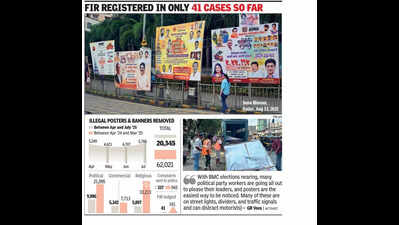
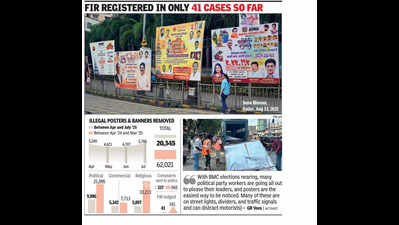
Mumbai: Over the four months from April and July 2025, the BMC’s licence department pulled down 20,345 illegal posters and banners across Mumbai — nearly half of them, or 48%, were political. Civic data shows 9,906 political hoardings, 5,342 commercial, and 5,097 religious were removed during this period, while FIRs were filed in 41 cases. However, civic activists feel this likely understates the scale of the problem, as many go undetected or are taken down by organisers before inspectors arrive. Similarly, in the period between April 2024 and March 2025, the BMC had pulled down 62,021 illegal posters and banners. This was also the period during which the city saw two crucial polls — the Lok Sabha in May 2024 and Vidhan Sabha in Nov 2024. Of these, 21,095 or 34% were political.BMC officials said their teams are on the ground to pull down illegal posters and banners. “Based on the action, we also then intimate the local police station to take action where required,” said a civic official, adding that during the festival season, they do see a spike in the number of illegal posters and banners. “Last year, owing to the code of conduct for the two elections, the number of illegal posters and banners was lesser for some months, but it again went up gradually,” said the official. Civic data shows that in the month of April last year, the least number of illegal posters and banners were pulled down, i.e. 653, of which 63 were political banners, 8 political boards, and 11 political posters. In Nov 2024, again, 1,578 illegal posters and banners were pulled down. In comparison, in other months, like Dec, 5,895 illegal posters and banners were removed by BMC, with the maximum in Sep 2024 of 22,065.If the data between the months of April and July is examined, the maximum illegal posters and banners were pulled down in July, totalling 5,768, while in June, it was 4,707.Activists and residents say the defacement has worsened since the splits in political parties such as the Shiv Sena and the Nationalist Congress Party (NCP), with rival factions battling for visibility. “With BMC elections nearing, many political party workers or karyakartas are going all out to please their leaders, and posters are the easiest way to be noticed. Many of these are on street lights, dividers, and traffic signals and can even go on to distract motorists. Further, I am also concerned about how sturdy these banners or posters are when put up on junctions or street lights and can have the potential to even injure a passerby or motorist in case it comes crashing,” said civic activist GR Vora from Sion.Others, like Surendra Jondhale, a political analyst, say that the festive season—beginning with Janmashtami and followed by Ganpati and Navratri — offers parties a prime chance to plaster their faces across the city amid large crowds and high public movement. “The fragmentation of political parties means each is keen to assert its identity. And what better time than the festive season to position themselves as the local face of a neighbourhood?” he said. Some argue that this kind of political positioning, done at no cost to the politicians, ultimately drains taxpayer money. “The manpower and machinery used to remove illegal posters and banners come from public funds, while netas enjoy free publicity,” said Nikhil Desai, a King Circle activist.Right to Information (RTI) activist Anil Galgali said it is the duty of the BMC to act promptly against such political defacement. “The BMC can actually earn revenue from such political positioning if it allocates a dedicated spot in each of the civic wards for political posters and banners to be put up at a particular charge,” said Galgali.