



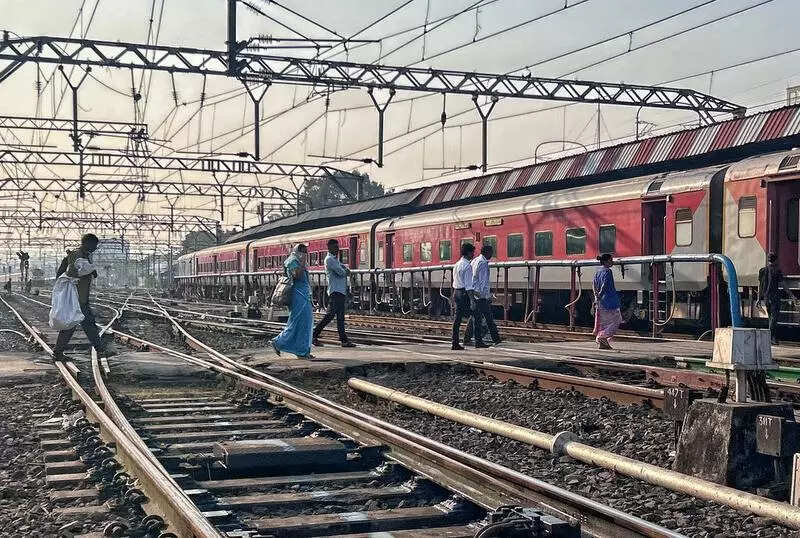
Pune: The local Railway Protection Force (RPF) contingent’s moves to address trespassing and fatalities on train tracks have been slammed by passengers and activists, saying authorities are not doing enough in terms of deterrence. As of Oct 2025, nearly 300 deaths have occurred in Pune division due to trespassing on the train tracks. Now, Pune RPF is shifting focus onto penal action over organising awareness campaigns, and plans to buy 96 ‘standalone’ CCTV cameras — at a costly Rs6,000 each — in the first phase for proper monitoring and action. However, this move has been criticised by railway activists, who said increasing staff strength for proper patrolling and ensuring strict penalties is the actual way forward. Some pointed out that when the plan to set up 170 high-end cameras at Pune railway station has not seen the light of day after many months, the new project may face a similar fate. Highlighting the need for patrolling, Nikhil Kachi, former member of Divisional Railway Users’ Consultative Committee (DRUCC), said, “Strict enforcement is extremely essential to control the number of incidents. This can only happen through continuous patrolling and immediate action without any warnings. The stricter they are towards taking action, the more deterrence it will create. The CCTV plan is good but needs to be implemented on a fast track. However, a question arises: how will the people caught on camera be identified and penalised? Ultimately, RPF has to move and hence, foot patrolling is a must.” Anand Saptarshi, a member of the Zonal Railway Users’ Consultative Committee (ZRUCC), agreed and said, “Railways must increase staff strength of RPF in Central Railway and Pune division. They can then hopefully depute more teams towards patrolling problematic areas. Regarding CCTV cameras, timely installation is very important. In many cases, implementation is very delayed, which should be avoided. We will raise the issue of track trespassing and deaths in a future meeting with senior officials.” Priyanka Sharma, divisional security commissioner (DSC) of Pune RPF, said, “We have been regularly holding awareness campaigns in different areas against track trespassing, trying to make people aware of the dangers. However, it seems that these are not working. So, we are going to focus more on penalising people. The campaigns will not stop, but the priority will shift.” Adding that the new standalone cameras would help, Sharma said, “Many black spots are prone to track trespassing, and these cameras will help cover them. They cost Rs6,000 per piece and are solar-powered, with a video back-up facility for 24 hours. The idea is to collect data for each day and study it, looking for offenders, identifying them, and taking legal action. In the future, we will have more such cameras to cover all spots. At present, we have seen that things normalize after an awareness campaign, but once RPF’s concentration shifts to a different stretch, trespassing starts again.” Crossing a railway track wrongly is a punishable offence under section 147 of the Indian Railways Act and can result in a fine of up to Rs1,000 or six months’ imprisonment or both. In March last year, senior rail officials said a plan was afoot to build fences stretching 290km on the Lonavla-Daund section to prevent trespassing. The project, costing Rs234.64 crore, also included construction of 16 subways at identified points prone to trespassing. When asked by TOI about an update on this project, Pune division PRO and divisional commercial manager Hemant Kumar Behera did not comment till the time of going to print. Shivajinagar resident Mangesh Joshi, a regular train commuter between Pune and Mumbai, said, “What is the status of the fencing plan? How much of the area has been fenced and how many subways have been constructed? Many rail projects get delayed and hence, problems persist. The use of drones and AI to detect and identify people is a good idea. I have seen the RPF raising awareness about it at Pune station. However, with the same not working, AI-enabled facial recognition cameras should come up at all the sensitive points so that identifying the offenders gets easier. RPF can also coordinate with local police or Govt Railway Police (GRP) on this.” Vikas Deshpande, a railway activist and president of Daund-Pune Pravasi Manch, said the idea of ownership is missing among officials. “They just wanted to finish their tenure and move on, so the problem recurs. Continuous and planned patrolling along identified stretches can bring incidents down. Cameras are an option, but they should complete the previous project before starting another one,” he said.