





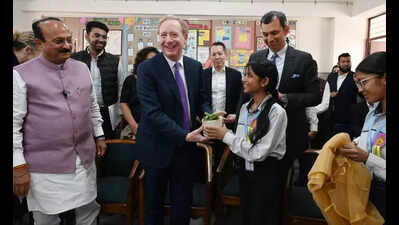
New Delhi: Inside a classroom at a CM Shri school in Delhi, learning is no longer with chalk and blackboard. As students settle into their seats, a lesson unfolds through colourful infographics projected on a smart panel, real-time feedback appears alongside explanations, and personalised prompts guide each learner differently. At the centre of this transformation is Microsoft Copilot, which educators now call a “thinking partner”.
On Friday, teachers at a CM Shri School, Pandara Road demonstrated how artificial intelligence is quietly reshaping everyday classroom practices. The initiative is part of Microsoft’s newly launched ‘Elevate for Educators’ programme in India, under which the company aims to train 2 million teachers and reach 200,000 schools by 2030. The AI-powered system is set to be implemented across all 75 CM Shri schools in the capital. India is the first country in Asia to roll out the programme, reflecting the scale of opportunity in what is often described as the world’s largest classroom, home to over 200 million students and nearly 10 million educators.So far, 356 teachers across CM Shri Schools have been trained. The programme emphasises enquiry-based learning, personalised instruction, and responsible AI use, aligning with the National Education Policy 2020, which introduces AI and computational thinking at grade 3.Delhi education minister Ashish Sood said the goal is to ensure that govt school classrooms become “smart”. “Earlier, students in govt schools were called underprivileged. We want to change that reality,” he said, adding that Delhi aims to become a hub for technology-enabled education that can be replicated across India. Speaking on this announcement, Brad Smith, vice-chair and president at Microsoft, said: “As AI becomes part of everyday learning, we want to ensure it strengthens education, preserves human judgement, and earns the trust of educators and learners. By taking AI at this scale across India, we want it to open new opportunities and deliver meaningful outcomes for teachers and students”. Puneet Chandok, president of Microsoft India and South Asia, said: “As intelligence becomes widely available, the real differentiator will be how confidently and responsibly people can use it.“For many educators, the biggest change lies in preparation and clarity. Sadaf Fatima, a teacher at the CM Shri School in Rohini’s Sector 11, described how lesson planning evolved. While preparing a Class XI biology lesson, she used Microsoft Copilot to create posters, infographics and structured presentations that clearly defined learning goals. Complex topics that once required lengthy explanations are now broken into smaller, understandable tasks. The technology is also opening doors to inclusion. Madhubala, a teacher from CM Shri School in Dwarka’s Sector 22, shared how AI helped her support an autistic student. Using Copilot, she created customised motivational stickers and feedback tools designed to make the child feel more comfortable. Language learning, too, is seeing a shift. Preeti Sharma, another educator from Rohini, said the tool helps simplify abstract concepts in English lessons and encourages higher-order thinking skills such as inference and prediction.Students are not just consuming technology; they are creating with it. Shubhi Yadav, a student, described building a project called “Parakh AI”. “By placing a fruit like an orange or mango in front of a camera, the system identifies it and provides detailed information,” she said. For another group of students, including Suhana and Aditi, AI became their backstage mentor. With no prior experience in theatre, they used Copilot to script a play, learning about costume design, lighting, mood, and tone along the way.