





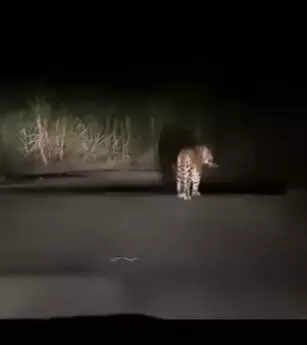
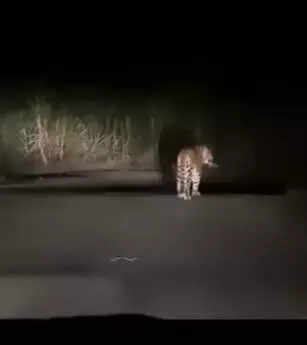
Pune: A new and alarming trend has emerged in several villages of Junnar tehsil, where groups of locals are venturing out after dark in four-wheelers to watch leopards in the wild. The practice — locally dubbed “night leopard safari” — has surged in popularity in the last few months, raising serious concerns among forest authorities and wildlife experts. Villagers said the nocturnal excursions begin after dinner, when youths gather and drive towards sugarcane fields and forest fringes known for frequent leopard movement. Many villagers halt their vehicles near fields, shine headlights into the darkness, and sometimes even chase the animals when they spot eye-shine or movement. Reels captured during these escapades, showing leopards startled or cornered by vehicles, are widely circulated on social media, further fuelling curiosity and imitation. Forest officials said the trend is dangerously disruptive, both for the animals and people. “This is a disturbing development. Such close-range encounters can easily provoke animals, making them aggressive and more likely to attack,” Smita Rajhans, assistant conservator of forest of Junnar division, said. “This is the first time we are seeing a trend of this sort in the state. It is not only illegal but puts everyone at risk,” she added. This trend is mainly observed in Junnar tehsil, where sightings are regular in villages like Otur, Pimpari Pendhar, and near Aalephata. Junnar, known for one of the highest densities of leopards in Maharashtra, has witnessed many human-wildlife interactions in recent years. Sugarcane fields provide ideal cover for big cats, leading to frequent accidental encounters. Most videos are also shot at night near sugarcane fields, chasing a leopard in a car. Forest officers emphasised that vehicles chasing or blocking leopards can heighten stress levels in the animals, altering natural behaviour patterns and potentially increasing conflict with humans. It can disturb the local ecosystem and lead the troubled animals to attack motorcyclists elsewhere. Videos are shot just to gain likes or attention online, they said. “It will disturb the animal severely if it happens frequently. In the past, a few videos circulated on social media platforms. Following this, we warned and reprimanded those violators. However, this time, many videos have come to the fore. It is a new challenge for us,” said Rajhans, who has decided to act against them. However, a section of forest officials said they are “not in a position” to act strongly against such offenders. “The conflict has escalated and there have been many fatalities in the region. Sightings have increased in the last few months. We can’t take strong action. We have to work in tandem with locals to mitigate conflict. So, we are going ‘slow’ on them,” said a senior official of the forest division. Locals said the ‘night safari’ trend began out of curiosity. “We often hear leopards near our farms at night. So, some youngsters started driving around to get a glimpse of them. Now it has become a kind of adventure activity,” said a resident of a village near Junnar. Some villagers are aware that such activities violate the Wildlife Protection Act, which prohibits disturbance, harassment, or pursuit of wild animals. “People should ideally not get into this kind of insane activity. If something goes wrong, who would be responsible for it? We have to work with the forest officials to address this issue,” said Narendra Dhome, sarpanch of Pimparkhed village, where three fatal attacks took place in the last month. Forest teams have now begun patrolling sensitive areas and are considering issuing strict warnings and initiating legal action where necessary. Awareness campaigns are also being planned to discourage villagers from engaging in such night safaris. “We can’t simply allow them to indulge in such practices. It’s highly disturbing for us and the animal. We will check each video and act against the violators appropriately. If needed, we will reach out to the local leaders to take help to stop this activity,” said Pradip Chavan, range forest officer, Junnar. Experts warn that the growing overlap between human settlements and leopard habitats requires responsible coexistence, not thrill-seeking behaviour. “Leopards are shy animals, but if repeatedly disturbed or chased, they may retaliate or shift closer to human habitation in unpredictable ways,” said a wildlife biologist familiar with the region, adding, “This trend must be curbed immediately.” With recent leopard attacks already unsettling villagers in Junnar, authorities fear that the rise of these informal night safaris could worsen the situation. As the phenomenon spreads across villages, forest officials are urging residents to prioritise safety, respect wildlife laws, and avoid activities that could escalate human-animal conflict.