





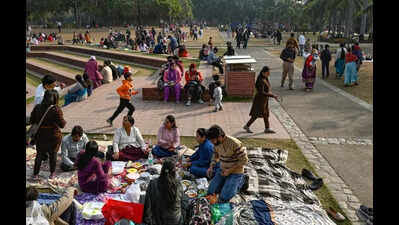
New Delhi: On Republic Day, Sunder Nursery resembled less of a tranquil green retreat and more of a tightly packed festive ground with around 15,000 tickets, priced at Rs 50 each, sold. Long, restless queues snaked across the forecourt of the 16th-century heritage park and pressed against every ticket counter. Families waited shoulder to shoulder, children tightly clutched their balloons and packets of snacks, and vendors weaved through the crowds selling bottled water. There was little respite from the throng even after one entered the nursery — its pathways packed, benches fully occupied and visitors spilling into every open patch of grass.Narrow strips of lawn between bushes, meant as visual buffers, were taken over by picnic mats and plastic sheets. Areas marked ‘no walking’ were full of people unpacking food and portable speakers. Warning signs near the water bodies were largely ignored, with families seen sitting dangerously close to the edge, posing for photographs. TOI talked to people across age groups who acknowledged both the strain on the park and the joy it offers. “Delhi is running out of green spaces,” said Mridula Rao (60), a physics teacher from south Delhi, who has been visiting Sunder Nursery for years. “I’ve watched this place change. Every year, the crowd keeps increasing. It’s wonderful that people love it, but it’s also becoming exhausting.”Young couples were seen arriving early in the day to take up vantage positions by the side of the lake before the crowds thickened. A little away, a large group — six families in all — had turned a quiet corner into a lively tambola session, complete with a microphone and speaker. Elsewhere, loud music echoed across the lawns, with one family playing patriotic songs while recording social media reels, and another blaring Bollywood tracks. Rinki Yadav (24), a nurse, travelled from northeast Delhi’s Karawal Nagar with her friend, Pankaj Singh Negi (26), a chef, to celebrate his birthday. In the lane leading up to the main tombs, they set up a small folding table and cut a cake amid curious glances. “We thought people would go elsewhere. But I guess, everyone thought the same and descended on this place,” Yadav said. Some long-time visitors to the park, home to 15 heritage monuments, linked this overcrowding to its transformation. “After restoration and conservation work, the biggest change is how accessible it has become,” said Satish Rao (70), a retired management professional. “Earlier, especially near the tombs, there used to be dense and wild bushes. People didn’t think it as a picnic spot. Restoration has made it accessible and beautiful.” Another elderly visitor said, “Parking restrictions and barricades near India Gate mean families don’t have many options left to spend outdoors in this part of the city. So, many land up here.” Some of the first-time visitors said they chose to spend Republic Day in the 90-acre heritage park after watching its online videos. Outside the park, an influencer was seen hosting a giveaway from the boot of his car in exchange for social media follows. Behind him, the stretch leading to the adjacent Humayun’s Tomb was choked, with cars barely inching forward and pedestrians spilling onto the road. Despite the chaos in and around Bagh-e-Azeem, as the park used to be called in the old days, one of the visitors had a different take. “In a way, crowding is good,” said Tanisha (28), a fashion designer. “Earlier, when there were fewer people, it looked deserted. Now families feel safer here.” As the day wore on, the crowd only grew thicker, the noise louder, and the lawns fuller — offering a changing snapshot of a city where open green spaces are cherished, but increasingly overwhelmed by the very love they are showered with.