






As R Gowtham’s debut feature rolls out, you wonder if you are in another Ee.Ma.Yau. (Lijo Jose Pelliserry) or Shavam (Don Palathara) ride. Here is yet another funeral film, but unlike anything one has seen before. Gowtham’s Tamil roller-coaster family-drama, Members of the Problematic Family (Sikkalana Kudumbathin Uruppinarhal), goes all Paul Thomas Anderson in Chennai’s Red Hills suburbs.
Gowtham’s film — developed at the NFDC Film Bazaar, produced by him and his friends at Library Narratives and another friend’s outfit Potato Eaters Collective — just premiered in the Forum segment of the 76th Berlin International Film Festival. It is the fourth Tamil film to screen in this segment, after Mani Ratnam’s Alaipayuthey (2001), Ameer’s Paruthiveeran (2008) and PS Vinothraj’s Kottukkaali (2024).
Members of the Problematic Family defies definitions, formal straitjacketing and even cinematic structure. Gowtham throws the plot out of the window. The cultural setting is familiar, but the filmmaker surprises you by sewing images and eking out a singularly riveting non-linear narrative. Raw, absurd, and with a wild energy bubbling over, the film will shock you in every aspect. It upends previously held notions of cinematic formalism. Here is a self-assured debut that unfolds backwards, from a funeral and into a character study of Prabha (A Ra Ajith Kumar) and through him, of others, each character wretched in their own way.

This is also a mother-son story, an upending of the Oedipal complex, of Shanthi and Prabha. One is as busy, running the household round-the-clock, as the wayward other whiles away his time and seeks her attention and lost love for him. Their outbursts and frustrations boomerang off each other. It perhaps draws from one phrase Nietzsche wrote in his Wahnbriefe (“madness letters”), before his death, after his mental collapse to his mother: “Mutter, ich bin dumm (Mom, I am a fool).” That fragile psychological state Prabha embodies, but he couldn’t say those words to his own mother. Prabha is an alcoholic, but his needs are not illogical.
.
Structurally, this film is like a novella. Divided into four incomplete chapters — with Wes Anderson-like titles — the film begins with Prabha’s funeral and ends with his final dream. Gowtham eschews the Aristotelian structure, avoids action and reaction, and instead shows fragments. Each character is incomplete and doubtful.
The fiction feature looks like a documentary, with electrifying acting by its ensemble cast, most of whom are non-actors, besides two: the uncle Sellam, here played by Karuththadaiyaan, who was the father in PS Vinothraj’s Koozhangal (Pebbles, 2021), and Ajith, who is from a theatre background. An opprobrious court jester, Prabha shows us the reality of our world hidden beneath masks of civility. More than alcoholism and portrayal of a dysfunctional family, the film is also about a man-child, misunderstood, emotionally and mentally trapped. Gowtham’s film scratches at a festering wound but from a healthy distance. Characters are liberated from both judgment and empathy.
‘Members of the Problematic Family’ (Tamil)
Director: R Gowtham
Cast: A Ra Ajith Kumar, Karuththadaiyaan, Kanchana Senthil, Uvesri
Runtime: 105 minutes
Storyline: A widowed mother, an impatient uncle, an ailing grandfather, a detached aunt, and a well-sorted cousin stumble through grief, guilt, memory, and yearning over the death of the alcoholic son, each confronting the pendulum of void and solace left by the unfinished life

Shot in a very cinéma-vérité style, the film is personal and lived in as it is poignantly observational. It lays out the micro- and macro-dynamics of Prabha’s place in his family and the family’s place (especially the mother and son’s) in this society. Through the tropes of alcoholism, family dysfunctionality, familial physical violence, trauma and mental distress, it delivers a masterpiece. Prabha’s close ones don’t shed a tear at the funeral. That performativity is eschewed. The 16-day-long funeral is a ritualistic affair that culminates in a feast. The extended family goes through the motions. Grief comes to them later — in brief moments of regret and even suppressed love. Tears roll down the mother’s cheeks when she looks at the decapitated head of a goat amid her laundry.
The jobless, wayward irritant but full of youthful goofiness, Prabha is a thorn in the side of everyone around. He can’t ride the scooter straight without nearly making his mother fall, and then bumping into a pole himself and blaming her for his misery. He will make his grandfather feel emasculated and suicidal by forcibly taking him to the salon to shave off his moustache. The mother is stuck between two insane men: her father and her son. He doesn’t like that his mother cares for his aunt’s little son more than her own grown-up one. His uncle, for whom he works, gives him a thrashing for not doing his job sincerely. He is a mess, but his dreams and desires are very basic — to be respected and loved, and to start his own family that loves him back — and these dreams die with him. But how does he die? That’s untold. It remains mysterious. The filmmaker reveals more by not telling, by digressing, by leaving one sequence to catch another seemingly unrelated one, but all the parts of this gestalt come together.
But what do the existence and loss of nobodies like Prabha mean to their community? Prabha is the filmmaker’s lens to zoom in on and heighten the ironies and hypocrisy of a society that creates the likes of him. Everyone knows a Prabha, maybe not an alcoholic but an ill-tempered being, often a misunderstood one. Members of this society, while drinking themselves, blame Prabha’s alcoholism for ruining the prospects of a could-have-been athlete; others point fingers at his mother’s upbringing.
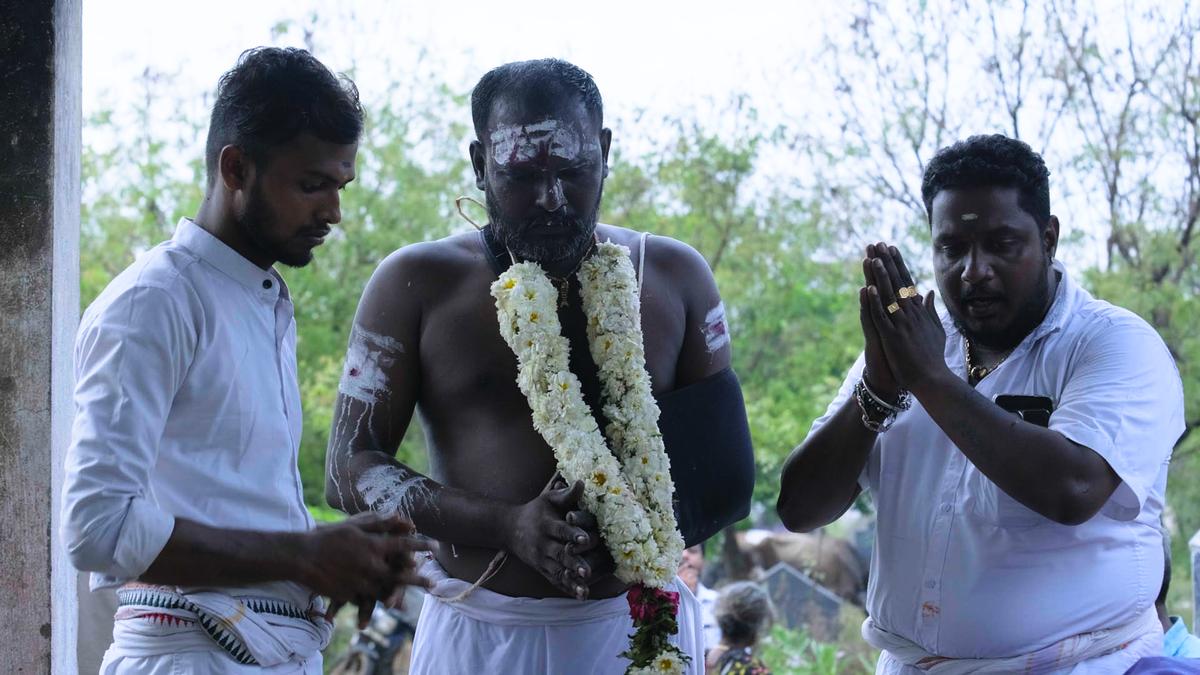
A still from ‘Members of the Problematic Family’
| Photo Credit:
Special Arrangement

Gowtham deftly films processions, whether a funeral or a religious one — the latter, as seen in his Vancouver-premiered documentary, On the Trails of Aandi: The Runaway God (2023), co-directed with Saravana Siddharth (who plays the cousin brother Mugil in MOPF). In big close-ups, he presents a pilgrim’s procession of Murugan devotees on Thaipoosam, an eve of Tamil ethnic importance with a 400-year-old heritage.
In MOPF, the camera stands and observes, from a fly on the wall to trailing a character, mid-length to close-ups, but always at eye level, neither looking up nor looking down at them. Shot in 1.66:1 aspect ratio, the lens is helmed by SRFTI graduate Siddharth Katir, who assisted cinematographer Jayanth Mathavan on Tamil indie Revelations (2016).
FTII dropout Ganesh Nandakumar has deftly handled the sound recording and edit and the film’s editing, which holds an unorthodox film like this one together, hiding and revealing just enough. A series of non-sequiturs make up this film.
The aural is also visual. The film borrows the music of the Dravidian stalwart Nagore E.M. Hanifa, a Tamil Muslim devotional singer, known for his political songs. That sound is a throwback to music of yore, of small towns and busy streets.
Despite its Marquezian ensemble of extended family and relatives — with a typical Tamil socio-linguistic specificity, where everyone is a brother, whether one’s own, a cousin or a neighbour — the world of Prabha isn’t a difficult one to follow. From every image to the intent behind it, the film remains authentic. It is that honesty that makes the localised universality of this indie gem connect with the European audiences in Berlin, many of whom admitted that this crazy ride of a film was one of the best they saw at the festival.
Members of the Problematic Family premiered at the Forum sidebar of the 76th Berlin International Film Festival
Published – February 20, 2026 07:28 pm IST