







Josh Safdie opens Marty Supreme with an admirably vulgar sort of confidence, suggesting ambition will now be treated as a decidedly corporeal function. He does so by staging the opening credits as conception itself, where a human egg is fertilised and immediately aestheticised into a spinning ping-pong ball set to shimmering ‘80s synths, as though destiny were something you could manufacture through sheer force of want. Timothee Chalamet’s impossibly vainglorious titular character spends the next two and a half hours behaving like a man convinced that the universe already endorsed him retroactively, which leaves everyone else stuck living inside the aftershocks of his self-esteem.

Set in 1952 but vibrating with a restlessness that belongs to no single decade, Marty Supreme marks Josh Safdie’s second solo feature since 2008’s The Pleasures of Being Robbed, and follows Marty Mauser, a Lower East Side shoe salesman whose prodigious table-tennis talent matters less than his belief that talent should entitle him to speed, access, and forgiveness. Safdie understands that this belief is comic and lethal, which allows the film to lampoon Marty while still tracking the damage he leaves behind.
Marty Supreme (English)
Director: Josh Safdie
Cast: Timothée Chalamet, Gwyneth Paltrow, Odessa A’zion, Kevin O’Leary, Tyler Okonma, Abel Ferrara and Fran Drescher
Runtime: 150 minutes
Storyline: Marty Mauser, a wily hustler with a dream no one respects, goes to hell and back in pursuit of greatness
Marty enters the movie already mid-hustle. He is sleeping with a married woman in the back of a family shoe store that he yearns to escape, and he speaks about his future with a cocksure certainty. Chalamet plays him as verbally overclocked, a half-beat ahead of everyone else in the room because he refuses to wait for permission to finish a thought. That confidence sows the seeds for what follows since every subsequent choice grows logically from Marty’s refusal to accept friction or setback as anything but a temporary inconvenience.
Safdie frames early-’50s New York as a pressure cooker in which money, sex, and ambition circulate through the same greasy ventilation system, so that the table-tennis club becomes a combined flop house, chapel, and delusion factory, endlessly incubating Marty’s male fantasy. Marty flourishes in this compressed environment because compression rewards loudness, yet the moment he leaves it — specifically during his London encounter with the monkishly unflappable Koto Endo — the limits of his velocity become impossible to ignore. His refusal to bunk with the other players, followed by his immediate relocation to the Ritz, plays as strategic self-importance, since Marty intuits that being seen matters at least as much as being good, and often pays better. The affair with Gwyneth Paltrow’s Kay Stone proceeds like a sweet-talk negotiation in which intimacy substitutes for capital, and Safdie lingers just long enough to show Marty mistaking adjacency to wealth for initiation into it. Losing the final to Endo deflates the coronation fantasy, although Safdie withholds real punishment until later.

A still from ‘Marty Supreme’
| Photo Credit:
A24
Daniel Lopatin’s exquisite score articulates ambition more clearly than dialogue ever could and rewires the film’s relationship to history. The choice to flood a 1950s story with ’80s synths and new wave anthems creates a productive dissonance, since the music motions towards futurity while the characters remain trapped inside outdated hierarchies. Lopatin’s cues behave like Marty’s nervous system, surging ahead of the body and dragging the narrative toward an imagined horizon that never quite arrives.
When Marty slingshots back to New York, the film shifts gears from propulsion to fallout, and pressure begins redistributing itself onto every person foolish enough to still stand nearby. Rachel’s (Odessa A’zion) pregnancy detonates the fantasy of endless postponement by demanding consequence in calendar form, while Marty’s preferred improvisations disguised as ingenuity mutate into a chain of increasingly deranged schemes involving a kidnapped dog, an increasingly irritated gangster, suburban bowling alleys, and the systematic liquidation of trust. Safdie resists escalation for its own sake, opting instead to let each disaster unfold as the logical response to the last one, which gives the chaos a queasy coherence even as the trajectory bends unmistakably toward collapse. Nothing here feels random — everything feels earned in the most damning way possible.

Chalamet makes this descent legible by refusing any semblance of interiority. Marty does not pause to think because thinking would slow him down, so the performance operates on appetite alone, calibrated to hunger rather than reflection. When humiliation becomes the cover charge for continued motion, Marty pays instantly and without receipt, treating dignity as a liquid asset meant to be spent, replenished, and spent again. What makes the performance sting is how casually he performs this exchange, as though converting self-respect into forward momentum were simply another cost of doing business in a world that keeps rewarding the loudest man in the room until the bill finally comes due.
The Safdie brothers have been flattened into a vibe by criticism that describes their films as simply “stressful” or “anxiety-inducing” rather than to ask what that stress is actually doing, and Marty Supreme makes the poverty of that shorthand impossible to ignore. The connective tissue running from Good Time through Uncut Gems and into this film has little to do with nerves and everything to do with exposure, since Josh Safdie keeps returning to capitalism as a system that demands ritualised abasement before it offers even the illusion of mobility. Marty’s life becomes a syllabus of required humiliations, each one framed as a reasonable toll for continued participation, whether that toll arrives as a fine, a ban, a public paddling on the bum, or the gradual erosion of everyone who believes in him.
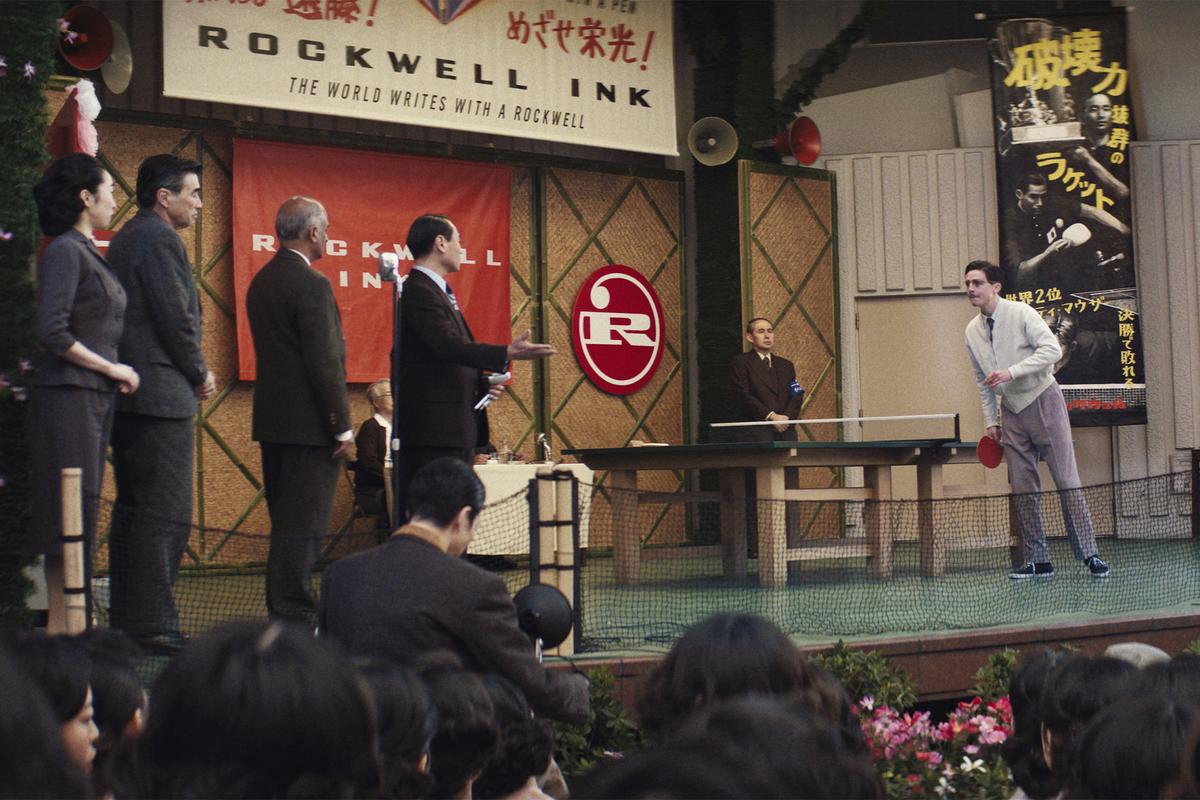
A still from ‘Marty Supreme’
| Photo Credit:
A24
Marty Mauser embodies a peculiarly American fantasy in which destiny metastasises into a personal branding exercise, and Safdie has obvious fun letting that fantasy curdle into parody. His conviction that greatness is owed to him feels eerily current, especially when paired with the image of orange table-tennis balls stamped with his name and patriotic promise, since it echoes the way American power loves to aestheticise itself as a product. Watching Marty hustle his way across borders boasting over his exceptionalism, it becomes hard not to think of another orange symbol of the American Dream™ ping-ponging across the country fueled on unfounded machismo and aggressively merchandised fascist fervour.
Safdie also slips one of the film’s sharpest knives in sideways, through a bit involving Holocaust “honey” that renders historical violence as something thick, marketable, and endlessly siphonable once you know how to sell it. The metaphor surfaces as Marty prods his former-rival and Auschwitz survivor to casually invoke inherited suffering to grease access to a certain Shark (who unfortunately features prominently in the film). Marty never articulates this system, yet he benefits from it instinctively, which is precisely the point, since Safdie seems to be alluding to how historical trauma becomes an endlessly renewable resource that could justify just about anything, which of course rings sonorous with a particularly well-worn state-level playbook.

It is difficult to watch Marty Supreme without recognising that Timothée Chalamet had been rehearsing for this role long before cameras rolled, especially once you recall his unapologetic declaration of greatness at the SAG Awards last year. The hubris of that moment feels like a very public spot of method acting in retrospect, since the hunger he displayed there became the animating force of his performance here. Chalamet plays Marty with a brazen thirst that feels at once, exhausting and magnetic, and the film benefits from his willingness to make ambition look depraved. As much as it pains me to admit it, watching an insufferable white boy channeling the pathology of an even more insufferable white boy results in something undeniable, because Chalamet finally aligns his own pursuit of validation with a character built to interrogate it.
May thy paddle chip and shatter, Timmy Tim.
Marty Supreme is currently running in theatres
Published – January 23, 2026 05:30 pm IST