





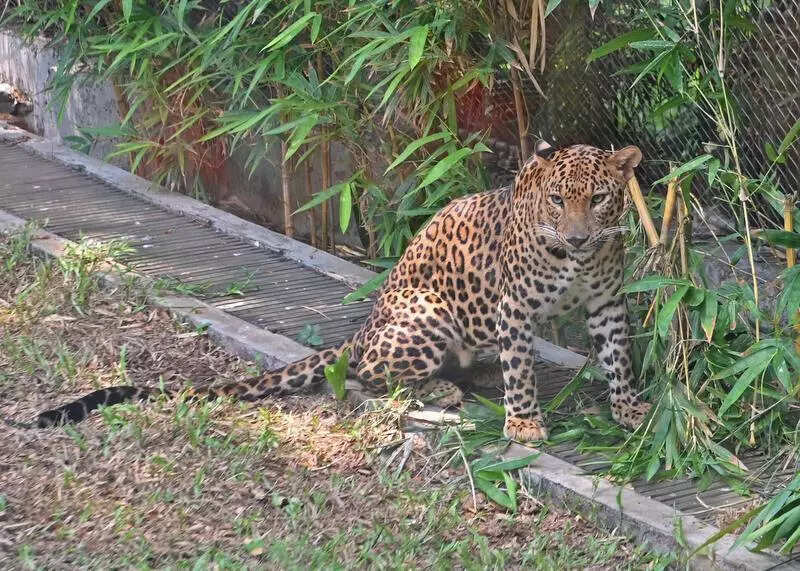
Pune: In western Maharashtra’s thick sugar cane belt, the Junnar forest division is set to launch a leopard-management trial to sterilise free-ranging leopards — a first for India — to curb growth in their population by stopping reproduction at its source rather than moving or capping the animals.The move follows years of rising leopard activity in farming villages, growing livestock losses and a spike in deadly human-leopard encounters. Junnar has become a key study site for human-leopard coexistence, but recent fatal attacks have put that fragile balance under severe strain.Understanding the significance of this moment means looking beyond Junnar’s fields to other continents — especially Africa, where wildlife fertility control has been tested on elephants, lions, baboons and other species for almost three decades. Bilal Habib, a senior scientist from the Wildlife Institute of India, who has worked in the Junnar division, said the birth control outcomes in the African nations were encouraging. “If we control birth for two years, the number of cubs would come under control. But we have to see how it works since it is a maiden attempt in India. Therefore, the experiment will be done on five females. Based on the success, we will make a future plan in the region,” he told TOI.The programme’s guidelines are being drafted by the principal chief conservator of forests office in Nagpur. Once the standard operating procedures (SOPs) are approved, work will begin on the ground. “We plan to capture female leopards from the conflict-prone areas,” Smita Rajhans, assistant conservator of forests, Junnar division, said.The pilot is modest — adult females from high-conflict clusters will be tranquilised, given a medical check-up and sterilised via contraception. After recovery, each leopard will be tagged or radio-collared and released back into its home range. “Carnivore sterilisation has been rarer in Africa, attempted on lions and cheetahs in private reserves to prevent inbreeding and territorial aggression. Unlike elephants, carnivores are harder to locate repeatedly, harder to dart safely, and more sensitive to social disruption if reproductive hierarchies change,” an expert in the field said.The experts categorically said Africa’s most successful projects depended on long-term tracking, sometimes one animal for a decade. Rangers knew herds, calendars and birth histories. Boosters were administered with clockwork precision. “But in Junnar, where leopards vanish into plantations within minutes, the logistic demand is exponentially higher. A sterilised leopard that disappears for years cannot be reinforced with contraceptive doses if needed. Unless radio-collaring, camera-grid mapping and ground tracking are expanded dramatically, results may remain anecdotal,” another expert said.Biologists said sterilisation was not a quick-resolution mechanism. “If Junnar sterilises five female leopards, conflict may remain unchanged for years because the existing adult population still hunts, breeds and interacts. Visible change emerges only when two-thirds or more breeding females are non-reproductive, a milestone far into the future,” a biologist said.African elephant programmes took 8-12 years to show measurable birth-rate decline. In baboons, reduced troop reproduction did not stop crop raids unless trash pits were secured and access to farmlands restricted. “If successful, the programme in Junnar could become the country’s template for carnivore conflict mitigation, an alternative to translocation, one-way cages and unending rescue cycles,” Ashish Thakare, the chief conservator of forest (Pune forest circle), told TOI.Sunil Limaye, former principal chief conservator of forests, wildlife, Maharashtra said the first few female leopards could be sterilised using immuno-contraceptive injections that stop ovulation. “Trials on lions and cheetahs in Africa have shown promise, but India is testing it for the first time on leopards,” Limaye said.Officials termed the scheme “preventive” rather than reactive. For the past 20 years, the standard response to human-leopard conflict has been rescue, cage capture or translocation—methods that merely shift the problem to another village without curbing numbers. Sterilisation, by contrast, could stabilise the breeding population over time while leaving individuals in their familiar habitats.Across South Africa, Kenya, Botswana and Namibia, wildlife managers have been using sterilisation and immuno-contraception since the 1990s, mainly to curb over-abundance in fenced reserves where natural migration is blocked. Elephants were the first large mammals to receive large-scale contraception. “In Africa’s enclosed parks the problem was the opposite of Junnar – too many animals, leading to habitat degradation rather than human-wildlife conflict. Elephant immuno-contraception worked when herds could be tracked, darted and checked each year, but it was costly, labour-intensive and required repeat boosters; missing even a single cycle could undo progress,” explained a wildlife biologist who has studied the African projects. He added that primates such as baboons have also been sterilised in parts of South Africa to reduce raids on farms and tourist sites, noting that success only improved when the programme was paired with waste-management measures, community outreach and rigorous monitoring – sterilisation alone never resolved the conflict, it merely slowed its escalation. Why Simply Capturing Leopards FailsWhenever a leopard is spotted, villagers panic. But just putting up cages or catching the animal does not solve the issue as the more leopards are caught, other leopards from the vicinity take their place and create more problems.Under the Wildlife Protection Act, leopards fall under Schedule I. They can be killed only if proven man-eaters or they are fatally injured and beyond recovery. They must first be tried to capture alive, and if it’s not possible, then only can be liquidated. Under section 12 of the Wildlife Protection Act, their relocation for scientific management requires central govt approval. This is why discussions are underway about shifting leopards to Schedule II, where state govt can give permission for their relocation for scientific management.