





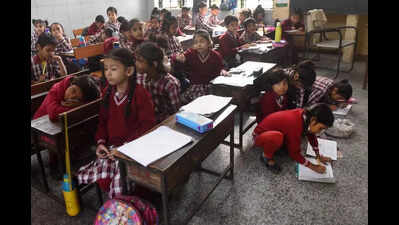
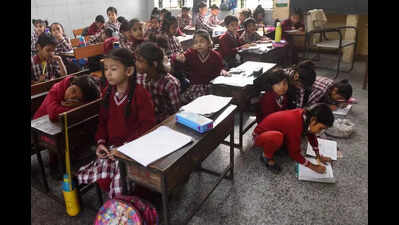
New Delhi: Some of Delhi’s schools are straining under the weight of overcrowded classrooms and limited infrastructure, point out experts. Such congestion reduces individual attention, stretches resources and weakens learning outcomes, they warn, pointing to an urgent need for new schools, improved facilities and better enrolment planning.According to the UDISE+ 2023-24 report, the city has 5,556 schools catering to nearly 44.9 lakh students, which translates to an average of 808 students per school, among the highest in India. The figures include all types of schools: those managed by the directorate of education (DoE), Municipal Corporation of Delhi, New Delhi Municipal Council and Cantonment Board, as well as govt-aided and private unaided institutions. Education experts say a balanced ratio should ideally be closer to 500 students per school. And this average conceals sharp disparities, with some schools enrolling barely a dozen studentsand others packed with several thousands.The on-ground reality in many districts is far more alarming. DoE reported last year that northeast Delhi had only 48 govt schools for 1,30,000 students, each serving nearly 2,763 students. “No school should have more than 2,000 students. There are schools that have 5,000 to 10,000 students, too, and it becomes impossible to manage. Ideally, there should be around 40 students per classroom,” said education activist and lawyer Ashok Agarwal.Agarwal, who has been advocating for better conditions in Delhi’s govt schools, added that some institutions had reached extreme levels of crowding. “We’ve seen schools in areas like Jangpura with as many as 8,000 students. In one case we filed in 2024, a school had 191 students in a single class. On average, classrooms accommodate between 90 and 140 students,” he said.While private schools are better equipped to handle the pressure — with more classrooms, better facilities and controlled intakes — most govt schools continue to struggle with uneven distribution of teachers and infrastructure. “Even then, some private institutions, too, try to fill classes with 50-60 students,” said Agarwal. The crisis is most visible in govt schools in densely populated areas like Khajuri Khas, Tukhmirpur and Karawal Nagar, where schools have resorted to running double shifts or calling students on alternate days. Some institutions even restrict attendance to three days a week because of the lack of space for all students at once.A Class XI student from Tukhmirpur said, “When I had enrolled, I was told I’d have to attend classes only on Tuesdays, Thursdays and Saturdays because the building couldn’t fit everyone.” Another student from Khajuri Khas said, “There are so many of us that we sometimes sit in the library because classrooms are full.”The impact of such arrangements is profound. Teachers often manage massive class sizes, making it impossible to give students personal attention or maintain effective engagement. Many schools have converted libraries and staff rooms into makeshift classrooms. This not only compromises the quality of teaching but also contributes to teacher burnout and absenteeism. The inconsistent rhythm of double-shift or alternate-day schooling disrupts learning continuity. In such circumstances, tracking student progress becomes difficult, increasing the risk of dropouts, particularly among children from disadvantaged backgrounds. “We try our best. And any kind of learning is better than no learning. That’s how I see it,” said a teacher at a north Delhi school. According to the previous govt, over the past decade, around 22,711 rooms were built across govt schools. The current Delhi govt also plans to tackle the problem through several measures, including the construction of more schools and the addition of more classrooms to existing campuses. Govt also plans to issue a white paper to ensure transparency and public oversight of the measures.However, education experts believe that while infrastructure expansion is a necessary step, it cannot be the only solution. They recommend a two-pronged strategy — short-term relief coupled with long-term reforms. In the immediate term, temporary or prefabricated classrooms could be set up in high-density zones to distribute students more evenly. Staggered shifts may continue but should be systematically planned, with fixed schedules and additional teachers to ensure that learning remains consistent.Over the longer term, experts argue for a comprehensive school mapping and enrolment policy that aligns infrastructure, staff strength and student distribution with population growth. “Building schools is only one part of the solution,” said Agarwal. “We need a policy that ensures every child has a classroom to sit in, a teacher to learn from and enough space to study with dignity.”