


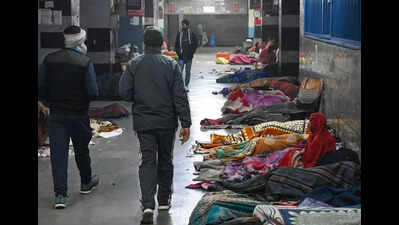
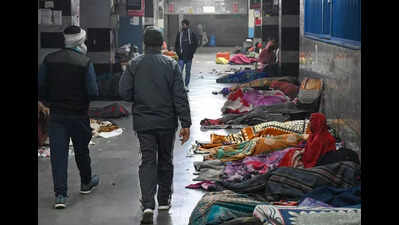
New Delhi: It is 4am, the temperature is in single digits and the winter cold bites sharply. But, outside All India Institute of Medical Sciences, the day has already begun, with patients or their caregivers lining up for the day’s appointments. What looks like a pile of discarded clothes or bundled rags from a distance turns out to be families huddled together, bodies pressed close and wrapped in thin blankets brought from home in a desperate attempt to survive the night. Men, women and children lie on pavements against boundary walls, under flyovers and inside the nearby subway. For thousands of patients — many from Bihar, Uttar Pradesh, Rajasthan and other states — sleeping outside AIIMS in the cold is not an exception, it is a routine.Rajesh Kumar, a 31-year-old from Bihar’s Bhagalpur, is awake. He carefully spreads his medical documents on his swollen leg, enlarged due to elephantiasis, using it like a makeshift table. He can’t work because of the illness. Bills, prescriptions, referral slips — each paper is flattened and rechecked. “At one hospital, they told me that I would have to cut this leg to survive or work again. Here it is frustrating that they are referring me from one doctor to another, but at least there is hope,” he said. That hope, he added, is enough to keep him going through freezing nights.Around him, other patients lie in a row, using thin plastic sacks as beds and blankets as protection against the cold. Some use sacks filled with medical reports as makeshift pillows too.A few metres away lies 60-year-old Rajpal. A pipe runs into his nose, secured with tape. He has a knot in his food pipe and can no longer eat normally. “This is the only way I can consume food,” he said, referring to the feeding tube. Rajpal has been coming to AIIMS for over one and a half years. His wife sleeps next to him, curled up close. On the dirty pavement littered with garbage, Rajpal himself prepares his feed, filling a syringe with milk and administering it through the tube.Sleeping outdoors and waking up before dawn is part of the unspoken system for these patients. They must rise early enough to secure a slip for appointments or ensure they are present when their turn comes. Being late, even by minutes, can mean losing the chance to see a doctor that day.There is also an unspoken code of protection. Men ensure their wives or other women sleep closer to boundary walls or corners — vulnerability is constant, they said, heightened by darkness, cold and crowding.According to Delhi Ur-ban Shelter Improvement Board, 16 night shelter tents have been set up around AIIMS, each of which can accommodate 20 people. On Friday night, all of them were over-occupied. Many patients also find them too far away to risk missing an appointment. The desperation is evident as night shelters at other parts of the city don’t see such crowding. On Friday night, only 6,356 of the total 19,984 spots at 335 shelters were occupied.The subway is unhygienic but warmer, and is full. As one descends the stairs, patients are seen lined up, wrapped tightly in blankets. Further inside, near its main crossing, bodies are arranged tightly, filling every available inch of space.Sangeeta, a 35-year-old from east Delhi’s Gandhi Nagar, waited with her four-month-old son in her lap. He has a congenital heart defect, a hole. “Most days, I struggle just to get a place inside the subway. Sleeping outside is too dangerous for my child — his condition is already sensitive.” Sangeeta said she cou-ld come from home, but be-ing late by even five to 10 minutes might mean losing an appointment. “Then we have to join the queue all over again and no one knows when the next appointment will come.” Nearby is 45-year-old Muwasareen from Uttar Pradesh. “Sometimes people throw cold water on us. I need the support of at least two people just to stand up or walk. Even then, I prefer the subway,” she said.Night after night, they wait, caught between illness and a system that offers treatment by day but abandonment by night.