



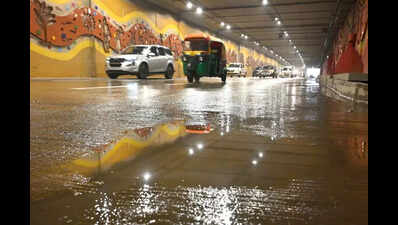
New Delhi: Facing criticism over persistent seepage last year, Public Works Department (PWD) has decided to undertake corrective engineering measures to address leakage in one of Delhi’s key underground infrastructure assets — the Pragati Maidan (ITPO) tunnel.The department has earmarked Rs 3.7 crore for waterproofing works at Tunnel-1 on the Basement-2 side of the ITPO tunnel, where sub-soil seepage was reported. The project aims to provide a permanent engineering solution to arrest both active and passive leakage affecting the tunnel’s reinforced cement concrete (RCC) structure, said officials.According to official documents, the scope of work includes polyurethane (PU) injection waterproofing to seal cracks, construction joints, honeycombs and voids in the concrete structure that allow groundwater ingress. PU grouting, a specialised technique widely used in underground structures, involves injecting expanding chemical grout into cracks under controlled pressure to stop water infiltration.The process will begin with detailed surface preparation, including the identification of leakage points, cracks and joints. Affected areas will be thoroughly cleaned using wire brushing, air blowing or water flushing to remove dust, grease and loose particles. Injection points will then be marked along the leakage paths at intervals.Once the injection process is complete and cured, the packers will be removed and the drilled holes sealed using non-shrink cementitious or epoxy mortar. Treated surfaces will be finished to match the surrounding structure and monitored over a specified observation period to confirm that leakage and dampness have been fully arrested.PWD has laid down strict conditions for the work. After completion, there must be no seepage or water flow under normal sub-soil water conditions. The work will be monitored and certified by the engineer-in-charge, and payments will be released only after satisfactory verification.The executing agency will be required to prepare a detailed waterproofing methodology and drawings in consultation with a specialised agency and the manufacturer of the waterproofing chemicals. These documents must be vetted by IIT before execution. All costs associated with documentation and approvals will be borne by the contractor, with no additional payment from PWD. The scope also includes photographic and video documentation of site conditions before and after the intervention.If seepage reappears, the agency will be required to carry out waterproofing again at its own cost. If the waterproofing fails at any point within 10 years of completion, the contractor will be liable to refund the entire amount paid and may face blacklisting from PWD and CPWD projects for a decade.The Pragati Maidan tunnel, built at a cost of Rs 777 crore and funded by Centre, was executed by PWD, which engaged Larsen & Toubro as the engineering, procurement and construction contractor responsible for design, execution, maintenance and repairs. However, waterlogging and seepage were observed soon after the tunnel became operational. In Feb 2024, during AAP govt’s tenure, PWD issued a formal letter to the contractor flagging these concerns.A five-member PWD committee, formed in March 2024, submitted a report in April identifying the factors behind the recurring waterlogging. However, no preventive measures were taken before the onset of the monsoon. The expert panel pointed to coordination gaps arising from multiple agencies working on different components of the Pragati Maidan redevelopment. While the tunnel network falls under PWD, Bharat Mandapam is managed by ITPO, and water infiltration from underground parking ramps and branch tunnels has led to frequent flooding and closures after spells of rain.PWD has attributed the problem to an incomplete drainage system within the Bharat Mandapam campus. Among the committee’s key recommendations was an immediate halt to the discharge of water by civic agencies, particularly NDMC, in areas surrounding the tunnel — a practice identified as a major contributor to water accumulation.