





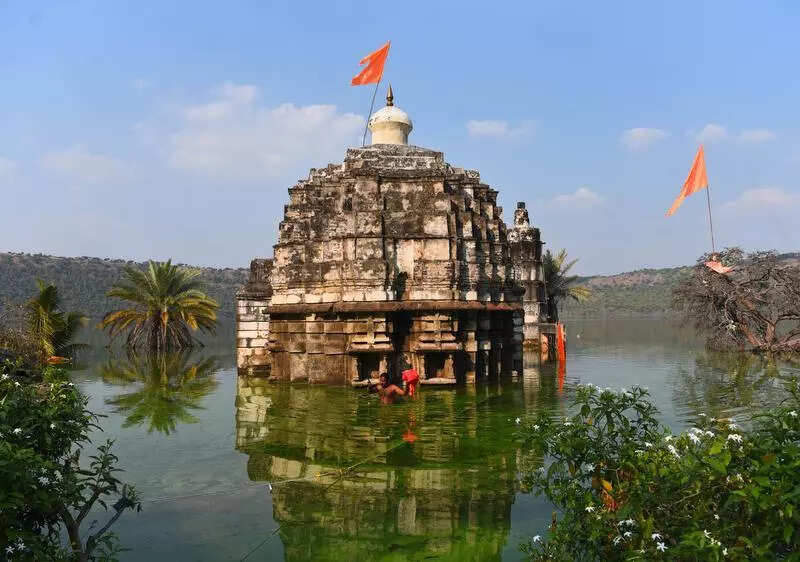
But what began as a scientific curiosity has escalated into an environmental emergency. As water levels continue to surge, the Nagpur bench of the Bombay High Court has taken suo motu notice, demanding answers as to why one of India’s most significant natural monuments is being irreversibly altered. The physical evidence of the crisis is visible to any visitor descending the crater’s steep rim. Nine of the 15 ancient temples that dot the shoreline —relics of a medieval architectural era —are now partially or fully underwater. In Nov last year, when forest officials surveyed the site, the water was merely lapping at the steps. Today, the flood threatens to submerge the idol of Kamalja Devi, the village deity whose temple has survived centuries, only to be besieged by 21st-century environmental shifts. “It is heartbreaking,” said a local forest staffer. “The rains lasted from May until Oct last year, and for the first time, the deity herself is in danger of being lost to the rising tide. The lake is growing, but in doing so, it is losing its soul.” The cause of this “flooding” in a closed-basin lake is not merely heavy rainfall, but a complex “perfect storm” of human intervention. Ashok Tejankar, a veteran hydrogeologist and former pro-vice chancellor of Dr. Babasaheb Ambedkar Marathwada University, recently conducted a survey of the 1,800-meter-diameter crater. He found that the lake level has risen by a staggering 20 feet—a change driven by an inadvertent breach of the crater’s natural plumbing. While the area has seen high rainfall over the past two years, Tejankar’s study points to a more permanent problem: the proliferation of deep borewells. “Farmers in the surrounding catchment area have drilled borewells to depths of 600–700 feet,” Tejankar said. “These wells have punctured the basaltic rock layers that were once impermeable. By piercing these deep aquifers, they have effectively activated a massive underground drainage system that is now funnelling groundwater into the crater.” The numbers are alarming. Historically, only two freshwater springs—Dhar (Gomukh) and Sitanahani—fed the lake. Now, two additional springs, Ram Gaya and Papareshwar, have begun flowing with such intensity that their combined discharge is equivalent to a 10-horsepower pump running around the clock. The scientific cost of this influx is catastrophic. As fresh groundwater slowly percolates through the rock, it dilutes the lake’s concentrated salts and minerals. The pH has plummeted from 11.5 to nearly 8.5. “A pH of 8.5 is close to neutral,” Tejankar said. “This dilution erases the very conditions that make Lonar unique. This isn’t just a change in water level; it’s a fundamental shift in chemistry that will trigger a domino effect across the flora, fauna, and microorganisms that have evolved here over 500 centuries.” While the lake overflows with fresh water, Lonar village — perched on the crater’s edge—is bone dry. The town receives municipal water only once a month and remains desperately dependent on tankers and the very borewells that are drowning the crater. Tejankar has proposed a two-fold solution to Buldhana MP Prataprao Jadhav. He suggested intercepting the spring water at the bedrock level and lifting it out of the crater. “After purification, this water could serve as a domestic supply for Lonar town,” he said. “This would provide a sustainable water source for the villagers while simultaneously lowering the lake level to save the temples and the ecosystem.” Despite being a Ramsar site, Lonar suffers from a lack of coordinated protection. Atul Jethe, head of the geography department at CT Bora College, said that 40% of Lonar village is built directly on the “ejecta blanket” — the debris field created by the original meteor impact. “We have failed to recognise the holistic importance of this site,” Jethe argued. “In the US, the Barringer Crater is meticulously protected. In Lonar, we have allowed roads, agriculture, fertilizers, and pesticides to encroach on the ejecta zone. Every time a new road is built or a new field is ploughed on the rim, the crater suffers.” The govt’s attempt to fix this by acquiring 86 hectares of land for research and conservation has stalled. Local farmers, fearing the loss of their livelihoods, are resisting. “The government wants our land, but they offer no alternative,” said one farmer. “Without our fields, how do we survive?” While the Maharashtra govt has long lobbied for UNESCO World Heritage status for Lonar, the reality on the ground remains a far cry from international standards. Basic infrastructure — from public washrooms to scientific interpretation centres—remains abysmal. Currently, the forest department is awaiting a detailed report from the groundwater surveys and development agency. Chetan Rathore, assistant conservator of forest, said that while the department is exploring ways to reduce water levels, they are hemmed in by the strict regulations of the Wildlife Protection Act.