




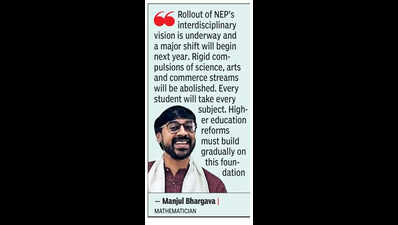
Pune: Indian-origin mathematician Manjul Bhargava said the country should not neglect foundational mathematics at a time when artificial intelligence, data science and emerging technologies are dominating global economies.The subject was not suffering from a lack of talent, but an absence of conversation and collaboration in India, said the Canadian-American mathematician whose work in number theory earned him the Fields Medal in 2014. He was speaking to reporters on the sidelines of the inaugural day of the Indo-European Conference on Mathematics at Savitribai Phule Pune University on Monday.The five-day event has been organised jointly by the European Mathematical Society and the Indian Mathematics Consortium. It is co-organised by SPPU and IISER Pune and will feature talks by award-winning international mathematicians.Bhargava said the reason why India lagged in fundamental and applied research was that mathematical institutes worked in isolation, the fragmented community did not allow their research to permeate to 90% of students in state universities and affiliated colleges, which anyway lack the wherewithal to support research activities.Indian institutes need to talk to each other and to the worldConferences are important for mathematical communities to come together, share ideas and push ahead global mathematics, said Bhargava. “If mathematicians Srinivasa Ramanujan and Godfrey Harold Hardy had not met and worked together for a few years, had they only written letters or read each other’s papers, it would not have produced world-changing mathematics,” he said, adding: “We need to support foundational mathematics research if India wants to become a leader in AI.“He spoke about the need for concerted effort to fund research and take it to state universities where 90% of PhDs and 90% of students were enrolled. “Most varsities are not of the quality of Pune University (SPPU). There is hardly any research in Indian state universities, unlike the US and Europe. One can imagine the amount of talent being wasted.”ANRF is a startThe Anusandhan National Research Foundation (ANRF) and its proposed funding to state universities may bring about changes, he said. “We are far behind in India and only if there is good foundational research will it translate to applied research.”NEP and end of academic silos:He said rollout of NEP’s interdisciplinary vision was underway and a major shift would begin next year at school level. Rigid compulsions of science, arts and commerce streams would be abolished. “Every student will take every subject,” he said and added that higher education reforms must build gradually on this foundation.Textbooks should include accurate, scientific inclusion of India’s contributionsBhargava said India’s contribution to mathematics dated back thousands of years and was deep and world-changing. “It should be included in textbooks and public discourse without putting down any other country. It is India’s soft power and will inspire youngsters,” he added.Way forwardHe said he was thinking about starting a nationwide network of maths and other subject circles for youngsters and it would develop into a community. “Children will make stronger contributions to their subjects if they start early and grow up together. India must provide opportunities to young people passionate about mathematics to pursue their interests through summer camps or getting together talented students.“The mathematician mentioned how he had started New York City’s Mathematics Museum which attracts hundreds of visitors daily. “Such places help the public interact with the subject,” he added.