




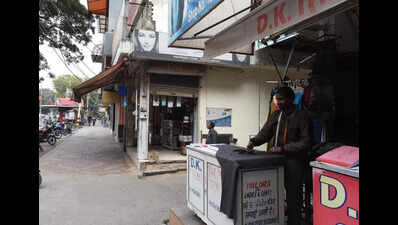
New Delhi: On Friday, the longest queue at Meharchand Market was no longer outside a tailor’s shop but a cafe. People now patiently wait for tables where they once used to wait for their shirts and trousers to be stitched. This shift captures the market’s ‘third life’.Long before today’s glass façades and menu boards entered the picture, Meharchand Market in Lodhi Colony began as a fragile line of nearly 240 khokhas (makeshift shops) set up by refugees from Pakistan who had poured into Delhi with little capital apart from entrepreneurial skills.
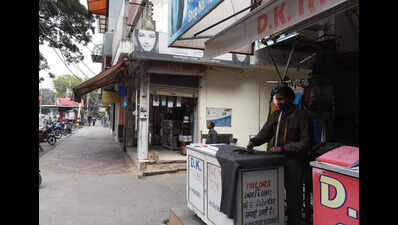
In 1964, the market finally turned pucca. The khokhas were replaced by 152 concrete shops, and the ‘refugee market’ was renamed Meharchand Market after Mehr Chand Khanna, then Union minister for rehabilitation. However, the structure changed, but the spirit did not. Soon, Meharchand earned its nickname: Delhi’s “wonder market”. Nearly 20 tailors used to work shoulder to shoulder, altering suits at lightning speed. Zips were fixed in minutes and jackets altered even before your tea went cold. Measuring tapes swinging from necks, the tailors frenetically clattered on their sewing machines through the day. Cut to 2022 when South Delhi Municipal Corporation approved a long-pending plan to redevelop the market into a three-storey, pedestrian-only shopping plaza with a uniform design. Existing shops were to be demolished and reconstructed by traders under a sanctioned plan.The market has started wearing a new outfit. Shops have given way to glass-fronted showrooms. A daily provision store has turned into a salon. A tent house that once supplied canvas for weddings and political rallies has been replaced by Carnatic Café, known equally for its food and queues of patrons snaking through lanes where tarpaulin once used to flap in the wind.“I moved here once the pucca shops came up,” said Inderjeet Singh, landlord and vice-president of Meharchand Market Association. “I am the second generation, and the third is already taking over. We gave our space to Carnatic Café, and just see the rush. That is what’s motivating many to redevelop or change strategy.” Market association president Ashok Sakhuja has seen the transition up close. “Who doesn’t want to grow? Consumer demand has changed, rents are better, and we are adapting. This time, we are determined to see Meharchand join the league of Connaught Place, Hauz Khas Village and Khan Market.”The “wonder tailors”, the market’s original stars, are mostly gone. Just one or two still hold their ground. Sitting at one such shop, D K Tailors & Wonders, Dev Kumar (62) remembers when alterations of clothes ruled the market. “The readymade revolution hadn’t taken off then,” he said. “Children wore hand-me-down clothes, and everything came to us for fixing. We could turn bell-bottoms into straight pants and back again.” Today, he says, full-fledged stitching from scratch brings steadier business, even as competition has thinned. However, some shutters are coming down for good. One such shop belongs to Anil Chaudhary, who on Friday was seen packing up Shyam Book Depot, a stationery store his family has run here since 1964. As he wraps old ledgers and leftover stock in cloth bags, he shrugs at the inevitability of it. “The demand has changed,” he said. “People order online now. It’s time we move on. Let’s see what we start next.”Others have chosen to adapt rather than exit. After all, reinvention has long been part of Meharchand’s rhythm. Praveen Bhaskar’s father began in a khokha, brewing tea. When the market turned pucca in 1964, the modest Pandit Ji Tea Stall became a permanent shop. By 1989, responding to rising costs and changing needs, the family pivoted again — this time to the stationery business. Today, Bhaskar Store stands as a reminder that survival here has always meant knowing when to change course.With redevelopment in full swing, the market has not vanished; it has reshaped itself. Its first life was about rebuilding after displacement during Partition, the second about adapting to changing times. The current phase is about reinvention — where urgency gives way to experience, scissors to menus, and neighbourhood utility to destination ambition. Many now hope it will become the next GK or Khan Market, though they admit that transition will take time, constrained as they by finances. A few kilometres away sits Khanna Market — older, quieter, but equally storied. Around 2018, New Delhi Municipal Council rolled out upgrades that were to serve as a pilot for market redevelopment across the city. There was no demolition or glossy makeover. The focus stayed on fundamentals: better streets, improved utilities and cleaner public spaces — modest yet significant changes.What remained untouched was Khanna Market’s temperament. Many shops still run as they always have. Devan’s still smells of freshly ground coffee, the owners having resisted the urge to turn it into a cafe. Nearby, Chidambaram’s New Madras Hotel continues to serve scrumptious south India fares to familiar faces. “The development happened around us, not within us,” a shopkeeper said. “The infrastructure changed, but the businesses have stayed the same. It’s not like Meharchand, where everything — look, feel and purpose — have shifted.”