



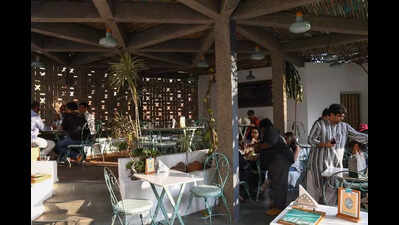
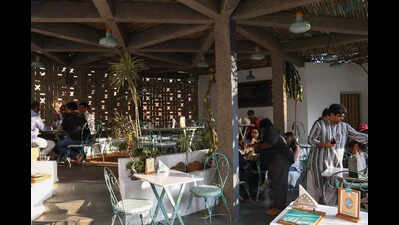
New Delhi: The courtyard of Triveni Kala Sangam in Mandi House rings with the clink of teacups, the clatter of cutlery and the hiss of kebabs crisping on griddles even as music from rehearsals and notes of a kathak tatkaar (rhythmic footwork) drift down staircases. At a table, lawyers in black coats review the ebb and flow of a case between bites of parathas; at another, students can’t stop dissecting a canvas they’ve just seen upstairs.For over 75 years, Triveni Terrace Cafe has been more a hub of adda than a mere canteen. It is now back with its heritage menu, which guides the patrons through the evolution of the cultural and arts complex and its culinary traditions.Founded in 1950 and formally operating out of its current Tansen Marg address since 1963, Triveni was the vision of Sundari Shridharani, an artiste shaped by her time at Almora spent with the legendary dancer-choreographer Uday Shankar and his brother, sitar maestro Ravi Shankar.Shridharani believed that arts must be accessible to everyone, not just the privileged. Hence, classes at Triveni were affordable, scholarships generously offered, and performances rarely ticketed. First come, first served was the only rule.The canteen grew out of this philosophy, recalls Kavita Shridharani Mohindroo, now president of Triveni Kala Sangam and daughter of its founder. In the late 1960s, the canteen had little more than a stove and a table — serving tea, biscuits and a simple snack or two. Artistes would gather here after rehearsals, lingering for hours over steaming cups. Then came Mrs Puran Acharya, the first person to manage the space on a professional basis. She expanded the menu, though modestly, by introducing nimbu pani, coffee and a few hot snacks. Gradually, she added kebabs and parathas that would become legendary across Delhi.“Soon, everyone was here,” Kavita recalls.“M F Husain, after getting down barefoot from his car painted with galloping horses, would hold court in a corner of the canteen. Fellow painters Krishen Khanna and Vasudeo S Gaitonde used to drop in as well. Photographer Raghu Rai held one of his early exhibitions here. Theatre actors, poets, writers and musicians made the courtyard their evening address. It was not unusual for three or four cups of chai to accompany meandering conversations about art, politics and life,” Kavita says.The food, she says, was simple and affordable, and continues to be so. “It was honest ghar ka khana,” Kavita says. “No one had money those days. But everyone had ideas.”Over time, the canteen passed through different hands. After Mrs Acharya retired, Kamala Ranjit Rai and her family ran it for many years, expanding the offerings while retaining its unpretentious soul. Cold coffee appeared on the menu, though it was simpler than today’s frothy one. More dishes were added, but the spirit remained intact: affordable, welcoming and unhurried. Unobtrusively, the canteen had evolved into a fledgling cafe.There was a brief interlude when a partnership dissolved and the cafe shuttered unexpectedly. The search for its new custodians was meticulous. Triveni needed more than restaurateurs; it needed like-minded collaborators who understood its artistic ecology. The eventual choice was the team behind the now-iconic Cafe Lota on the premises of National Crafts Museum. “This team believed in good ingredients, no aerated sodas, and a certain integrity,” Kavita says. “And it clicked.” Today, while the menu has expanded, a conscious effort keeps a section — mostly dal, rajma and roti — affordable so that students can eat here. At lunch hour, lawyers from the nearby Delhi High Court sometimes take over the entire courtyard. In the evening, the tables are abuzz with dancers, designers, journalists, techies and tourists. What makes the cafe unique is its architecture as much as the food. Designed by American architect Joseph Allen Stein, the building unfolds around a central courtyard like a village square. You cannot reach the cafe, the galleries or even the restrooms without passing at least a rehearsal, a performance or an exhibition. Music seeps into your meal. A Manipuri performance unfolds on stage while diners watch on, mesmerised in between the bites. Even when no formal show is on, the strains of a flute rehearsal or the thump of tablas waft in.“You nourish yourself with the food,” Kavita smiles, “and at the same time you nourish your mind.”The current heritage menu offers everything that once endeared the cafe, with its managers making their best efforts to keep original tastes intact. Mrs Acharya’s famed vegetable cutlets, keema paratha served with boondi raita, kebab-paratha and ‘tasty toasts’ are back. There’s even ‘Husain’s samosa’, a nod to the painter’s preferred snack. And then there’s the good old chicken curry, done exactly it used to be over half a century ago. These recipes have been revived in consultation with those who remember them best.“Since launching the heritage menu a few days ago, the response has been incredible. Guests are rediscovering the beauty of simple flavours. Seeing these timeless dishes resonate so deeply is a delight. It’s a wonderful reminder that true excellence of anything often lies in its simplicity,” says Rajesh Ojha, who now runs the cafe.“Couples had their first dates here; some got engaged at these very tables. Young photographers, inspired by a gallery upstairs, found their calling. Students who once scraped together coins for tea and later visited us as Fulbright Scholars now ask us from faraway Berkeley whether we still serve the kebabs and parathas,” Kavita says.Long-time visitors love the options on the heritage menu. “Shammi kebabs were affordable to even penniless students like me. You could lounge around sipping chai from kulhars with no one to hurry you up. The other day, I had a plate of kebabs for old times’ sake. The taste took me back to my childhood,” says Paro Anand, a writer and performance storyteller.