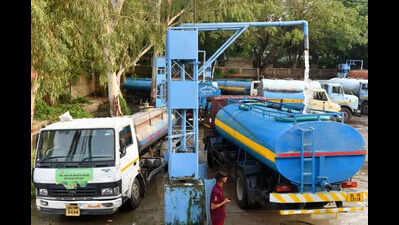





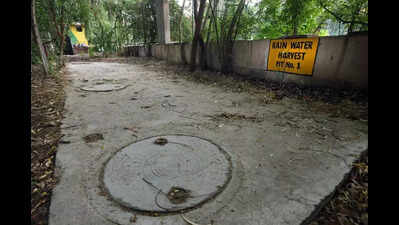

New Delhi: To address persistent waterlogging in low-lying areas and seepage in basements of buildings at pockets in Lutyens’ Delhi, Central Ground Water Board conducted an assessment of groundwater levels on behalf of New Delhi Municipal Council early last year. The subsurface study, which spanned 45 days, has revealed a significant rise in levels at most of the 14 locations surveyed and a marginal decline at a few, underscoring the need for intervention to manage excess subsurface water, officials of the civic agency have told TOI. The assessment was part of the Council’s efforts to monitor groundwater conditions and evaluate the impact of rainwater harvesting, based on which it plans conservation initiatives, its vice-chairman, Kuljeet Chahal, said. “We sought the technical support of the water board for suggesting measures to check frequent waterlogging on roads, exploring solutions for pumping out excess groundwater, revival of defunct borewells and diversion of surplus water through recharge structures,” Chahal said.The water body’s report said groundwater accumulation intensified due to restrictions on pumping under existing regulations. Based on the findings, the civic agency claimed to have received permission to dig borewells at 20 locations. It has approached National Green Tribunal seeking approval to reopen 57 out of 124 defunct tubewells to divert excess water for irrigation and to supply to water-scarce areas. “The tribunal has sought a response from the water board, which is awaited,” officials of the agency said.The board also shared with the agency findings of surveys of groundwater levels it had conducted between Jan and Nov 2024 at its 14 monitoring stations. The data indicated a notable rise in levels at multiple heritage and institutional sites. It found groundwater levels at Sunder Nursery Plaza increasing from 5.4 mbgl (meter below ground level) in Jan 2024 to 4 mbgl in Nov 2024. Shram Shakti Bhawan-1 saw an increase from 8.12 mbgl to 5.23 mbgl, while levels at Safdarjung Tomb rose from 11 mbgl to 8.22 mbgl. Similar trends were observed at Humayun’s Tomb (from 8.4 mbgl to 7.3 mbgl), Agrasen ki Baoli (Dhobi Ghat; from 16.8 mbgl in May to 15.5 mbgl in Nov), Mahavir Vanasthali (from 21.8 mbgl to 18.2 mbgl), Shram Shakti Bhawan (from 8.6 mbgl to 5.5 mbgl) and Shanti Path near the embassy area (from 20.9 mbgl to 18.8 mbgl). However, at Birla Mandir, the water level dropped from 9.9 mbgl to 10.8 mbgl, while at Lodhi Garden (D), it declined from 3.6 mbgl to 4.2 mbgl. Talking about the second study conducted at the beginning of last year, Chahal said, “It included mapping groundwater flow patterns, identifying waterlogged zones, delineating layered aquifers and determining the causes of water accumulation. It examined the feasibility of reviving defunct borewells to pump out excess groundwater and redistribute it to water-deficient areas.”The civic agency identified 37 chronic waterlogging points, including Purana Quila Road back lane, Golf Links, Bharti Nagar, Lodhi Estate and Colony, Panchkuian Road, Shanti Path underbridge, Connaught Place middle circles, Sarojini Nagar, Raisina Road, Baba Khadak Singh Marg and Golf Club Gate near Dr Zakir Hussain Marg. The water board attributed this waterlogging largely to groundwater flowing from surrounding areas towards the eastern part of the zone that was studied before getting trapped due to subsurface geological ridges. The survey also marked areas suitable for artificial recharge, particularly locations where groundwater levels were deeper than 10 mbgl as on Nov 2024. Around 20 sites, including Africa Avenue underpass, Panchsheel Marg near Samrat Hotel, South Avenue Road, Teen Murti, Vinay Marg and Shanti Path, were identified as feasible for constructing recharge structures.