



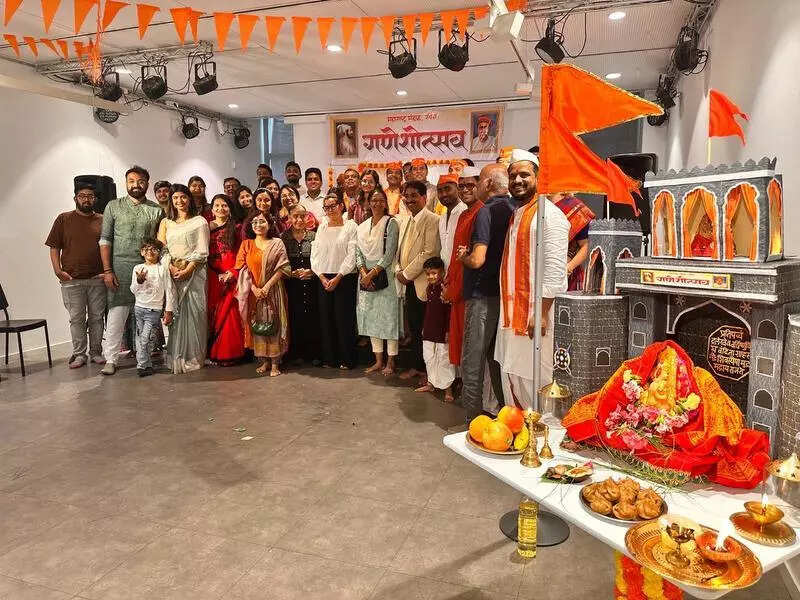

Pune: Across Europe, Maharashtra mandals are using Ganeshotsav to bring the diaspora together, with growing turnouts for traditional rituals, performances, and community feasts. In countries where Indian festivals are usually private affairs, these organisations are shaping spaces of devotion and community while adapting rites to local rules and environments. In Barcelona, chants of “Ganapati bappa morya” filled the Federació d’Entitats Calàbria 66 on Aug 30, as Maharashtra Mandal Spain hosted its third consecutive Ganeshotsav. A fort-shaped entrance, honouring Unesco’s recent recognition of Shivaji Maharaj’s forts, greeted a crowd of over 400 attendees. “We provide not only an opportunity to unite but also a platform to preserve and showcase Marathi culture and traditions on a global stage,” said Sumit Kutwal of Maharashtra Mandal Spain. The Consul General of India to Barcelona, Inbasekar Sundaramurthy, and Assistant Consul Sumodh Sarasan also joined the festivities, performing the aarti alongside children singing stuti and vandana, and local volunteers presenting abhangas. The choice of an eco-friendly idol and the focus on cultural programming reflected how faith and heritage are held together in the diaspora setting. In Sweden, Maharashtra Mandal Gothenburg celebrated the festival on Aug 31, with a theme drawn from the Pandharpur wari pilgrimage. Volunteers built decorations by hand, re-creating the imagery of the iconic walk that defines devotion in Maharashtra. President of the mandal, Sachin Pujari, said, “Although Sweden has fewer Indian-origin residents compared to other European countries, the mandal has grown steadily and is a registered non-profit association with about 500 members.” The one-day celebration included a palkhi procession, lejhim, games, and a spread of snacks from vada pav to samosa chaat prepared by members. Indian Ambassador to Sweden Anurag Bhushan attended the event. “Local laws prohibit idol immersion, so the community reuses the same murti annually, carrying it in a symbolic procession before returning it for safekeeping. Visarjan, like we do in Maharashtra, is prohibited here. Our mandal conducts only the palkhi, aarti, and pooja. The same Ganesh murti (idol) is respectfully used each year in compliance with these regulations,” said Pujari. In Luxembourg, over 1,000 people came together at Tramschapp Hall for the fifth Ganeshotsav organised by Marathi Mandal Luxembourg on Aug 30. The event included murthi stapna, pooja, dhol tasha, lejhim, cultural performances, and a communal aarti. “We had multi-state food stalls by Indian caterers serving authentic items like Mumbai vada pav and modaks. The mandal has adopted a practical approach to visarjan by immersing the idol in a small bucket, with the water later poured into plants to maintain an eco-friendly cycle,” said mandal member Aisha Karnik. In France, the Marathi community will celebrate Ganeshotsav on the day of visarjan, Sept 6. “Every year’s celebrations are designed to be family-oriented and interactive with Ganesh idol-making workshops for children and dhol-taasha performances with a small community procession. The idea is to celebrate together while also encouraging the younger generation to experience and participate in Maharashtrian traditions. We collaborate with chefs from within the Maharashtra Mandal France (MMF) community, who prepare authentic traditional Marathi dishes for the festival. Every attendee receives a food box along with prasad, ensuring that everyone shares a meal together in the festive spirit,” said Sachin Angal, social media coordinator of MMF. “Since a traditional visarjan (immersion of the idol in a river or sea) is not possible in Paris, we adapt the ritual. On the day of the event, we hold a symbolic small procession within the venue, accompanied by music and collective prayers, to bid farewell to Lord Ganesh. The emphasis is on capturing the same spirit of devotion and community bonding, while being mindful of local environmental and logistical constraints,” said Angal.