




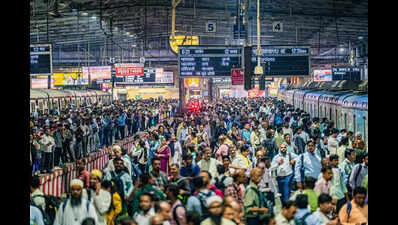
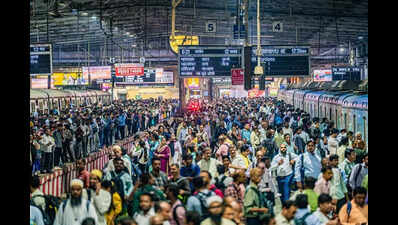
Mumbai: Central Railway has barred all future agitations at CSMT’s concourse area—a day after a flash protest on the terminus paralysed suburban services, left thousands stranded, and caused two passengers to die on the tracks. Yet, no FIR has been filed and blame continues to be deflected.The concourse at CSMT, located in front of the motormen’s lobby, is also a key passenger movement and holding zone. The blockade at this spot on Thursday evening prevented motormen and guards from taking charge of suburban trains between 5.50pm and 6.45pm, bringing peak-hour services to a standstill.A CR official said, “There is no official permission to block the concourse area. However, we have advised unions not to hold dharnas or agitations that obstruct the movement of train crew or passengers.”An assistant commissioner of police (ACP) from the Government Railway Police (GRP) has been assigned to probe the twin fatalities that occurred when passengers began walking on the tracks after suburban services were suspended for nearly an hour.Despite evidence that the agitation endangered lives, the GRP has adopted a wait-and-watch stance, saying it will seek legal opinion and review CCTV footage to explore whether charges can be pressed against those responsible for paralysing services.Thursday’s disruption was triggered by the GRP’s earlier decision to file an FIR against two Central Railway engineers in connection with the June 9 Mumbra mishap that claimed five lives.Two separate protests were held on Thursday — first, the National Railway Mazdoor Union (NRMU) staged a peaceful demonstration in the afternoon, but later, the Central Railway Mazdoor Sangh (CRMS) escalated matters by blocking access to the motormen and guards’ lobby at CSMT, preventing staff from operating trains.A senior GRP officer said the police would verify whether a cognizable offence is made out in connection with the agitations at CSMT and insisted that the “unions’ protests will not affect the probe into the Mumbra case”.The officer added the GRP had been given prior intimation about the unions’ agitation but it was “never anticipated that the protest would extend to blocking the motormen’s lobby and paralysing train services”.Meanwhile, Central Railway headquarters has sought a detailed explanation from its Mumbai suburban division on Thursday’s disruption.Pravin Bajpai, president of CRMS, said the demonstration was “spontaneous”. “We didn’t stop passengers or motormen from operating trains.” he said, adding, “It is unfortunate that lives were lost, but we are not responsible for the tragedy.”Bajpai also questioned the GRP’s reliance on a VJTI report to register the FIR in the Mumbra case, arguing that the institute lacked expertise in track geometry.Legal experts, though, said the “spontaneous” claim does not absolve responsibility. Senior advocate Satish Maneshinde said while invoking criminal prosecution for negligence may be difficult, the probe must scrutinize the entire chain of events to determine whether negligence can be ruled out. Advocate Atal Dubey added the unannounced stoppage of suburban train services violates the Industrial Disputes Act, 1947, which requires due notice before any strike in essential public services.“The sudden disruption of an essential service during peak hours directly endangered thousands of lives and infringed commuters’ right to life and liberty under Article 21 of the Constitution,” Dubey said. “This is not a mere labour dispute — it is a public-safety failure of the highest order.”But some senior advocates said criminal liability can be invoked on staff who allegedly deliberately blocked motormen from doing their job. Veteran crime counsel Nitin Pradhan said on Friday, “While I feel the death cannot be the motorman’s fault, it is a gross case of criminal negligence by union members who purportedly blocked the motorman’s cabins, preventing them from doing their job, thus causing chaos during peak hours and leading to an avoidable fatality. This may even attract a graver offence of culpable homicide not amounting to murder under Section 105 of the Bharatiya Nyaya Sanhita (BNS).” The offence, he added, involves having knowledge that such actions are likely to cause someone’s death — especially during peak hours when trains are stranded without announcements and hapless commuters are forced into dangerous situations.Two Thane passenger associations have urged chief minister Devendra Fadnavis and the Central Railway GM to act against those behind the CSMT protest.“When the GRP had already held an expert inquiry, why did CRMS hold passengers hostage?” asked Madhu Kotian of Mumbai Railway Pravasi Sangh.NCP (SP) Thane questioned conflicting GRP and CR findings in the Mumbra mishap, while the Suburban Railway Passengers Association’s Nandkumar Deshmukh sought a judicial probe, saying warnings about the curve were ignored.The FIR, registered on Nov 1 following a detailed probe led by ACP S Shirsat, alleged that Mumbra station officials had alerted the Thane engineering section about displaced ballast and a sinking stretch of the platform due to heavy rain, but no action was taken. Two CR engineers — a sectional engineer and an assistant engineer — have been booked under Sections 105 and 125 of the Bharatiya Nyaya Sanhita for alleged criminal negligence.The GRP’s case is primarily based on a report by Veermata Jijabai Technological Institute (VJTI), which concluded that poor maintenance and human error were behind the incident.(With inputs from Manoj Badgeri)