


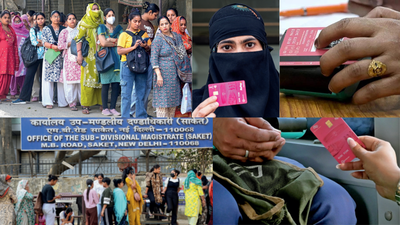
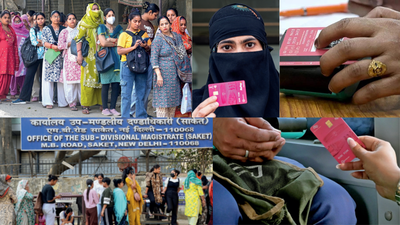
NEW DELHI: 219 — a hurried scrawl in blue ink across my wrist that had taken nearly four hours of waiting to earn. Around 3.30pm on Friday, a woman guard sitting behind a desk outside the sub-divisional magistrate’s office in Saket scribbled that number, marking my place in the queue for Delhi govt’s Saheli card — the pass that will soon replace the pink paper tickets women have been using to travel free on city buses. For the women in the line, these numbers felt less like a token and more like a small victory. The road to them had already been long.Catch-22 in system ?A potential catch-22 is emerging in Delhi’s transition from paper pink tickets to the new Saheli card. Under the system being rolled out, once the pink card is swiped on a bus, it cannot be used again for 60 minutes. For women who rely on two or more connecting buses to reach their destination, this could mean either waiting for the cooldown period or paying for the next ride.For now, the problem is partly masked because free paper tickets are still being issued alongside the cards. But once the card becomes the sole mode of free travel on public buses in the city, the rule could affect thousands of women commuters, especially domestic workers and daily wage earners who often change buses to reach their workplaces.To test how the system works, this TOI reporter queued for hours at a distribution centre to obtain a card and later boarded multiple buses across the city. The restriction turned out to be real.At several centres, another challenge was visible: server glitches stretching what should be a two-minute registration process into waiting lines lasting over five hours, inconveniencing many commuters, particularly working women and the elderly.Long queueOn reaching the SDM office around noon, I found a long line outside the gate, snaking across the compound. “Where are pink cards being made?” I asked someone standing nearby. A woman pointed to the line.At the front, two guards sat behind a desk with a notebook, writing down names. Each time a name was entered, the woman’s wrist was marked with a number. I joined the barely moving line.Most of the women appeared to be from lower-income households — domestic workers, daily wage earners, elderly women, students. Some had brought children along. A few husbands stood nearby, holding bags or watching over toddlers.Tired, some women had already sat on the ground, children playing around them. At one point, the woman behind me leaned forward and said, “Aapke aage jo hai yaad rakhna. Beech mein koi ghus na jaye. Main bhi yaad rakhungi ki mere aage aap ho (keep an eye on who is standing in front of you, someone else shouldn’t sneak in).” I nodded — an informal pact between strangers trying to protect their place in line.As the hours passed, the queue did not shrink. It grew.Stories from the lineThe women began talking. Many had arrived early in the morning. “Subah saat baje se khadi hoon, abhi tak number nahi aaya,” said Kiran, who works as a helper at a women’s PG in Saket and depends on buses for her daily commute.Another woman, Suman, a homemaker who often travels across the city to attend satsang gatherings, said this was her third day at the distribution centre. “Pichle do din bhi aayi thi, par number nahi aaya.” A domestic worker, Kavita Devi, said she had taken leave from the house where she worked as a cleaner. “Kothiwali madam se chhutti le ke aayi hoon… kal phir nahi milegi,” she said, glancing anxiously at the slowly moving line.Some women were calling their husbands to remind them to pick up their children from school. Others worried about reaching work late.As the wait dragged on, conversations drifted to other long queues people remembered — during the demonetisation, during the Covid lockdown. “Pehle toh theek tha… ticket le lo aur chalo,” one woman said, supporting the pink ticket system.System stallsAround us, the process slowed further. Inside the office, the server had gone down. Officials said OTPs were not arriving; some women had registered phone numbers that belonged to family members who were not present; others could not access the phones where the OTP was sent.Two separate lines had formed — one for writing names in the register and marking numbers on wrists, and another for those waiting to complete the formalities. The first line itself had stopped moving. After repeated requests, a guard finally resumed writing down names, warning the crowd, “Baad mein card na mile toh ladna mat (don’t fight later if card is not issued).”Everyone agreed instantly. Anything to keep the line moving.Hours passIt was nearly 2pm. Older women asked others to wa-tch their spot while they sat down briefly to rest swol-len feet. Some women fasti-ng during Ramzan stood quietly in the heat. There was no drinking water nearby. The washroom, several women whispered, was unusable. At one point, desperate to use a cleaner washroom, some of us walked into the govt office building pretending to be staff. When we emerged, we laughed about the small shared secret.AnnouncementAfter hours of waiting, my number was finally written — 219. But relief was short-lived. Soon, a guard announced, “No more cards today. Come tomorrow or on Sunday.”The crowd erupted — “I have been standing since the morning”, “this is my third day”, “small children are there at home” — voices rose from every corner.Some women walked past us smiling, waving the small pink card triumphantly. Others stayed in line, hoping the decision might change.On the wall beside us, a large poster advertised the scheme: “Free travel, Samarth Delhi, Safe travel.” The official timings printed below read 9am to 5pm. But by 3.30pm, the process had effectively stopped.“Server down,” an offic-ial said. “If you want to waste your time, stand. Otherw-ise go home.”At 5pm, I, too, gave up and left. Even those whose names had been written down were told they would have to repeat the entire process the next day.Day 2 The next morning, I returned before the gates opened. At 8.30am, nearly a hundred women were already waiting outside. When the office opened at 9am, the same routine began. More waiting. More conversations.This time, after about an hour, I received my Saheli card. The process took just two minutes for OTP confirmation.Testing cardSaheli in hand, I set out with a photographer to test the system. At 9.36am, we boarded a bus from Saket towards Mehrauli.When I handed the card to the conductor, he smiled. “Abhi banwaya hai?” he asked. “Ji,” I replied.He swiped it and handed me a ticket. Then he asked casually, “Will you take another bus?” When I said yes, the warning came — “Catch it only after an hour, otherwise the card will not work.”For now, conductors are still issuing paper tickets alongside the new card.Odd rule After reaching Mehrauli and walking past another long queue and hearing similar concerns at the local SDM office — where a guard said 200-300 cards are being issued daily and flagged lack of water and toilet facilities — I boarded another bus at 10am towards central Delhi.When the conductor tried swiping my card, the machine refused to read it. He looked puzzled. “Seems the machine is hanging,” he said. For nearly eight minutes, he kept trying, while other women waited. Eventually he handed me an old pink ticket instead.By the time I board-ed my third bus at 10.57am, the one-hour gap had passed. This time the card worked fine. When I asked the conductor about the rule, he shrugged. “Madam, we don’t know yet. Old tickets are still working.”Looming dilemmaOnce pink paper tickets stop completely, the 60-minute gap between swipes could create a dilemma for women who rely on two or even three buses to reach their destination. They may have to wait 30-40 minutes between rides. Or pay.One woman in the queue had put it simply the day before. “I have to take two buses to go to GK from Bhati Mines. For one ticket, I have to pay up to Rs 25. How will I manage if free tickets stop,” she worried. On returning to the newsroom later that morning, I realised that I could easily have taken a cab or an auto if I had been late. But that’s not an option for many of the women I had stood with.What govt saysAccording to data obtained from govt, over 90,000 pink cards have been issued in a week since March 2 when the registration began. The highest number of cards — 10,289 — were distributed on Saturday.On the time limit, a govt official said, “The 60-minute moratorium is proposed for the same bus, not on other connecting buses.” Govt may decrease the gap based on feedback and operational efficiency following a review in May-end, he added.The managing director of Delhi Transport Corporation, Jitender Yadav, said, “We have already tested through a video two-three days ago. This is to avoid multiple taps on the same bus and wastage of govt revenue.” However, this reporter couldn’t use her card on the second bus within the 60-minute lock.On the erratic server leading to long queues, the govt official said, “Delays occur due to mobile OTP and authentication through UIDAI. These are external dependencies. We are taking it up with our concessionaires.”Ruling out online registration to ensure only genuine people get the card, he said a QR code sytem might be introduced for those without the card.