




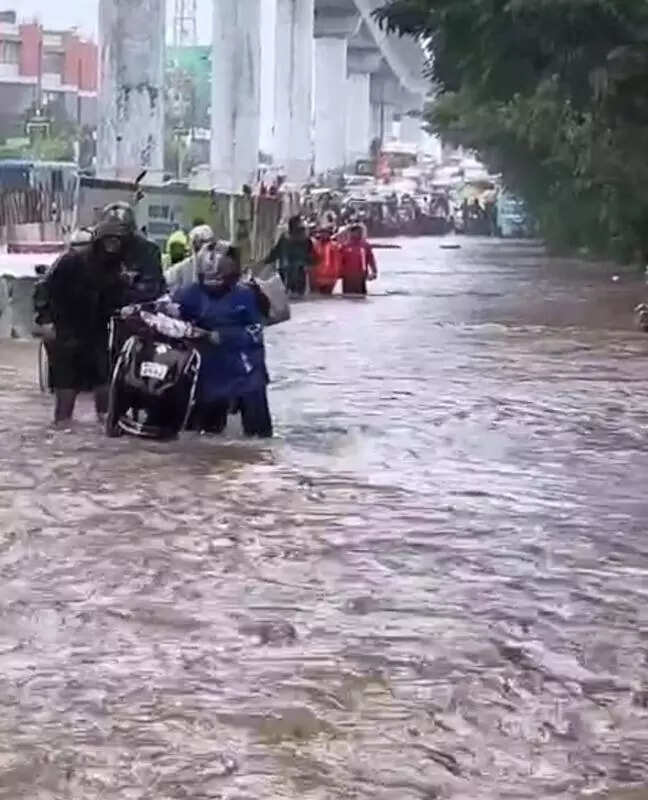
Pune: Perennial traffic snarls, waterlogged streets and crater-like potholes leading to a frustrating commute has become a daily reality for hundreds of IT professionals trying to get to and from their offices or homes in Hinjewadi — especially amid rainy conditions.Crowned as Maharashtra’s largest IT park, the Rajiv Gandhi Infotech Park in Hinjewadi has crumbled under the heavy downpour witnessed by the city late in May. Techies told TOI they have been taking two hours on average to finish a journey that usually requires 40 minutes. Many were even seen wading through water to get home after work. Unfortunately, such flash flooding is not new to this area.Stretches under water hide dangerous craters“The waterlogging situation during rain has been the same across Hinjewadi for at least four years now. In fact, this year, areas in Phase 3 that did not get waterlogged last year also saw flooding. Most internal roads are buried by water even after just 30 minutes of heavy rain,” Navanath Dharam, an IT professional working in Phase 3, said.“This is not only damaging our vehicle engines but makes potholes invisible. It is a big risk for two-wheelers. Traffic is a problem round-the-clock due to poor roads,” he added.For most having to travel to Hinjewadi daily, there are no alternative routes. As vehicles forge cautiously through waterlogged spots in fear of potholes, the traffic can pile up for as long as 2-3km.Unfinished & ongoing works a hindranceAccording to IT professional Ashutosh Pandey, not only does barricading for ongoing Metro work shrink the already narrow carriageway width of roads here, but it is also an accident waiting to happen. A native of Lucknow, Pandey left Pune recently for a break after getting frustrated by the commute he has to endure on a daily basis.“I will return only after a month. Every part of Hinjewadi is waterlogged. The other day, I had to wade through stomach-high water — a health hazard. In such conditions, using your own vehicle is a risky task, but travelling by buses means longer commute hours, irregular timings and fear of being stranded if the bus breaks down,” he said.“To add to this, Metro barricading is not always properly done, so there are spots where iron rods are sticking out dangerously. Several freshers who just joined our company might brave the dire conditions to get to work and ensure job security — but they are putting themselves at risk an accident daily because of poor infrastructural work. Things are well-managed in other IT areas. Why can’t local authorities in Hinjewadi learn from other neighbourhoods to manage water run-off?” asked Pandey. Absence of police staff compounds hasslesWhenever there is a heavy downpour, everything from Hinjewadi’s internal roads to service roads leading to the IT park are submerged under water. “Bhumkar Chowk en route is infamous for being flooded after just a few minutes of rain and so are some stretches in Hinjewadi itself. The fact that this is common knowledge should make it easy for police personnel to manage traffic. However, when rain spells are heavy, there is no one on the ground managing vehicles. During peak hours, roads could be widened by adding an extra lane from the side that is not crowded to clear traffic faster,” said IT professional P Kulkarni.“There’s always this uncertainty of when one will reach home, which is affecting a lot of people, especially those dependent on public transport,” Kulkarni added, and said, “Officials tried last year to fix some stretches, but these works don’t stand the test of time. Some craters are very deep — when puddles cover them, there is no way of knowing where they are and how risky they might be to navigate vehicles.”Multiple governing bodies, no improvementThe fact that there are so many local governing bodies running this zone is a big problem, said residents and commuters. They claimed there is no communication between various agencies, so commuters suffer the most in the absence of solutions.“Roads in Hinjewadi were dug up around five months ago and not fixed again. These spots are now waterlogged and difficult to drive through. There is a bus stop in Phase 3, next to which some digging took place a few months ago. This was also left as is — standing at the stop is near impossible. Wherever repairs are done, they turn out to be temporary and get washed off by a few showers,” IT professional Dhiraj Bahirwade told TOI.“Authorities need to actively start working on road repairs well in advance and complete them before mid-May to ensure that an early monsoon — like we are witnessing — doesn’t hamper their schedule. Sticking to timelines for repairing roads is crucial. There is no need for roads to stay dug up for months on end. It is a hassle for commuters and pedestrians alike,” he said.One of the major reasons waterlogging is a recurrent issue in Hinjewadi is because natural drains have been blocked by Metro work and other development works here, said former vice-president of Hinjewadi Industries Association (HIA), Yogesh Joshi.“Even hawkers that sought permission from PMRDA to set up shop have raised platforms, which is further blocking drains that are already choked with debris and other garbage. Wading through waterlogged streets is stressful and takes not just a physical but also a mental toll on IT employees. Through HIA, I had been communicating with PMRDA, MIDC and PCMC to get the issue resolved before monsoon, but each department just pushes the buck,” he added.———————PMRDA and MIDC collectively need to give more attention to Hinjewadi IT Park, which is witnessing flooding quite frequently in recent times. I am not against development — but I am certainly against unscientific development. At present, multipronged development is occurring in the IT Park, leading to various issues like flooding. Govt needs to give urgent attention to improve the infrastructure of the IT park, where over 6 lakh people are directly or indirectly employed— Supriya Sule | Baramati MP———————There is a chronic waterlogging spot in Hinjewadi Phase II for which MIDC has agreed to build a culvert. However, they are waiting for some approvals to get work started. Till then, some makeshift pipeline work has been done to prevent stagnation. As far as potholes and road conditions in the area are concerned, the public works department (PWD) was initially looking into it. They were to build a road with a bituminous layer, but after 150m, they ran out of funds. Thereafter, negotiations were ongoing between PMRDA and the private agency(Tata Group) to see who would do the work. It has been decided the latter will do it. Now, the rain has made it difficult to repair the road immediately. After it clears, work will begin— Rinaj Pathan | Chief engineer, PMRDA———————If state govt cannot provide proper infrastructure to its biggest IT park and chooses to remain a mute spectator in this situation, especially when the employees get stuck for two-three hours in traffic on a daily basis, then the authorities have to think of some other solutions. A policy must be created to offer employees the option to work from home (WFH) during heavy spells of rain— Pavanjeet Mane | Member, Forum for IT employees———————Pune: Perennial traffic snarls, waterlogged streets and crater-like potholes leading to a frustrating commute has become a daily reality for hundreds of IT professionals trying to get to and from their offices or homes in Hinjewadi — especially amid rainy conditions.Crowned as Maharashtra’s largest IT park, the Rajiv Gandhi Infotech Park in Hinjewadi has crumbled under the heavy downpour witnessed by the city late in May. Techies told TOI they have been taking two hours on average to finish a journey that usually requires 40 minutes. Many were even seen wading through water to get home after work. Unfortunately, such flash flooding is not new to this area.Stretches under water hide dangerous craters“The waterlogging situation during rain has been the same across Hinjewadi for at least four years now. In fact, this year, areas in Phase 3 that did not get waterlogged last year also saw flooding. Most internal roads are buried by water even after just 30 minutes of heavy rain,” Navanath Dharam, an IT professional working in Phase 3, said.“This is not only damaging our vehicle engines but makes potholes invisible. It is a big risk for two-wheelers. Traffic is a problem round-the-clock due to poor roads,” he added.For most having to travel to Hinjewadi daily, there are no alternative routes. As vehicles forge cautiously through waterlogged spots in fear of potholes, the traffic can pile up for as long as 2-3km.Unfinished & ongoing works a hindranceAccording to IT professional Ashutosh Pandey, not only does barricading for ongoing Metro work shrink the already narrow carriageway width of roads here, but it is also an accident waiting to happen. A native of Lucknow, Pandey left Pune recently for a break after getting frustrated by the commute he has to endure on a daily basis.“I will return only after a month. Every part of Hinjewadi is waterlogged. The other day, I had to wade through stomach-high water — a health hazard. In such conditions, using your own vehicle is a risky task, but travelling by buses means longer commute hours, irregular timings and fear of being stranded if the bus breaks down,” he said.“To add to this, Metro barricading is not always properly done, so there are spots where iron rods are sticking out dangerously. Several freshers who just joined our company might brave the dire conditions to get to work and ensure job security — but they are putting themselves at risk an accident daily because of poor infrastructural work. Things are well-managed in other IT areas. Why can’t local authorities in Hinjewadi learn from other neighbourhoods to manage water run-off?” asked Pandey. Absence of police staff compounds hasslesWhenever there is a heavy downpour, everything from Hinjewadi’s internal roads to service roads leading to the IT park are submerged under water. “Bhumkar Chowk en route is infamous for being flooded after just a few minutes of rain and so are some stretches in Hinjewadi itself. The fact that this is common knowledge should make it easy for police personnel to manage traffic. However, when rain spells are heavy, there is no one on the ground managing vehicles. During peak hours, roads could be widened by adding an extra lane from the side that is not crowded to clear traffic faster,” said IT professional P Kulkarni.“There’s always this uncertainty of when one will reach home, which is affecting a lot of people, especially those dependent on public transport,” Kulkarni added, and said, “Officials tried last year to fix some stretches, but these works don’t stand the test of time. Some craters are very deep — when puddles cover them, there is no way of knowing where they are and how risky they might be to navigate vehicles.”Multiple governing bodies, no improvementThe fact that there are so many local governing bodies running this zone is a big problem, said residents and commuters. They claimed there is no communication between various agencies, so commuters suffer the most in the absence of solutions.“Roads in Hinjewadi were dug up around five months ago and not fixed again. These spots are now waterlogged and difficult to drive through. There is a bus stop in Phase 3, next to which some digging took place a few months ago. This was also left as is — standing at the stop is near impossible. Wherever repairs are done, they turn out to be temporary and get washed off by a few showers,” IT professional Dhiraj Bahirwade told TOI.“Authorities need to actively start working on road repairs well in advance and complete them before mid-May to ensure that an early monsoon — like we are witnessing — doesn’t hamper their schedule. Sticking to timelines for repairing roads is crucial. There is no need for roads to stay dug up for months on end. It is a hassle for commuters and pedestrians alike,” he said.One of the major reasons waterlogging is a recurrent issue in Hinjewadi is because natural drains have been blocked by Metro work and other development works here, said former vice-president of Hinjewadi Industries Association (HIA), Yogesh Joshi.“Even hawkers that sought permission from PMRDA to set up shop have raised platforms, which is further blocking drains that are already choked with debris and other garbage. Wading through waterlogged streets is stressful and takes not just a physical but also a mental toll on IT employees. Through HIA, I had been communicating with PMRDA, MIDC and PCMC to get the issue resolved before monsoon, but each department just pushes the buck,” he added.———————PMRDA and MIDC collectively need to give more attention to Hinjewadi IT Park, which is witnessing flooding quite frequently in recent times. I am not against development — but I am certainly against unscientific development. At present, multipronged development is occurring in the IT Park, leading to various issues like flooding. Govt needs to give urgent attention to improve the infrastructure of the IT park, where over 6 lakh people are directly or indirectly employed— Supriya Sule | Baramati MP———————There is a chronic waterlogging spot in Hinjewadi Phase II for which MIDC has agreed to build a culvert. However, they are waiting for some approvals to get work started. Till then, some makeshift pipeline work has been done to prevent stagnation. As far as potholes and road conditions in the area are concerned, the public works department (PWD) was initially looking into it. They were to build a road with a bituminous layer, but after 150m, they ran out of funds. Thereafter, negotiations were ongoing between PMRDA and the private agency(Tata Group) to see who would do the work. It has been decided the latter will do it. Now, the rain has made it difficult to repair the road immediately. After it clears, work will begin— Rinaj Pathan | Chief engineer, PMRDA———————If state govt cannot provide proper infrastructure to its biggest IT park and chooses to remain a mute spectator in this situation, especially when the employees get stuck for two-three hours in traffic on a daily basis, then the authorities have to think of some other solutions. A policy must be created to offer employees the option to work from home (WFH) during heavy spells of rain— Pavanjeet Mane | Member, Forum for IT employees———————