




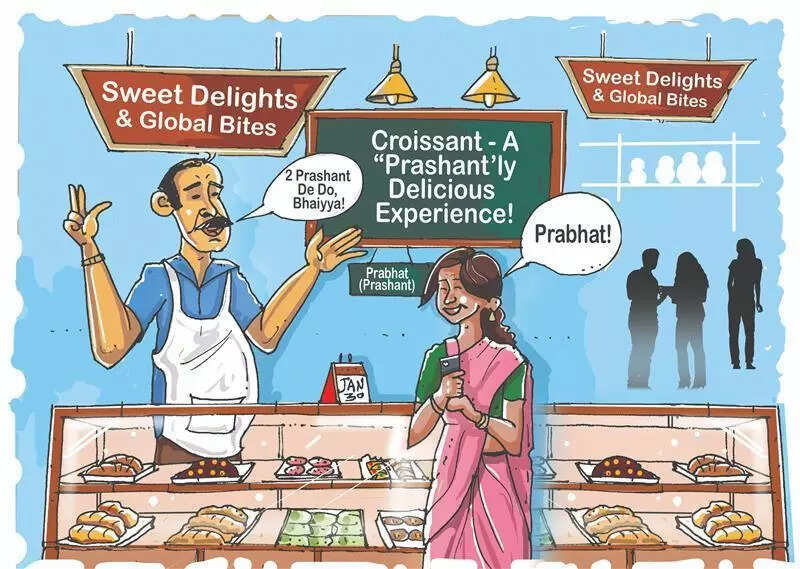
Pune: When a croissant became “prashant”, it wasn’t just a meme; it was a moment. The trending video of an Indian boy confidently misnaming the French pastry caught fire, and Britannia leaned in, renaming its own croissants “rashant”. Across India, mispronunciations of foreign foods are a norm and not an exception. “Crêpe” (krehp) often becomes “crape,” “crème brûlée” (krem broo-lay) morphs into “cream broo-lee,” and “schnitzel” (shnitsel) is “snitch-sale.” In this multilingual, masala-loving country, getting it “wrong” is often just our way of making it ours. Navdeep Tupe, an IT professional in the city, recalled how he was taught the correct pronunciation of Quesadilla by the owner of a Mexican restaurant with a linguistic jugaad. “I knew what it was as I saw it in TV shows and movies and wanted to try it. The owner at the counter saw me struggling to order it, saying ‘kwesadilla’. She told me to pronounce it as ‘kaise diya,’ like when you’re asking a vendor the price of something,” said Tupe.Tanmay Tagare, teaching German at the Goethe-Institut/Max Mueller Bhavan Pune, said pronunciation was half the battle, and often half the fun. “One of the quirks of teaching German in India is watching how confidently, and hilariously, students mispronounce foreign food names. Sachertorte (pronounced zakh-er-tor-teh) is a famous Viennese chocolate sponge cake, but students often link Sacher to sakhar (sugar in Marathi),” he said.“Muskatnuss (pronounced moos-kaat-nooss) means nutmeg, but Muskat sounds like muskatt, which means a slap! Wange (pronounced vahn-geh) means cheek, but students burst out laughing because it sounds like vaange, brinjal. Then there’s Dickmilch (pronounced dik-milkh), a type of sour milk, which gets some very awkward reactions when said in English,” Tagare added.Not just international cuisine, Indian regional dishes get mispronounced too. “Nenjelumbu rasam” turns into “ninja rasam,” and “Chemmeen Ularthiyadhu” is as good as anyone’s guess. Adeline Lannes, a French national pursuing an internship in Kolkata, said, “The whole ‘croissant-prashant’ fiasco was hilarious. My friends back in France were making reels, where they were going to cafes and asking for prashant, not croissant. But it shows the love and demand for croissants among Indians, in India and while travelling abroad. We too make mistakes when ordering Indian food. I remember how I kept calling a sandesh a ‘sandwich’ till one of my colleagues corrected me politely.“Preetam Shah, a hospitality executive from Surat, recalled how local dishes were often mispronounced not only by foreign nationals but also by non-Gujaratis. “When I was doing my hotel management in 2018, a foreign student kept referring to ‘kadhi’ as ‘curry’. I explained that while both were gravies, ‘kadhi’ had a unique preparation with yogurt and gram flour. I also noticed how many non-Gujarati speaking people referred to ‘Akha Adad’ as ‘Aka Dad’. It only shows how people are interested to try new things in food, even if they don’t know how to pronounce those accurately.”Shruti Mahajan, a home chef from Bengaluru, is fascinated by how regional pronunciations evolve and sometimes become points of friendly contention. “At a food festival I attended in the city a couple of years ago, there was a panel discussion on whether it’s ‘do-sa’ or ‘do-sha’. Being from Tamil Nadu, I chimed in, explaining that ‘dosai’ is the original term,” said Mahajan.