



NEW DELHI: Amicus Curiae Sanjay Upadhyay informed the National Green Tribunal that despite GRAP being operational across NCR, air quality consistently remained in the “very poor” category, and emergency measures like cloud seeding failed. Flagging AQI data gaps and sprinkling outside the monitoring stations, he noted that Delhi’s comprehensive action plan had not been revised since 2018, despite conducting a source-apportionment study in 2023. The NGT is hearing various cases, including a suomoto cognisance of a TO I report, merged into one case on deteriorating air quality in the country. The tribunal appointed Upadhyay as amicus in the matter in 2023. In a report dated Nov 6, which was uploaded on the NGT’s website on Tuesday, Upadhyay said, “Stage-1 GRAP was initiated on October 14 and stage-2 on October 19, 2025. Despite stage-2 GRAP orders, the AQI consistently remained in ‘poor’ to ‘very poor’ quality.” Highlighting tampering with AQI meters at Anand Vihar and RK Puram, the amicus said, “Multiple newspaper reports clarify that there has been tampering with AQI monitor readings by undertaking sprinkling close to AQI monitors, thus reducing the PM level reading by the monitors to mislead and misinform the severity of the air quality situation.”
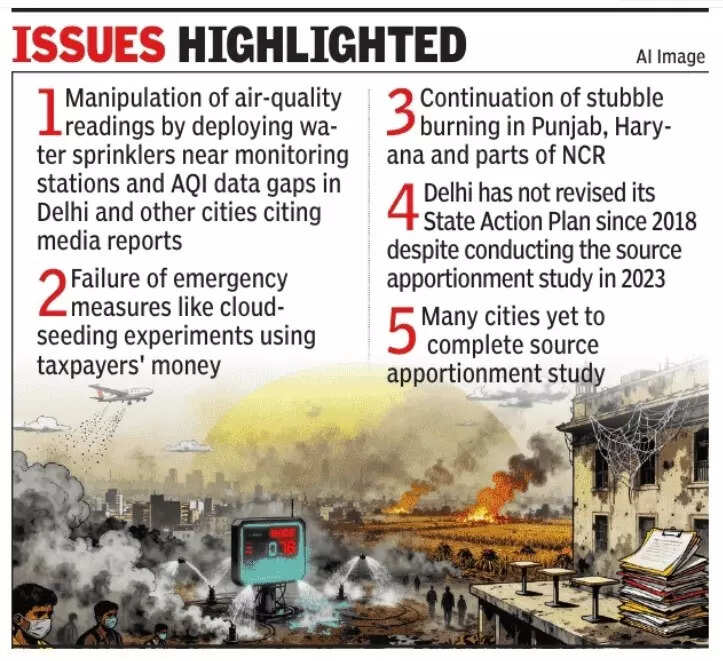
Delhi’s comprehensive action plan had not been revised since 2018
He also cited TOI reports on sprinkling close to stations in Agra and data gaps in Haryana. “State pollution control boards must explain to the tribunal the reasons for such anomalies and disruptions. This appears to be a very serious allegation where human health and the right to life itself are at stake. The CAQM also needs to explain the action taken in this regard,” said the amicus in his report. He suggested the tribunal may question the Delhi govt on cloud-seeding efforts, which used public funds but delivered no meaningful impact. “Govt of Delhi, along with IIT Kanpur, signed a 3.21 crore MOU for undertaking five trials of cloud seeding exercise. Two experiments were undertaken in Oct 2025; however, the experiment failed both times,” he said. He added that one of the main causes for the failure, as reported by both IIT Kanpur and IIT Delhi, is that winter months are climatologically unsuitable for consistent cloud seeding due to a lack of moisture and saturation and western disturbances. “The Delhi govt may be asked to explain the raison d’être of going for cloud seeding and paying taxpayers’ money. What were the other emergency measures taken for curbing air pollution other than cloud seeding measures, which has turned out to be a failure admittedly,” said the report. Commenting on farm fires, he recommended that the NGT may seek a clear status of such stubble burning incidents and the action taken by CAQM as well as the state pollution control boards. He further pointed out that several non-attainment cities have still not completed source-apportionment studies. The amicus said the NGT, in its order dated July 29, directed the CPCB to disclose the current status of source apportionment studies across 53 cities. However, source apportionment was completed in 12 cities and was underway in Noida, Khurja, Jhansi, Lucknow, Amritsar, Thane, and Faridabad. He added that although Delhi conducted source apportionment studies with the latest real-time source apportionment carried out in 2023, the amicus noted Delhi has also not revised its State Action Plan since 2018, despite conducting the study in 2023. Calling for an airshedbased strategy, Upadhyay recommended that the NGT consider setting up a technical committee to monitor airsheds across the country and examine the feasibility of city-specific GRAP. “GRAP can no longer be limited to the NCR region and areas adjoining it and should be extended to other states and regions,” he added.