




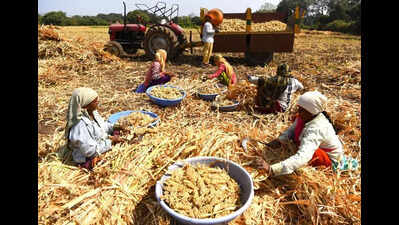
Pune:Hundreds of farmers in the district are staring at mounting losses after allegedly substandard jowar seeds distributed ahead of the rabi season failed to deliver expected yields, affecting nearly 240 acres in Bhor taluka alone.Growers from villages including Dhangavadi, Khandoba Mala, Kari, Sasewadi and Kunjirwadi have complained that seeds supplied through authorised channels under the supervision of the district agriculture department showed poor germination and uneven crop growth.
Around 24 quintals of certified jowar seeds were reportedly distributed in the tehsil before sowing. Farmers say the seeds, promoted as high-yielding and suitable for local soil and climatic conditions, initially showed normal growth.However, within weeks, plants began to appear stunted, with poorly developed ears and inconsistent height across fields.“Initially, the crop seemed normal, but after a few weeks we noticed uneven growth. The plants remained stunted and the ears did not develop properly,” said a farmer from Kari village. “We followed all recommended practices, including fertilisers, irrigation, and timely sowing. The problem is clearly with the seeds.”According to estimates shared by farmers’ representatives, each acre has suffered losses of up to Rs40,000 due to reduced output. With nearly 240 acres cultivated using the same batch of seeds in Bhor alone, the total financial impact could run into crores, they fear.The variety in question, ‘Parbhani Shakti’, has been widely distributed across Maharashtra.District agriculture officer Sanjay Kachole confirmed that an inquiry has been initiated following complaints.“This variety is recommended for the entire state. Farmers have reported stunted growth in certain fields in the district. After receiving complaints, we initiated a probe,” Kachole told TOI.”We cannot draw conclusions until scientific verification is completed. We will also examine the performance of the same variety in other parts of the state,”he added.In this season, the district has reported jowar sowing on 87,000 acres across 13 tehsils.Agriculture officials from Bhor taluka have visited affected villages and collected crop samples for testing.A senior officer said a preliminary inspection has been conducted to assess whether the issue stems from seed quality, soil conditions, nutrient deficiencies, pest infestation or other agronomic factors.“We have received complaints regarding poor growth in specific fields. A technical team is assessing the situation. If any lapses are found, action will be taken as per rules,” the officer said.However, farmers insist the damage pattern is consistent across multiple villages and largely confined to fields where this particular seed variety was used. They argue that neighbouring farms using different seed brands have reported comparatively better crop performance, strengthening suspicions of seed quality issues.Many cultivators had opted for jowar this rabi season hoping for stable returns amid fluctuating prices of other crops. Instead, they now face underdeveloped crops that are unsuitable even as quality fodder for cattle.“We invested in fertilisers and labour after taking loans. Now the crop has failed. Who will repay our debts?” asked another farmer from Sasewadi, adding, “The government must conduct a proper inquiry and compensate us.”Local farmers’ representatives and growers have demanded an immediate survey of the affected fields and compensation of at least Rs40,000 per acre. They have also sought strict action against the seed supplier if irregularities are established.Agricultural experts said that while erratic rainfall and nutrient imbalances can impact crop performance, uniform complaints from multiple villages warrant a thorough investigation into the seed batch.Most talukas have traditionally relied on jowar as a key crop for both grain and fodder. A setback of this scale could have cascading effects on farm incomes as well as livestock owners, who depend on jowar residue as feed.With the harvest period approaching, farmers say time is critical. “We cannot wait months for reports. Our losses are immediate,” said farmer leader Shantaram Sarvade. “The administration must act swiftly so that we can prepare for the next season.”