




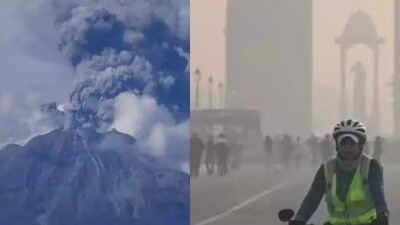

NEW DELHI: A volcanic ash cloud from Ethiopia’s Hayli Gubbi volcano is expected to enter parts of western India on Monday evening, moving across several northern states, meteorologists said. Early signs of the plume were spotted near Jamnagar in Gujarat around 5.30 pm. The authorities will monitor its progress towards Delhi and Jaipur.Will it impact Delhi AQI? The ash cloud is travelling at 100-120 km/h at altitudes of 15,000 to 45,000 feet and contains volcanic ash, sulphur dioxide, and tiny particles of glass and rock. While it may make the sky appear darker and hazier, experts said it is unlikely to significantly affect Delhi’s air quality.Sunil Dahiya, founder and lead analyst of think tank EnviroCatalysts, said, “The volcanic ash consists of dust, silica, rocky material, and other minerals and can be hazardous for health. Volcanic ash while passing over the air shed over Delhi may lead to a sudden spike in pollution levels, worsening the air quality further.”Anumita Roychowdhury, Executive Director, Research and Advocacy, Centre for Science and Environment, said, “The magnitude of this problem requires immediate assessment. Volcanic ash can travel long distances and affect faraway regions. “This plume is a toxic mix of fine particles and gases like sulphur dioxide, nitrogen dioxide, etc., that can worsen the smog in Delhi that already has a saturated airshed. This toxic haze can affect vulnerable groups and enhance the health risks.” A thick layer of haze already engulfed the national capital on Tuesday morning, with the Air Quality Index (AQI) remaining in the ‘very poor’ category across Delhi and the National Capital Region, according to the Central Pollution Control Board.Disruptions in Air Traffic IndiaMetSky warned that the plume could disrupt air traffic, causing delays and longer travel times. “The ash cloud is about to enter Gujarat and will move towards Rajasthan, north-west Maharashtra, Delhi, Haryana, and Punjab by 10 pm,” the agency said. The eruption of the nearly 10,000-year-dormant Hayli Gubbi volcano began at 8:30 am UTC on Sunday. While the explosive activity has now stopped, the plume continues eastwards. The Toulouse Volcanic Ash Advisory Centre (VAAC) said authorities and airlines are closely monitoring the cloud to ensure safe air travel. The sudden eruption also sent ash clouds sweeping across the Red Sea toward Oman and Yemen before shifting east, with volcanic activity reported across parts of the Arabian Peninsula. Airlines issued cautionary notices for Middle East flights, though no advisories have been issued for flights to India.(With inputs from agencies)