


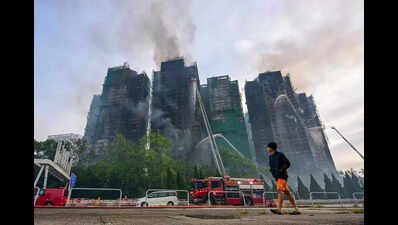
New Delhi: As the world watched on in horror the inferno ripping through seven high-rise towers in Hong Kong, fire department officers in Delhi said on Thursday that a critical loophole in maintenance is exposing residents of its high-rise buildings to similar catastrophic risks.They warn that internal firefighting system, which is essential for controlling blazes in tall structures, frequently fails to function in Delhi when needed, thereby hindering rescue efforts. A fire safety no-objection certificate (NOC) is a must for such structures, but the core challenge lies in compliance. “While all equipment is often installed to successfully obtain the initial NOC, their proper and sustained maintenance is often not done,” a senior officer said.While the city’s fire department is equipped with state-of-the-art tools — aerial platforms like Bronto skylift that can reach a height of 70 m, turntable ladders, hydraulic platforms and articulating water towers — the blame for failure of the internal firefighting system falls squarely on authorities managing such buildings and residents. The internal system includes smoke detectors, fire-alarm panels, automatic sprinklers, fire hydrants and extinguishers. While the department receives 30,000 to 35,000 calls every year, blazes in high-rise buildings account for less than 1% to 2%, A K Malik, Delhi’s deputy chief fire officer, said. Such structures dot areas like Rohini, Dwarka, Motibagh, Moti Nagar, Chatarpur, Nehru Place, Bhikaiji Cama Place, Netaji Subhash Place, and Lutyen’s Delhi. The internal firefighting system, the officers said, is crucial because it often takes long for rescue teams to reach trapped occupants. “Blazes in tall buildings quickly spread upwards, ripping through staircases and trapping residents on the upper floors. If the internal system functions properly, controlling and dousing a fire becomes significantly easier,” one of the officers said. He added that the risks are compounded by a combination of poor structural design and negligence on the part of residents. For instance, staircases, which serve as primary evacuation routes, are occupied by cabinets, flowerpots and other items, blocking the lifeline for both the residents and firefighters.“Furthermore, a lack of design foresight regarding fire safety during construction results in poor ventilation that often traps smoke inside tall buildings,” the officer said. The widespread use of flammable materials to decorate homes and unauthorised additional wiring increases the intensity and speed with which blazes spread. Fire safety regulations are often disregarded during high-rise construction, further compounding the danger. A tall building’s design plays an important role in ensuring safety, the officers say. It should include multiple escape routes and avoid the use of glass facades. Also, electric meters should never be installed near the main entrance of a tower. When constructing such buildings, realtors should consult fire personnel in addition to architects to ensure compliance with safety norms.It is a must for residential buildings taller than 15 metres or those with ground plus four or more storeys, including mezzanine floors, to obtain NOCs in Delhi. From Jan to May this year, 26 certificates were issued. However, inspections frequently identify shortcomings: 51 defects were found even after NOCs were granted in 2023 and 2024. The Delhi fire service checks 20 crucial aspects during an inspection, including access to the building for emergency services and the number, width, type, and arrangement of fire exits. Protection of these exits through fire-rated doors or pressurisation systems is also evaluated. For residents to be truly safe, mandatory fire safety checks must extend beyond initial certification and include rigorous and recurring audits of essential life-saving equipment. A fire official said regular mock drills should be conducted, wiring in buildings should be inspected periodically and external firefighting equipment should always be ready for use.