



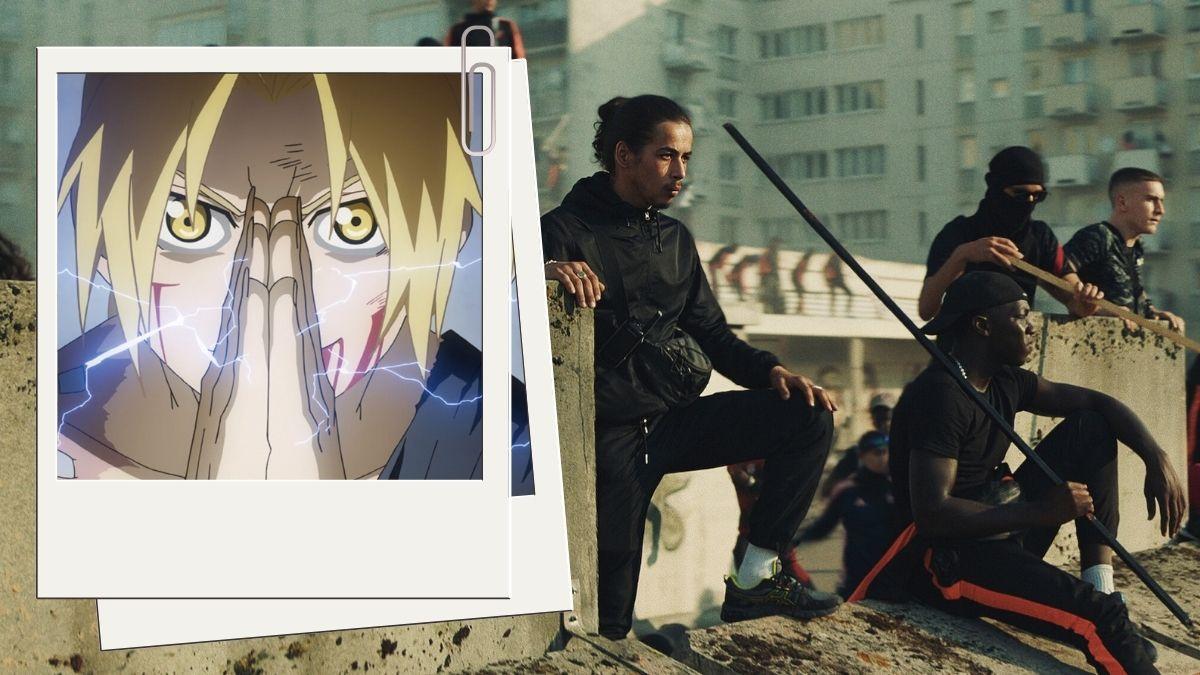
Stills from ‘Fullmetal Alchemist: Brotherhood’ and ‘Athena’
| Photo Credit: Crunchyroll, Netflix
This week’s picks are siege stories at heart that examine empire from two ends of time and form.
Fullmetal Alchemist: Brotherhood (available of Crunchyroll) is an expansive, procedural anime, unfolding across decades of history and carefully engineered cause and effect. Meanwhile, Athena (streaming on Netflix) is compressed and breathless, trapping us inside a single incendiary night. Together, they offer a grimly lucid study of how legitimacy is manufactured, sacrifice is distributed, and how rebellion emerges when systems designed to absorb harm can no longer contain it.

From the drawing board
Fullmetal Alchemist: Brotherhood remains one of the most widely revered works in anime for reasons that go well beyond nostalgia. Produced by Bones and directed by Yasuhiro Irie, the MyAnimeList veteran was conceived as a full, faithful adaptation of Hiromu Arakawa’s manga after the earlier 2003 version outpaced its source.

The story follows brothers Edward and Alphonse Elric, prodigies of alchemy raised in a rural backwater of the militarised nation of Amestris. Their forbidden attempt to resurrect their dead mother leaves Ed without an arm and a leg, and Al without a body, his soul bound to an empty suit of armour. To reclaim what was taken, they enter the state apparatus, with Ed becoming the youngest state alchemist in history.
Often celebrated within the otaku community for its meticulous world-building, internally consistent power system, and disciplined character arcs, FMAB also stands as one of the most sustained and incisive critiques of imperial and fascist authority produced in popular serialised fiction. Framed within the accessible trappings of a shounen quest, the narrative steadily widens into a systemic examination of how states manufacture legitimacy through violence.

A still from ‘Fullmetal Alchemist: Brotherhood’
| Photo Credit:
Crunchyroll
The story stages a state-sponsored genocide as a war sparked by a deliberately engineered incident and later absorbed into national myth, while revealing that the destruction of a racialised population ultimately served to convert expendable lives into energy reserves of immeasurable value.
If you’re drawn to politically minded pieces that interrogate empire like the colonial counterinsurgency of The Battle of Algiers, the procedural extermination of dissent in Jin-Roh: The Wolf Brigade, or the administrative cruelty of Andor; FMAB’s anatomy of empire forms their closest companion
Foreign affairs
Athena is structured as a modern epic compressed into one continuous night, directed by Romain Gavras with an emphasis on spatial continuity and escalating consequence. The French political-thriller begins at a press conference outside a police station and follows an insurrectionist group of youths as they storm the building, seize weapons, and retreat back to their Parisian banlieue. The technical choice of framing the film collapses the distance between provocation and escalation, and embeds us directly in the momentum.

The inciting incident involves a 13-year-old boy who is lynched to death by men wearing police uniforms, and footage of the assault circulates online before any official investigation takes shape. His brothers respond along divergent lines that structure the film’s conflict. Brotherhood here is enacted through coordination and proximity under threat and these positions are practical strategies that collide once the estate is sealed off.
As the siege develops, Romain anchors the spectacle in logistics. Fireworks are repurposed as improvised projectiles to disorient riot police. Motorbikes are used to move weapons and people quickly through narrow access points. The housing complex becomes a closed system governed by chokepoints, stairwells, rooftops, and courtyards, and the camera tracks how bodies navigate these spaces under pressure.

A still from ‘Athena’
| Photo Credit:
Netflix
Gavras’ film earns its force by showing how quickly legitimacy collapses when confronted with armed resistance. Amid sustained global unrest against oppressive regimes and police brutality, Athena operates in the immediate present tense. Its lineage includes the police siege paranoia of co-writer Ladj Ly’s own Les Misérables, the banlieue powder keg of La Haine and even and the urban militarisation of The Wire.
Ctrl+Alt+Cinema is a fortnightly column that brings you handpicked gems from the boundless offerings of world cinema and anime.
Published – January 09, 2026 04:40 pm IST

