




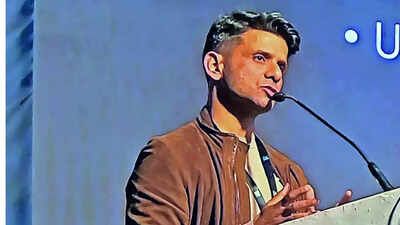
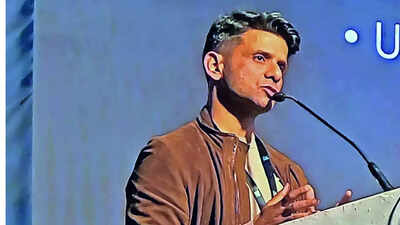
PUNE: On his first evening back on Earth after returning from the International Space Station (ISS), Group Captain Shubhanshu Shukla sat down to an entirely ordinary task – answering emails. After responding to a torrent of messages, he pushed his laptop aside, causing it to drop, instantly remembering of gravity.“That’s when I realised how powerful the human mind is. It adapts to its surroundings. Space doesn’t just transform the body. It rewires perception,” he said, while sharing his journey to the ISS and back with a spellbound audience of children, teenagers and adults at the India Science Festival at IISER Pune on Saturday.Coming from a modest background, Shukla was commissioned into the IAF in 2006. His space mission marked India’s return to human spaceflight 41 years after Rakesh Sharma’s historic voyage in 1984. “The next time won’t take as long. We will launch from India, on an Indian rocket, in an Indian capsule and bring our astronaut back safely,” he said.The audience watched in awe as Shukla showed visuals from space – the Earth’s curved horizon glowing green due to oxygen atoms in the upper atmosphere, a brilliantly illuminated India coming into view, the sweep of the Himalayan range, flashes of purple lightning storms, a star-filled sky and finally, a radiant blue sunrise. “Beautiful, isn’t it?” he asked. “Now imagine seeing this view 16 times every day. It changes how you look at everything,” he said.Recounting the launch, Shukla said the experience shattered all preconceived notions. “The moment the engines ignited, everything I thought I knew disappeared. The vibration was so intense that every bone in the body shook. In just eight-and-a-half minutes, we went from zero to 28,500km per hour,” he said.On the affects of the extreme G-forces, he said: “You can’t inhale, only exhale. You breathe using your stomach. That’s why years of training are essential before spaceflight.”Then, suddenly, the engines cut off and silence filled the cabin. The crew had entered microgravity. “Your body lifts off the seat. Hands and legs float. We release a small toy to confirm weightlessness. That moment tells you. You’re in space,” he said.On his first day, Shukla found himself unable to cross a module because another astronaut was conducting an experiment in the centre. “I didn’t realise I could simply walk on the ceiling. That was the moment my mind truly understood space,” he said.His body underwent dramatic changes too. Fluids shifted towards the head, his face became swollen, his movements slowed initially, muscles weakened, appetite diminished and his spine elongated – making him 6cm taller temporarily. “Space presents us with problems humanity has never faced before. And learning to solve them helps us improve life on Earth,” he said.Shukla admitted that life in space brought an unexpected sense of calm, and for a moment, he even wished he wouldn’t have to return. The journey back, however, proved just as demanding as the launch. After days in microgravity, his body had forgotten how much effort it took simply to stand upright. Walking became difficult and it took days of rehabilitation before he could resume normal activities.He described the mission as only the beginning of India’s human spaceflight ambitions. “We have the Gaganyaan missions, plans for a space station and a targeted human landing on the Moon by 2040,” he said. “Who knows, one of you sitting here today could be the first Indian to walk on the Moon. So dream big. Dream audaciously. Because the sky was never the limit, not for me, not for you and not for India,” he added as the hall erupted in thunderous applause.